
Reviewed · GOTHIC QUARTER TOURS
Barcelona Old Town & Gothic Quarter Small Group Tour
Barcelona’s oldest streets are easy to wander into and surprisingly easy to misunderstand. This walking tour links the Roman foundations, Gothic lanes, La Rambla, Boqueria Market, El Born, and Catalan modernist landmarks in one sensible route. I like the small-group format and the way a guide such as Alba, Joris, Miguel, or Isabel can explain the city while you walk.
I also like the morning and afternoon choices, which help you fit the tour around museum visits or a late arrival. At $22.15, the price is fair for 2.5 hours with a local guide, though food, drinks, and interior admission at the Cathedral or Santa Maria del Mar are not included. The main drawback is that the route covers a lot of ground, so some stops are brief.
Key points at a glance
- Roman Barcelona beneath the Gothic Quarter: See traces of the city’s earliest foundations among later medieval buildings.
- A smart first-day orientation: The route connects several central districts, helping you understand how Old Barcelona fits together.
- Boqueria Market with time to browse: You can look at fruit, cured ham, and other foods, or buy a juice or snack at your own cost.
- Small groups with room for questions: The tour is designed for a more personal pace than a large city walk.
- A finish near Palau de la Música: End close to one of Barcelona’s finest modernist buildings and the Born district.
- Good family flexibility: Children under two join free, and children aged three to eight receive 30 percent off.
Why this route works as a Barcelona introduction
I like this tour because it gives you a useful mental map before you tackle Barcelona on your own. In a short walk, you move from the old Roman settlement through medieval streets, public squares, market life, churches, and Catalan modernism.
The route is not built around one grand entrance or a long museum visit. Instead, it helps you read the city outdoors. You’ll see how narrow lanes open into squares, how the old defensive edge became La Rambla, and how El Born blends historic buildings with a younger social scene.
That approach suits you if you are visiting Barcelona for the first time, have only a few days, or want a local explanation before exploring independently. Guides have been praised for making the past understandable, adding local customs and political context, and answering questions rather than simply reciting dates.
The advertised small group is capped at 12 people for a personal feel, while the booking information gives a maximum of 15 participants. Either way, this is far more manageable than a large coach-based city tour. You should be able to hear the guide more easily and ask about the things that catch your eye.
More Gothic Quarter walks:
- Barcelona Gothic Quarter Tapas & Taverns Food & Wine Tour
★ 5.0 · 1,470 reviews - Barcelona: Gothic Quarter Ghosts and Legends Walking Tour
★ 4.7 · 1,443 reviews - Barcelona: Old Town and Gothic Quarter Walking Tour
★ 4.8 · 1,393 reviews
Starting among Roman remains in the Gothic Quarter
The walk begins on Carrer de Fontanella, 2, in Ciutat Vella. Check the exact meeting point carefully, since one guest reported that the marked location and the actual meeting spot were more than 100 meters apart. The address is central and near public transportation, but give yourself a little extra time to find the group.
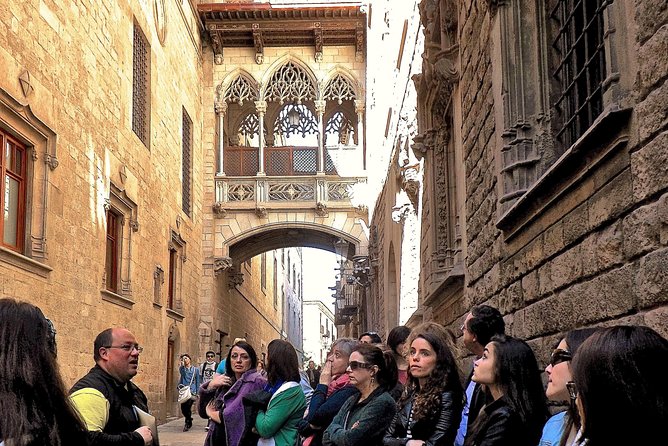
The first main section takes you into the Gothic Quarter, a maze of narrow streets and small squares. This is the part of Barcelona where a guide earns the fee quickly. On your own, you can admire the stonework, but it is harder to connect Roman remains, medieval growth, Gothic architecture, and the legends attached to particular corners.
Your guide may point out pieces of the Roman village still visible around the district. The value here is not just identifying old stones. You begin to see that the Gothic Quarter is built in layers, with the modern city running through a much older street plan.
The lanes can be crowded, and the uneven route requires attention. Keep your group in sight when the streets tighten. One guide, Miguel, was specifically praised for gathering people back together and helping separated members rejoin the walk, a useful skill in this part of town.
Ciutat Vella and the story of Old Barcelona
Ciutat Vella means Old City in Catalan, and the tour uses this district to broaden the story beyond the Gothic Quarter. You’ll hear how Barcelona developed as a city and how its culture took shape over time.
This section lasts about 15 minutes, so expect an overview rather than a full history lecture. That is appropriate for a walking tour. I prefer a clear explanation of how the neighborhoods connect, followed by time to explore individual sites later, rather than a long speech that leaves no room for questions.
Several guides have been praised for making this history lively. Alba, in particular, is repeatedly described as energetic and clear, while Isabel has been praised for connecting the Roman period, the Visigoths, the Moors, and later Spanish history. The individual guide will shape the tone, but the format leaves room for questions along the way.
La Rambla, where an old boundary became a city stage
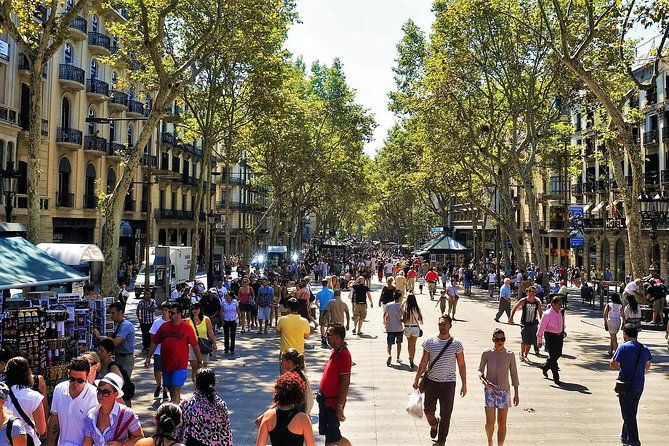
From the old lanes, the route reaches La Rambla, Barcelona’s famous central avenue. Today it is lined with restaurants, bars, shops, and street performers. Its earlier role was much less glamorous: a sandy stream that helped defend the edge of the old city walls.
That change tells you something useful about Barcelona. The city’s most famous public spaces often began with practical purposes and later became places for meeting, eating, watching, and being seen.
The La Rambla stop is about 15 minutes, so you will not get a detailed survey of every building. Instead, you’ll get your bearings and learn how this broad avenue relates to the tighter streets behind it.
Use normal city awareness here. The tour information does not promise a formal safety briefing, but a guide can help you move through the crowded central area without losing the route. This is one of the places where staying with a small group is handy.
A few more Barcelona half-days worth comparing
- Barcelona: Sagrada Familia Entry Ticket with Audio Guide
★ 4.6 · 105,312 reviews - Barcelona: Park Güell Admission Ticket
★ 4.4 · 76,534 reviews - Barcelona: Casa Batlló Entry with Self-Audioguide Tour
★ 4.7 · 25,359 reviews - Barcelona: 24 or 48-Hour Hop-On Hop-Off Bus Tour
★ 4.4 · 20,872 reviews
Boqueria Market: the most sensory stop
The walk continues into Mercat de la Boqueria, one of the best places on this route for a quick taste of daily Barcelona. The market brings together bright produce, cured meats, prepared foods, and colorful stalls beneath an elegant structure.
You have about 15 minutes here. That is enough to look around and buy a fresh fruit juice or a bite, but not enough for a leisurely food crawl. Food and drinks are not included, so bring a little spending money if you want to sample something.
I would treat this as an introduction, not a full market visit. Take note of anything that interests you, then return later if your schedule allows. One visitor specifically found it useful to come back after the tour, which is sensible if you want time to browse without keeping the group waiting.
The market also gives the guide a chance to explain Catalan food traditions, including the source and preparation of Iberian cured ham. You get more from the stop if you ask questions about what you are seeing instead of rushing through for a photograph.
Plaça Reial and the young Gaudí connection
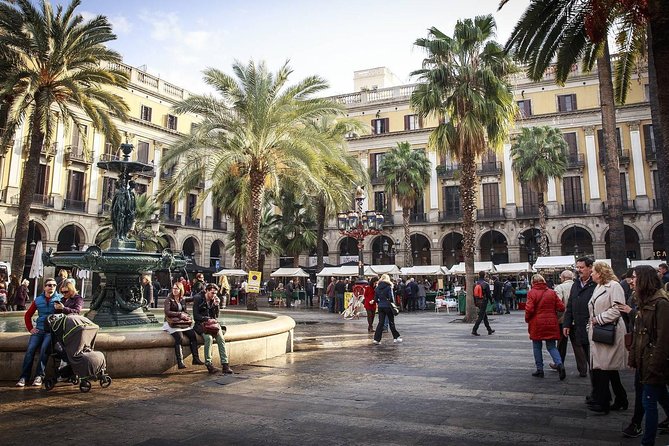
Plaça Reial offers a welcome change of scale. After the narrow lanes, you enter a large square with terraces, palm trees, a fountain called the Tres Gracias, and distinctive street lamps linked to a young Antoni Gaudí’s first public commission.
The square is associated with artists, bohemians, and people taking a break from the city’s busy streets. Its Napoleonic-era design gives the space a more formal feel than the surrounding medieval lanes.
This is another short stop, about 15 minutes. You will have time to take in the layout and hear the story behind the lamps, but you should not expect a long architectural study. The square is also a practical place to note for a later drink or meal, though the tour price does not cover purchases.
Barcelona Cathedral and two different Gothic traditions
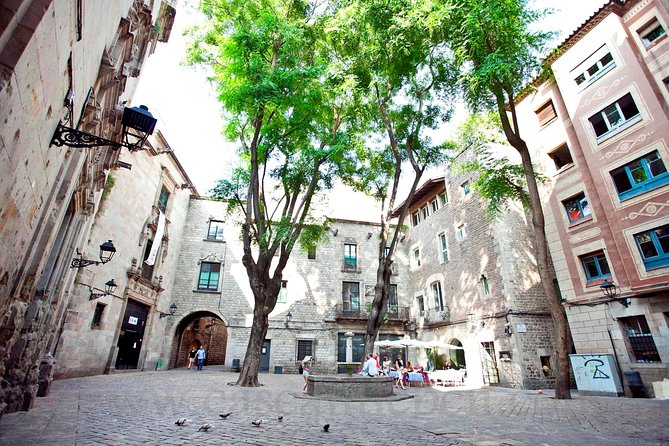
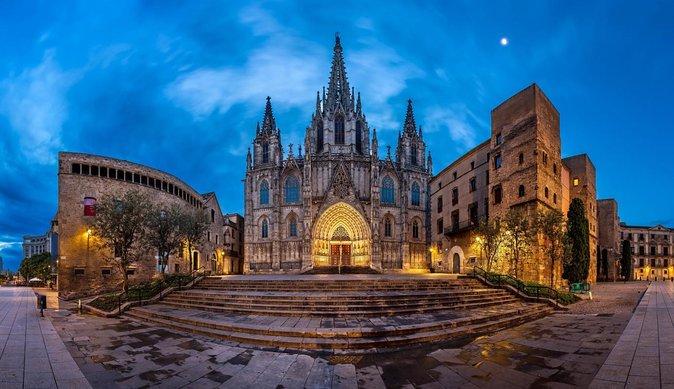
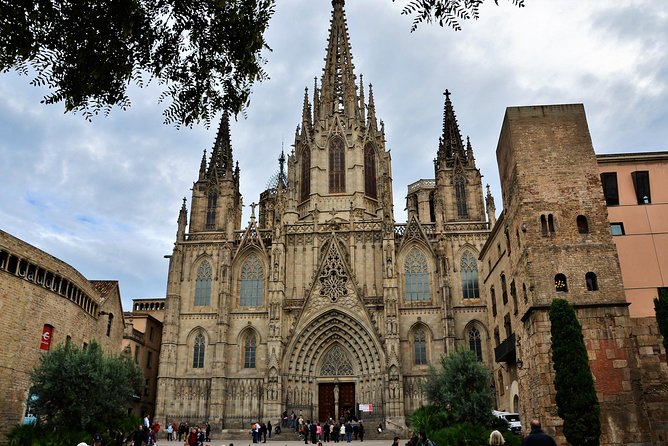
The route passes Barcelona Cathedral, a major Gothic landmark dedicated to Saint Eulalia. Its exterior is known for gargoyles and tall towers, while the interior includes a bright patio and soaring columns.
Admission is not included, so the scheduled stop is best understood as an exterior visit unless you choose to enter separately. That distinction matters. If you want a full look inside, you will need to plan another visit and pay any required admission yourself.
Later, the tour reaches the Basilica of Santa Maria del Mar in El Born. This church is often called the real cathedral of the Old Town because local residents helped build it during the medieval period. It is a major example of Catalan Gothic design.
The two churches make a useful comparison. The Cathedral presents one side of Barcelona’s religious and civic power, while Santa Maria del Mar is tied more closely to the people of its neighborhood. The tour allows about 15 minutes at each scheduled stop, so you’ll receive context and an exterior look rather than a slow architectural inspection.
El Born and the finish near Palau de la Música
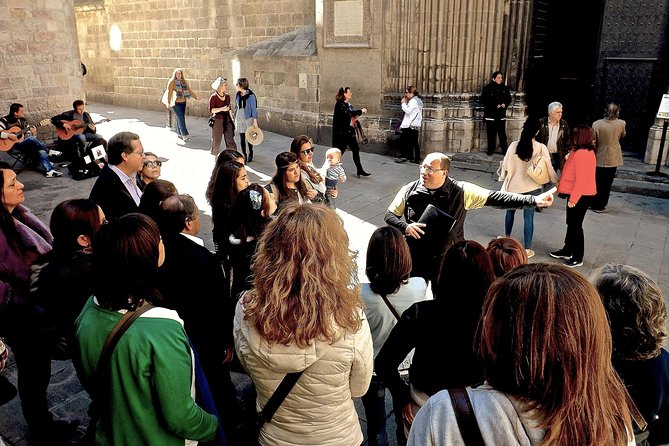
El Born brings a different mood. Its streets combine old buildings with newer shops, restaurants, and gathering places. The route gives you a taste of the district and points toward sites such as Santa Maria del Mar and Palau de la Música Catalana.
The final point is near Palau de la Música, a modernist concert hall designed by Lluís Domènech i Montaner, who taught Gaudí. Its decoration combines sculpture, mosaic, stained glass, and wrought iron, and the building is recognized as a UNESCO World Heritage Site.
You may not have time for an interior visit during the walking tour, but finishing nearby is useful. You are left in the city center, close to the Born district, with plenty of options for continuing on foot. You can make the Palau a separate visit, explore more of El Born, or return to the Cathedral or Boqueria Market with a better sense of where you are.
What the guides add to the walk
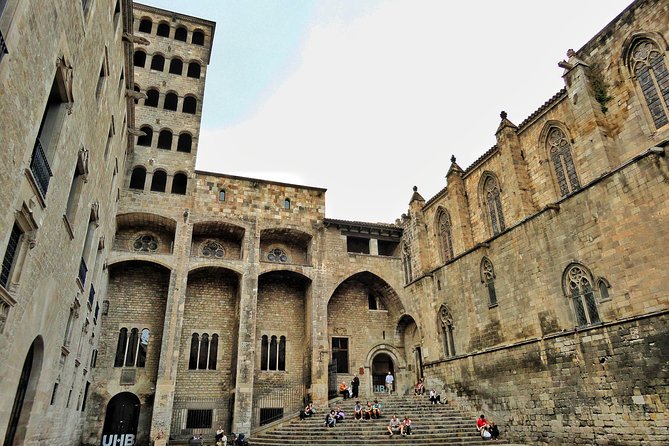
The guide is the biggest variable in any city walking tour, and the named guides associated with this experience have earned strong praise for different strengths. Alba is repeatedly described as warm, energetic, and good with children. Joris is noted for patience, humor, and clear answers. Miguel has been praised for organization and helpful local suggestions.
Isabel’s style appears especially suited to people who enjoy connecting major historical periods with present-day life. Other guides, including Steven, Anna, Tatiana, Adria, Laura, and Ane, have also been singled out for friendly storytelling, local detail, or a well-judged pace.
You cannot necessarily request a particular guide, so I would not book on the assumption that one named person will lead your departure. Still, the repeated praise points to a useful pattern: the tour depends on conversation, stories, and explanation rather than simply marching from one address to the next.
The small group helps here. You can ask about Catalan culture, local customs, politics, food, or nearby sights. Several guides have also offered practical suggestions for paella, gelato, and later visits, though those recommendations should be treated as helpful extras rather than a formal part of the tour.
Price, pace, and who gets the best value
At $22.15 per person, the tour offers good value if you want orientation and historical context. You are paying for roughly 2.5 hours with a local English-speaking guide and a route through several of Barcelona’s most central districts. You are not paying for meals, transport, hotel pickup, or admission to the Cathedral or Santa Maria del Mar.
The route moves at a steady walking pace, with most stops lasting 15 minutes and the first Gothic Quarter section lasting about 45 minutes. That makes it manageable for many people, but it is not a slow photography walk. Wear comfortable shoes and keep water with you, especially in warm weather.
Families can make good use of this tour. Children under two join free, and children aged three to eight receive a 30 percent discount. Children must be accompanied by an adult, and the experience is described as suitable for most participants. One family also found the route stroller-friendly, though the old lanes can still be tight and uneven.
You can choose a morning or afternoon departure. I would choose morning if you want to use the rest of the day for museums or the market. An afternoon start works well if you arrive late, prefer a slower morning, or want the walk to lead into an evening in El Born.
Free cancellation is available if you cancel at least 24 hours before the start time. Inside that window, the payment is not refunded, and late changes are not accepted.
Should you book this Barcelona walking tour?
I would book it if you want a well-priced introduction to Barcelona’s oldest districts, especially on your first day. The route gives you Roman traces, Gothic lanes, La Rambla, Boqueria Market, Plaça Reial, two major churches, El Born, and Palau de la Música in one walk.
I would skip it if your priority is entering every major monument or spending a long time at the market. The schedule is too short for that. In that case, use the walk as a starting point and return independently to the Cathedral, Santa Maria del Mar, Boqueria, or Palau de la Música.
For most first-time visitors, the balance is right. You get a human explanation of the city, a manageable route through the historic center, and enough free time afterward to follow your own interests.
FAQ
How long is the Barcelona Old Town and Gothic Quarter tour?
The walking tour lasts approximately 2 hours and 30 minutes.
What language is the tour offered in?
The tour is offered in English.
Where does the tour start?
The meeting point is Carrer de Fontanella, 2, Ciutat Vella, 08002 Barcelona, Spain.
Where does the tour finish?
The tour ends near Palau de la Música Catalana in the city center, close to the Born district.
What neighborhoods does the route visit?
The route includes the Gothic Quarter, Ciutat Vella, La Rambla, El Born, and nearby central areas of Barcelona’s Old Town.
Is food included in the price?
No. Food and drinks are not included, although you can buy a fresh fruit juice or something to eat at Boqueria Market.
Are admission tickets included for the Cathedral and Santa Maria del Mar?
No. Admission is not included for Barcelona Cathedral or the Basilica of Santa Maria del Mar.
How many people are in the group?
The tour is described as a small group of up to 12 people, while the additional booking information gives a maximum of 15 participants.
Can I cancel for a full refund?
Yes. You can receive a full refund if you cancel at least 24 hours before the experience begins. Cancellations or changes made within 24 hours are not refunded or accepted.
Recently added around Barcelona
- Park Guell Guided Tour with Skip the Line Tickets★ 4.0 · 739 reviews
- Entrance to the Mirador Torre Glories Barcelona★ 4.5 · 193 reviews
- Bohemian Barcelona Neighborhood Evening Tapas & Wine Tour★ 5.0 · 419 reviews
- Transfers From Cruise Port to Barcelona Airport★ 4.5 · 155 reviews
- Authentic Flamenco Show Barcelona : Intimate Casa Sors Experience★ 5.0 · 809 reviews
- Barcelona Expert Tour with Local Guide in Eco Tuk Tuk Private★ 5.0 · 216 reviews
- Barcelona Sunset Cruise with Light Snacks and Open Bar★ 5.0 · 476 reviews
- Barcelona: Sagrada Familia, Park Guell & Tapas Private Tour★ 5.0 · 903 reviews
Gothic Quarter Tours, compared.

Barcelona Gothic Quarter Tapas & Taverns Food & Wine Tour
Read our review →
Gothic Quarter Ghosts and Legends Walking Tour
Read our review →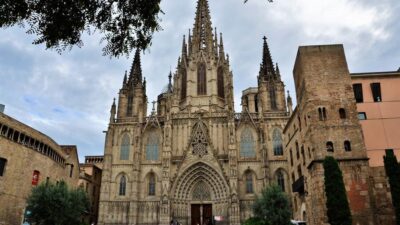
El Born and Gothic Quarter Wine & Tapas Bar Tour
Read our review →
Kids and Family Gothic Quarter Walking Tour in Barcelona
Read our review →
Barcelona Gothic Quarter VIP Tapas & Wine Tour
Read our review →Browse the lists this tour appears in