

Reviewed · ROYAL PALACE TOURS
Madrid: Guided Visit to the Royal Palace
Madrid’s Royal Palace is less about ticking off a royal residence and more about seeing how Spain’s monarchy displayed power: marble stairs, mahogany doors, ceiling frescoes, gilded reception rooms, and a throne room designed to impress at every turn. The 90-minute visit covers the grandest accessible rooms in one of Europe’s largest palaces.
I like the small-group feel reported on several departures, along with guides such as Pacho and Tamar, who brought clear explanations and a good sense of humor. I also like the separate entrance, which can save you from standing in the palace’s longer public queue. The main drawback is pace: 90 minutes can feel rushed, especially when the guide must explain everything in both English and Spanish.
Key points to know before you book
- Meet away from the palace entrance: Find the Isabel II statue in Plaza de Isabel II, 5, and look for the guide carrying a white umbrella.
- The tour covers the palace highlights: Expect the staircase, throne room, royal chapel, porcelain room, reception spaces, private royal rooms, and banqueting hall.
- The guide makes the difference: Pacho and Tamar have been singled out for clear, engaging explanations, while other guides have earned praise for patience and humor.
- Allow time for the approach: The group walks from the square to a side entrance, so do not go straight to the palace expecting to meet the guide there.
- Bring a one-euro coin for the locker: Large bags must be stored, and the coin is returned when you collect your belongings.
- Best for first-time palace visitors: You get useful Spanish royal context, but people who prefer a slow look at every room may find 90 minutes too short.
What the Madrid Royal Palace tour is really like
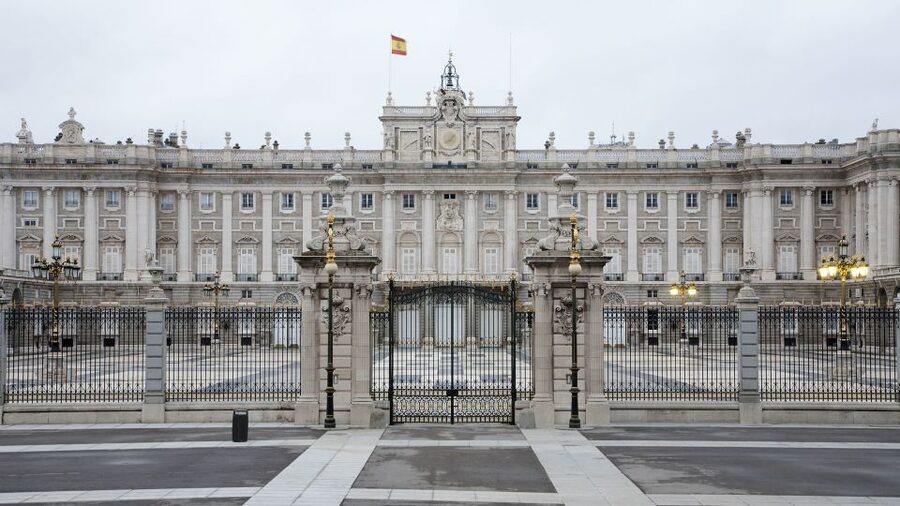
The Royal Palace of Madrid is an imposing place to visit, but it is not presented as one giant, fully open residence. The palace has more than 300 rooms, yet this guided route focuses on the most important ceremonial and royal spaces.
That is both its strength and its limitation. You see the rooms with the greatest visual impact and hear why they mattered, but you will not wander through every corridor or private corner. If you want a polished introduction to the palace, the format works well. If you want an unhurried architectural study, you may want more time after the guided portion.
The tour lasts 1.5 hours, and the price is $40 per person. That is reasonable if you value entry assistance and a live explanation of what you are seeing. The price is less attractive if you are happy to read labels at your own pace and wait in the regular line.
More Royal Palace tickets:
- Madrid: Royal Palace Fast-Access Admission Ticket
★ 4.6 · 13,856 reviews - Madrid: Royal Palace Expert Guided Tour with Skip-the-Line
★ 4.7 · 6,986 reviews - Madrid Essential: Historic Center, Plaza Mayor & Royal Palace
★ 5.0 · 6,416 reviews
Finding the guide at Isabel II Square
The meeting point is Plaza de Isabel II, near the statue of Isabel II, at number 5. This is not the same place as the main Royal Palace entrance, and that distinction matters.
Give yourself extra time to find the square. A few people have had trouble locating the meeting spot or reaching the tour company when they were already running late. The guide carries a white umbrella, which should help you identify the group, but do not rely on arriving at the last second.
The square is a practical place to arrive early. You can get your bearings, have a coffee, or pause for a drink before the tour. Once the group gathers, you walk together to a side entrance of the palace.
That short walk is easy enough, but it explains why going directly to the palace can leave you confused. If the entrance seems quiet or your reservation is not visible immediately, stay calm and confirm you are at the correct meeting point first. One departure involved a wait of about 40 minutes in the cold because of confusion at the entrance, so arriving early is a sensible precaution.
Entering through the separate palace entrance
The tour includes palace admission and entry through a separate entrance. This does not mean you skip every security step. You still pass through security, and food and drinks are not permitted inside.
Large bags and other sizable items must go into the locker room beside the Hall. A one-euro coin is useful for the locker, and the amount is returned when you take your things out. Travel light, especially if you are visiting with children or carrying shopping bags.
The separate entrance is one of the clearest practical reasons to book this experience. Waiting in line outside a major attraction can eat into a short Madrid visit. The guide also gathers the group and handles the transition into the palace, rather than leaving you to work out the entry system alone.
Keep your phone, wallet, and any small essentials with you. The tour does not allow food or drinks inside, so finish your coffee before joining the group.
The Sabatini staircase and the royal approach
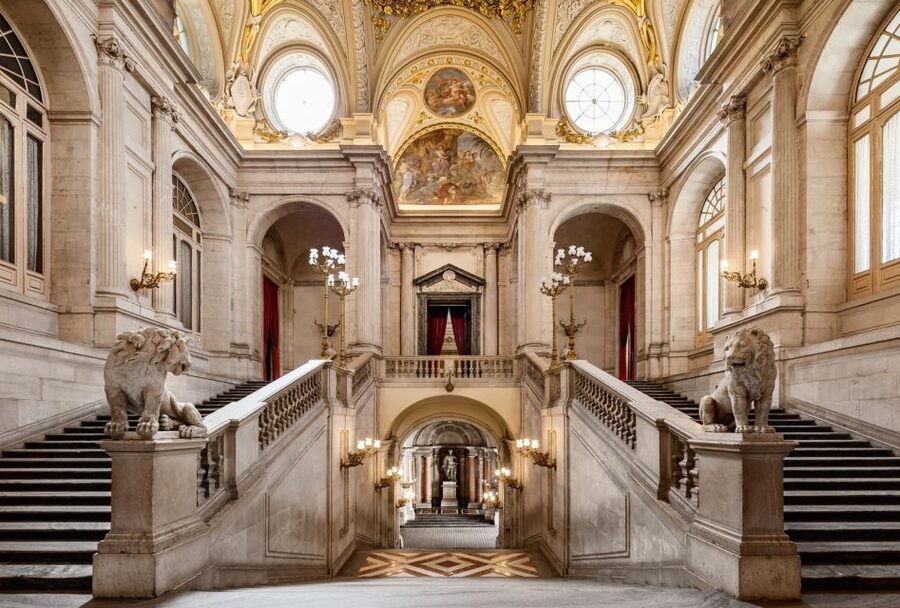
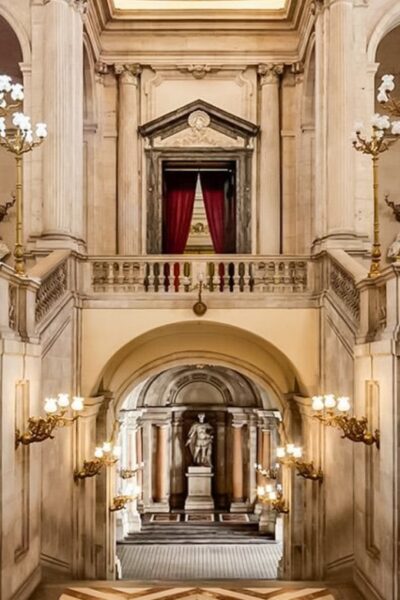
The first grand moment is the staircase designed by Francesco Sabatini. It gives you an immediate sense of the palace as a place built for ceremony, not merely comfort.
The staircase is a useful introduction to the monarchy’s public image. Every element is meant to signal order and rank, from the scale of the steps to the polished materials and formal arrangement. A guide can add the details that are easy to miss if you simply walk upward and take photographs.
This part also reveals one physical consideration. The palace involves stairs, and the route may be tiring for anyone moving slowly or managing a pram. The activity is listed as wheelchair accessible, but families with a stroller should be prepared for steps and ask the guide for help with the route if needed.
As you move onward, look for the contrast between the grand public approach and the more intimate royal rooms. The palace was designed to make official business feel majestic, while still providing spaces for the king and queen to live and receive people.
A few more Madrid half-days worth comparing
- Madrid: Tour Bernabéu Entry Ticket
★ 4.5 · 21,573 reviews - Madrid: Prado Museum Entry Ticket
★ 4.6 · 17,509 reviews - Madrid: “Emociones” Live Flamenco Performance
★ 4.8 · 12,866 reviews - Madrid: Panoramic Route City Tour
★ 4.1 · 12,259 reviews
Reception rooms and the business of monarchy

The tour includes a reception room used for international meetings, with King Felipe VI as host. This is where the palace moves beyond old furniture and decorative art. You get a sense of how the building remains tied to Spain’s current state functions.
That connection is valuable because the palace is not only a museum of royal life. It is also an official residence and a place associated with present-day ceremonies. The royal family does not occupy every room in the way earlier monarchs did, but the building still carries an active public role.
The guide’s explanation matters here. Without context, a reception room can blur into the next grand chamber. With a good explanation, you can understand why one room was used for diplomacy, another for meals, and another for formal presentation.
The bilingual format can affect the pace. Tours are offered in English and Spanish, and in exceptional cases the visit may be bilingual. When every point is repeated in two languages, the group may move quickly to cover the same ground within 90 minutes.
Private rooms, the banqueting hall, and royal display
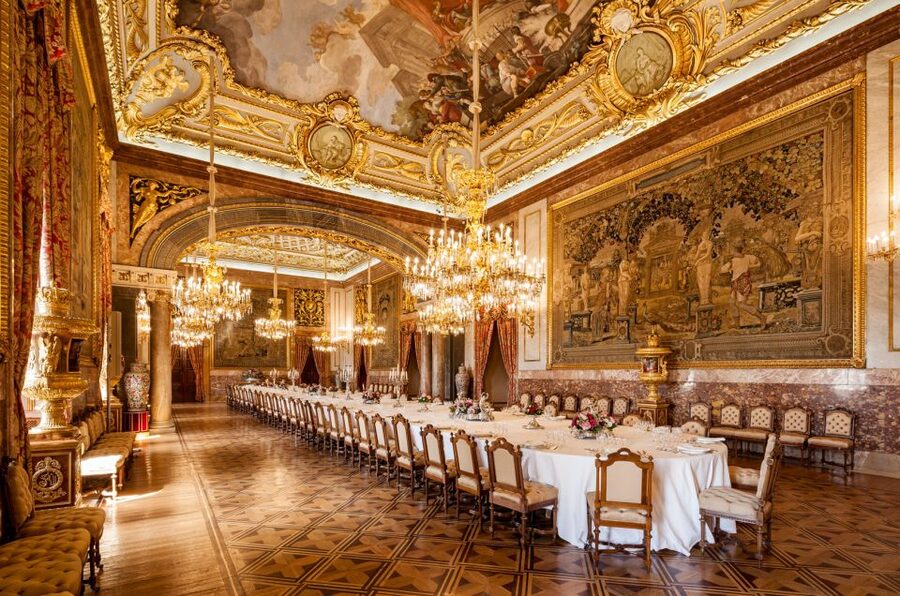
The route continues through private rooms associated with the king and queen, along with the great banqueting hall. These rooms help you compare private royal life with the palace’s formal public areas.
The private apartments are not necessarily private in the modern sense. They are still highly decorated, and the furnishings reflect the rank of the people who used them. The banqueting hall is larger and more ceremonial, built for gatherings where the meal was only one part of the event.
I find this sequence useful because it gives the palace a human scale. The grand staircase and reception rooms can feel like a parade of decoration. The apartments and dining areas help you picture daily routines, entertaining, and the strict social order surrounding the monarchy.
Do not expect a long stop in each room. The palace has a great deal to cover, and the guide must keep the group moving. If you want a close look at every chair, painting, and wall detail, note the rooms that interest you most and return to them if the palace allows continued independent viewing after the guided section.
The porcelain room and royal chapel

The porcelain room is one of the more distinctive stops. Its decorated surfaces offer a change from the marble, wood, and painted ceilings elsewhere in the palace.
This is the sort of room that benefits from a guide. Decorative work can look pretty but anonymous if you do not know why it was made or how it fit into royal life. Listen for the practical explanation of the room’s purpose, not just the names of materials and artists.
The royal chapel provides another change in mood. Its ceiling has an extraordinary fresco by Corrado Giaquinto, and the chapel shows how religious ceremony was woven into court life.
The chapel is also a reminder that the palace was not simply a residence. It supported official worship, state occasions, family ceremonies, and the daily routines of a royal household. The fresco is worth looking up at carefully, though the tour’s pace may give you only a short viewing period.
The throne room and Tiepolo’s ceiling
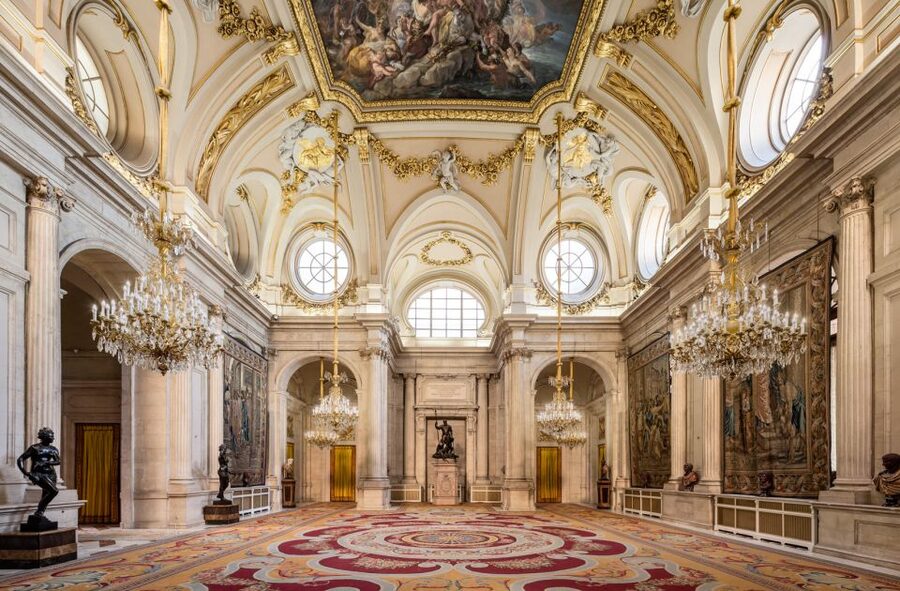
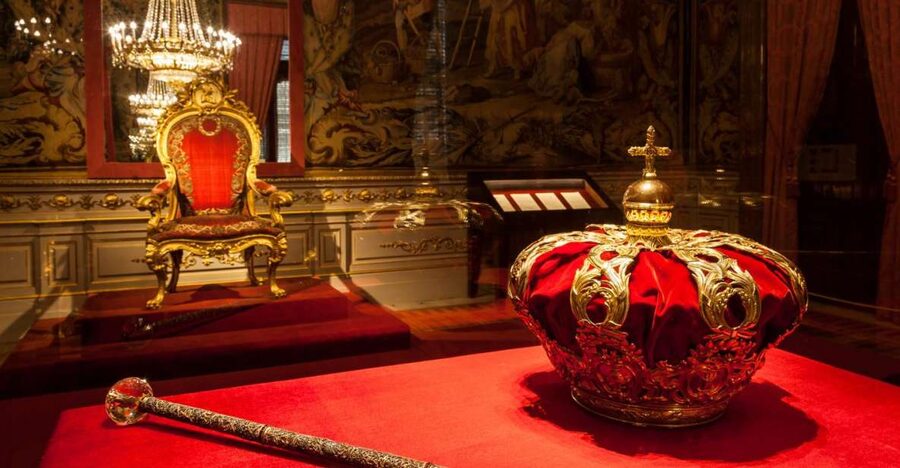
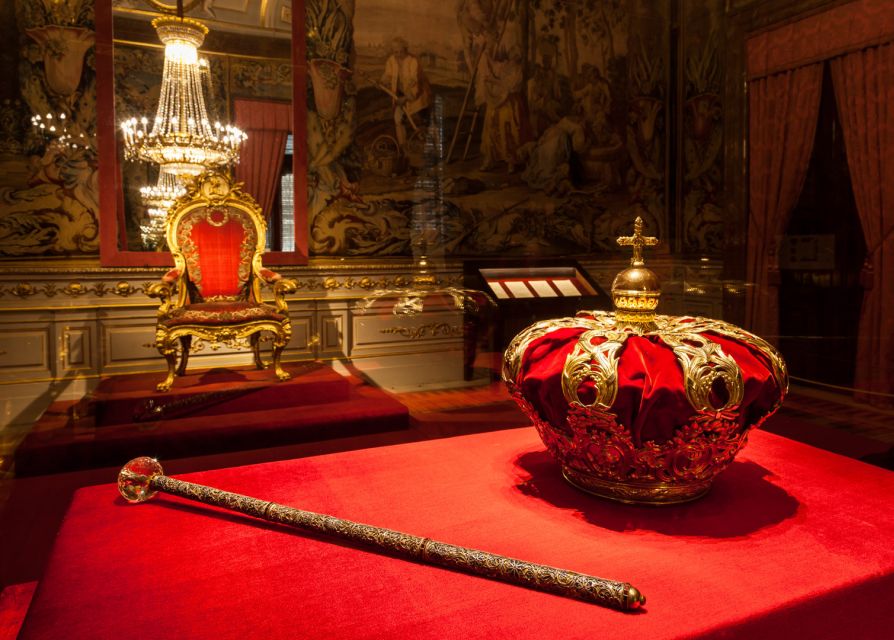
The throne room is likely the visual high point of the tour. Its ceiling was painted by Giovanni Battista Tiepolo, and the room’s marble surfaces, mahogany doors, and polished details create the kind of theatrical setting expected from a royal court.
This is not a modest room designed for quiet conversation. It was built to make authority visible. The throne room’s effect comes from the whole arrangement: the ceiling above, the hard reflective surfaces around you, and the carefully ordered furniture below.
Look upward before you focus on the thrones. Tiepolo’s ceiling is easy to miss if you spend all your time studying the lower half of the room. The fresco draws your eye into a larger, symbolic world above the ceremony.
The guide’s commentary can turn the room from a beautiful photograph into a lesson in royal messaging. You learn how art, architecture, and furniture worked together to present the monarchy as powerful and legitimate.
Artworks, frescoes, tapestries, and instruments

The palace contains much more than rooms. Along the route, you see artworks, frescoes, tapestries, and a notable collection of stringed instruments.
The instruments add variety to the visit. They point to music’s role in court life and give you something different to notice after several heavily decorated rooms. If you have an interest in music, ask the guide to pause on this collection if time allows.
The frescoes and tapestries also reward a slower eye. They cover walls and ceilings with stories, symbols, and decorative patterns, but the sheer amount of visual material can become tiring. A good guide helps you decide which pieces deserve your attention.
This is where the tour’s educational value is strongest. You are not simply told that the palace is grand. You are shown how its art supported ceremony, religion, diplomacy, and royal identity.
How the guides shape the experience
The strongest part of this tour is the live explanation. Guides have been praised for being friendly, patient, funny, and clear, with Pacho and Tamar specifically earning warm personal notice. Several different guides have also been described as highly effective at explaining Spanish royal history.
That matters because the palace can otherwise feel like a long sequence of impressive rooms. A good guide connects the rooms to the monarchs who used them and explains the purpose behind details that might seem decorative or excessive.
The best experience comes when you stay close enough to hear. The palace can be crowded, particularly during busy periods such as Holy Week, and a large room can swallow a quiet voice. If the group is bigger than expected, position yourself near the guide before the explanation begins.
Group size may vary. One departure had only eight people, while another had a single Spanish-speaking participant. A small group gives you a better chance to ask questions and keep the guide’s attention. You should not assume every departure will be equally intimate.
Is 90 minutes enough?
For a first look, yes. For the entire palace, no.
The 90-minute format works because it gives you a clear route through the most important rooms without asking you to spend half a day inside. It suits a busy Madrid schedule and provides enough context to make the palace easier to understand.
The tradeoff is speed. One guide may have to explain each room in English and Spanish, leaving less time for quiet observation. If you are especially interested in art, architecture, royal furnishings, or photography, the visit may feel compressed.
I would treat this as a guided introduction, not a complete study visit. Focus on the staircase, reception room, royal chapel, porcelain room, throne room, and banqueting hall. Let the guide supply the context, then use any time available afterward to look more closely at what caught your eye.
One useful tip is to ask how to continue on your own before the tour ends. A guide may be able to explain what parts of the palace remain open for further viewing.
Is the $40 price fair?
At $40, this tour asks you to pay for three things: admission, a live guide, and a more organized entry process.
The price makes sense if you dislike waiting in long lines, want clear explanations in English or Spanish, or have limited time in Madrid. It is particularly useful for a first palace visit because you do not have to identify the key rooms or work out the symbolism alone.
The value drops if you already know Spanish royal history, prefer reading at your own speed, or want to spend a long time examining individual artworks. You are paying for structure and interpretation, not unlimited time inside every room.
The free cancellation policy up to 24 hours before the start and the reserve-now, pay-later option also reduce the risk of fitting the tour into a changing Madrid schedule. Check the available start times before booking, since the duration is fixed but the departure time varies.
Who should book this Royal Palace visit?
I would recommend it to first-time visitors who want the palace explained rather than simply photographed. It also suits families and older visitors who may appreciate organized entry and a route through the major rooms, though the stairs and quick pace should be considered.
It is a good match for anyone interested in Spanish monarchy, royal ceremony, decorative art, or the palace’s continuing official role. The guides add the most value when you want the story behind the rooms.
I would be more cautious if you have already visited many royal palaces and prefer a slower, less selective experience. The palace may feel less surprising if you have seen several similarly decorated residences, and 90 minutes may not satisfy a serious art or architecture enthusiast.
Final decision: book or skip?
Book this tour if you want a well-organized introduction to Madrid’s Royal Palace, especially when avoiding a long entrance queue matters. The strongest reasons are the separate entry, the useful royal context, and the guides’ clear and friendly approach.
Skip it if you want to wander alone, study every object, or place the palace at the very top of a short Madrid itinerary. The route is worthwhile, but the palace’s full scale cannot be covered in 90 minutes.
Before booking, mark Plaza de Isabel II on your map, arrive early, carry a one-euro coin for the locker, and expect a brisk route. Those small preparations will prevent the most common frustrations and leave you free to enjoy the rooms that make this palace memorable.
FAQ
Where does the Royal Palace tour begin?
Meet near the Isabel II statue in Plaza de Isabel II, 5, 28013 Madrid, Spain. The guide carries a white umbrella.
Does the tour meet at the Royal Palace entrance?
No. You meet in Isabel II Square and then walk with the group to a separate entrance at the palace.
How long does the guided visit last?
The guided visit lasts 1.5 hours, or 90 minutes. Starting times vary, so check availability when booking.
What languages are available?
Tours are available in English and Spanish. In exceptional cases, a tour may be bilingual.
Is palace admission included?
Yes. The activity includes entrance to the Royal Palace of Madrid and a guided visit with an expert bilingual guide.
Can I skip the regular entrance line?
The activity includes access through a separate entrance, which can help you avoid the longer public queue. You still need to pass through security.
Are large bags allowed inside?
Large items and bags must be left in the locker room next to the Hall. A one-euro coin is useful for the locker and is refunded when you collect your belongings.
Can I bring food or drinks into the palace?
No. Food and drinks are not permitted inside the Royal Palace.
Is the tour wheelchair accessible?
Yes, the activity is listed as wheelchair accessible. The route also includes stairs, so anyone using a pram or trolley should ask about the best route before the visit begins.
Recently added around Madrid
- Tour Madrid: Secrets in a Electric Tuk Tuk★ 4.6 · 155 reviews
- Madrid: Tasty Tapas Tour & Visit to a Terrace with Views★ 4.5 · 118 reviews
- Madrid: Flamenco Show&Drink at Tablao 1911 (World’s Oldest)★ 4.7 · 253 reviews
- Small Group Prado Museum Guided Tour with Skip the Line★ 4.2 · 106 reviews
- Madrid: Street Art Tour with Local Graffiti Hunter★ 4.8 · 270 reviews
- Madrid: Afternoon Prado Museum Tour with Skip-the-Line Entry★ 4.4 · 491 reviews
- Madrid: Royal Palace Guided Tour with Skip-the-Line Entry★ 4.5 · 780 reviews
- Secret Food Tours Madrid★ 4.9 · 134 reviews
Royal Palace Tours, compared.

Royal Palace Expert Guided Tour with Skip-the-Line
Read our review →
Madrid Essential: Historic Center, Plaza Mayor & Royal Palace
Read our review →

Madrid Old Town & Royal Palace Walking Tour Skip the Line Ticket
Read our review →
Royal Palace Guided Tour with Skip the Line Ticket
Read our review →
Royal Palace & Prado Museum Skip the Line Guided Tour
Read our review →Browse the lists this tour appears in