
Reviewed · CASTILE TOURS
guided night tour
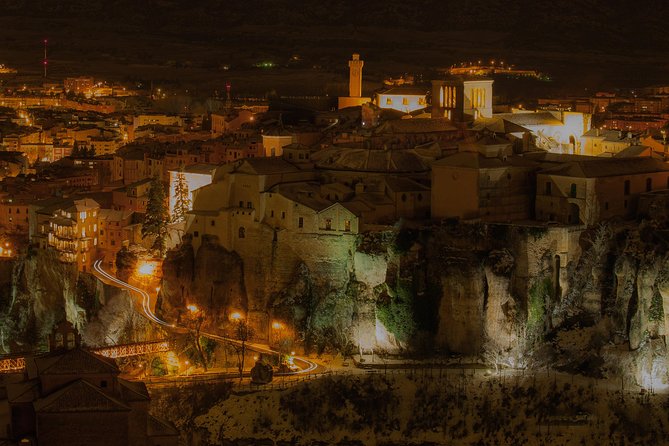
Cuenca becomes a different city after sunset. On this two-hour evening walk, illuminated churches, leaning houses, castle ruins, and the famous Casas Colgadas take on a sharper, more dramatic look. You move through narrow medieval lanes while your guide fills in the stories behind the stonework, the ravines, and the odd shapes of the old town.
I like the timing, since an 8 pm start avoids much of the daytime heat and gives you the best chance to see Cuenca glowing at dusk. I also like the price: at $9.88 per person, this is an inexpensive way to get your bearings before exploring on your own. The main consideration is group size, which can reach 50 people, so the walk may feel less personal than a small private tour.
Key points to know before booking
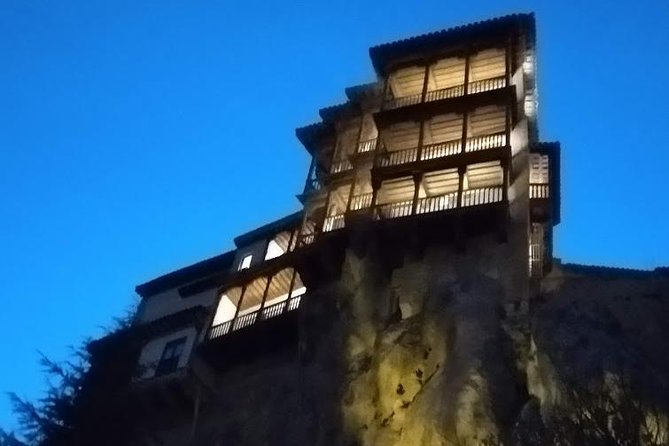
- The Casas Colgadas arrive at the end: The route builds toward Cuenca’s best-known sight, with the hanging houses specially lit after dark.
- You cover the old town in two hours: The walk includes the Plaza Mayor, churches, castle ruins, the old prison, bridges, ravines, the Parador, and the Casas Colgadas.
- Guides add personality: Carlos, Guillermo, and Hugo are named in tour feedback, with particular praise for clear explanations, humor, and local curiosities.
- The route helps you get oriented: Starting on Calle Alfonso VIII and ending by the Spanish Abstract Art Museum gives you a useful framework for later exploring.
- The evening setting matters: Dusk views and illuminated façades are a major part of the appeal, not just a convenient change in schedule.
- The price is unusually modest: At $9.88, you are paying mainly for interpretation and orientation rather than entry to paid attractions.
Why Cuenca works so well after dark
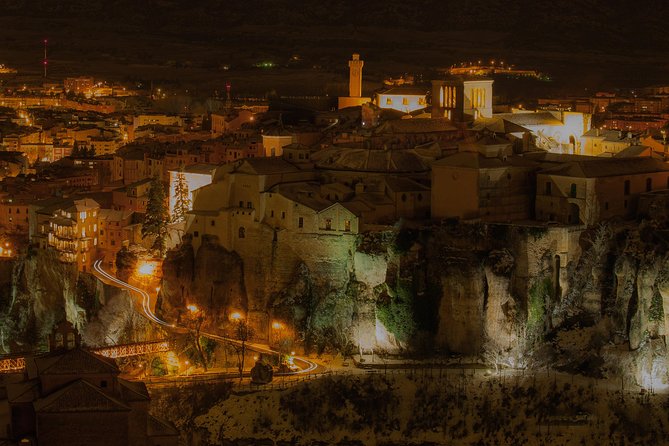
Cuenca’s historic center sits between the Huécar and Júcar gorges, with old buildings pressed into a narrow ridge. In daylight, you notice the steep setting and unusual architecture. At night, the lights pick out the edges of the buildings and make the drop-offs feel even more dramatic.
The walk is not just a parade of façades. Your guide explains how Cuenca developed, how Moorish-era streets shaped the old town, and why the houses were built in such striking positions. You also hear stories about churches, bridges, former religious buildings, and the people who used them.
I would choose this tour early in a Cuenca stay. It gives you a useful map in your head, so you can return later to the places that interest you most. It also helps you decide how to spend your daylight hours, especially if you want to visit museums, enter churches, or take in the gorge views at a slower pace.
The tour is offered in a group of up to 50 people. That number is worth noting. A large group can make it harder to hear in a narrow lane, and you should stay close to the guide at each stop. On the other hand, the low price makes the group format reasonable.
A few more Castile half-days worth comparing
- From Madrid: El Escorial and Valley’s Basilica Half Day Tour
★ 4.4 · 638 reviews - From Madrid: Day Trip to Ávila and Salamanca w/ Guided Tour
★ 4.5 · 456 reviews - Madrid: Cuenca Day Tour with or without Enchanted City
★ 4.8 · 398 reviews
Plaza Mayor: the right place to begin
The walk starts at C. Alfonso VIII, 1, at 8 pm. The first major sight is the Plaza Mayor, the natural center of Cuenca’s old town. Here you see colorful leaning houses and the illuminated fronts of the Cathedral and City Hall.
This is a strong opening because it gives you several of Cuenca’s signature features at once: old stone, bright façades, irregular building lines, and a tight urban setting. Your guide uses the square to explain the character of the historic center before leading you into the smaller streets.
At dusk, the plaza should feel more atmospheric than it does under harsh midday sun. The evening light also helps you appreciate the contrast between the warm-colored houses and the cooler stone of the Cathedral.
You should take a moment here to look around before the walk moves on. The opening stop is useful for orientation, and the square is also a practical reference point if you return later for dinner or another stroll.
San Pedro and Cuenca’s church architecture
The route continues to the Church of San Pedro, an octagonal church built on a limestone cornice. Its shape and position make it more interesting than a standard stop on a church tour.
The octagonal design gives the building a distinctive profile, while the limestone setting connects it directly to Cuenca’s dramatic topography. Your guide explains the church and its place in the old city, helping you see how religious buildings were fitted into a town with very little level ground.
This stop is a good example of what the tour does best. You are not simply told the name of a building. You get the architectural detail that makes it worth noticing, then hear how the building relates to the rock and streets around it.
If you prefer to enter monuments and study their interiors, this walk may feel limited. The emphasis is on the outside setting, city stories, and the connection between architecture and terrain.
The former convent and Covarrubias connection
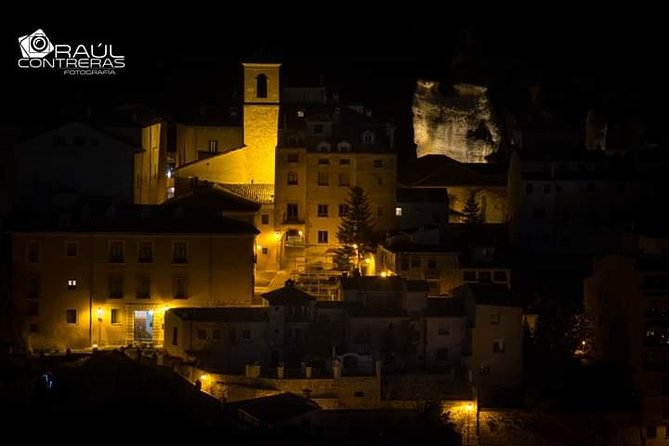
Another stop brings you to a former 17th-century convent, also linked with the Palace of D. Sebastián de Covarrubias. It is an easy place to pass without understanding what you are seeing, particularly in the dim streets of the old town.
That is where the guide’s commentary matters. The building carries several layers of Cuenca’s past, and the Covarrubias connection adds a personal and civic story to the route. Instead of treating the old town as a collection of attractive walls, the tour gives you names and uses that make the streets easier to read.
Guides Carlos, Guillermo, and Hugo receive especially warm praise for making these explanations lively. Carlos is noted for mixing history with humor and unusual details. Guillermo is praised for explaining architecture in a way that makes the buildings more meaningful, while Hugo is described as friendly and engaging.
The exact guide depends on the date of your booking, so you should not expect a particular person unless the operator confirms it. Still, the repeated emphasis on clear storytelling is a good sign for anyone who wants more than a silent walk through old lanes.
Same base in Castile, a completely different kind of day:
- Salamanca Sightseeing Walking Tour with Local Guide. Spanish
★ 4.7 · 312 reviews - Avila & Salamanca Tour with Tickets to Cathedral + Medieval Wall
★ 4.5 · 250 reviews - Royal Site of San Lorenzo de El Escorial Entrance Ticket
★ 4.4 · 239 reviews - Tour Guiado En Tuk Tuk Recorre Avila De La Forma Mas Comoda
★ 4.4 · 235 reviews
Castle ruins at the narrowest point of the old town
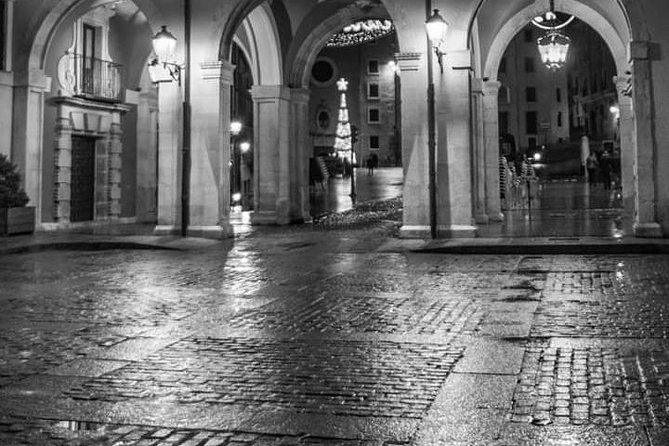
The route reaches the ruins of Cuenca Castle, dating from the 13th century. The remains mark the narrowest part of the historic center, between the two gorges.
The ruins are valuable less for the amount of surviving masonry than for their position. From here, you can understand why Cuenca was built where it was. The old city occupies a narrow high ridge, and the castle helped control this difficult approach.
At night, ruins can be harder to study in detail. You may not see every stone or architectural feature as clearly as you would in daylight. But the lighting and the setting bring out the defensive character of the site, and the guide’s explanation gives the remains a purpose beyond their appearance.
I would pay close attention to the geography here. It explains much of Cuenca’s identity: steep streets, sudden views, buildings perched at edges, and a town shaped by the gorges as much as by its walls.
The former Inquisition court above the Huécar Gorge
The walk also stops at a former court of the Inquisition and prison, positioned above the historic center on the edge of the Hoz del Huécar. This is one of the more serious stops on the route.
The building’s location is part of its story. It dominates the old town, and the drop toward the gorge adds a stark quality to the site. You hear about its former role and more recent use as a prison, which gives you a sense of how long the structure remained tied to authority and confinement.
This is not a museum visit with displays or interior access. It is an exterior stop, interpreted through the guide’s account. If you enjoy social history, this may be one of the most memorable parts of the walk because it shifts attention away from pretty houses and toward power, law, and punishment.
The gorge edge also makes this a place to walk carefully. The tour is generally manageable, but Cuenca’s old town has narrow streets and abrupt changes in level. Comfortable shoes are sensible, even though one guide described the route as not especially tiring and with few major climbs.
The Casas Colgadas after dark
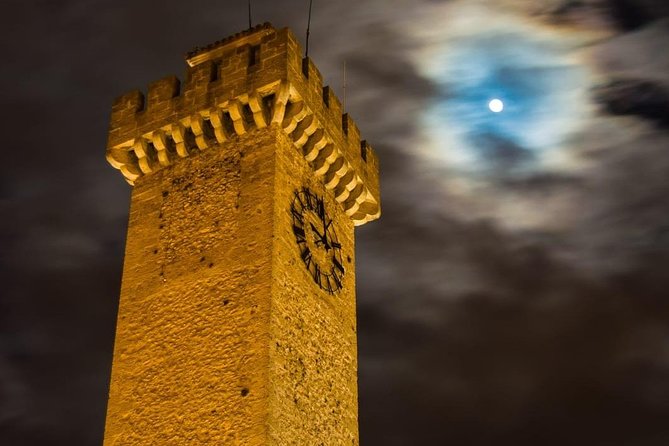
The Casas Colgadas, or Hanging Houses, are the tour’s visual payoff. More than 600 years old, these houses project over the gorge and seem to defy the drop below. Their special lighting makes them especially striking at night.
The route ends near the Spanish Abstract Art Museum and the Casas Colgadas at C. Canónigos, 3. This is a practical finish because you can remain in the area for photographs, continue walking across the old town, or visit the museum at another time if its opening hours suit your plans.
The houses are famous, but a guide helps you see more than the postcard view. You learn how the buildings relate to the rock, why their construction is unusual, and how Cuenca’s architecture makes use of the gorge rather than avoiding it.
This stop also explains why the evening schedule is worthwhile. You see the Casas Colgadas as the city lights come on, rather than simply viewing them under strong daytime glare. If you have already seen them during the day, the night setting gives the familiar sight a new mood.
The iron bridge and the story behind the crossing
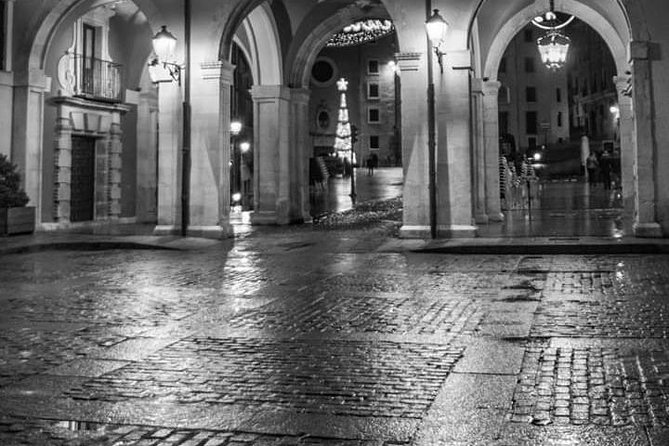
The walk then explains what happened to the earlier stone bridge and why it was replaced by the current iron bridge in 1903. This is a useful detail because bridges in Cuenca are not merely ways to get from one side to the other. They connect the high historic center with the dramatic ravines around it.
The bridge offers another chance to understand the city’s engineering problems. A town built on cliffs and narrow ridges needs practical routes, but those routes must also cope with steep drops and difficult foundations.
The stop is likely to appeal to you if you enjoy the small facts that make a city memorable. It is the kind of detail you might miss while rushing toward the Casas Colgadas, yet it helps explain how Cuenca remained connected as its buildings and streets changed.
The Parador above the ravine
The final landmark is the current Parador, carefully lit and set on a rock beside the ravine. Its position gives you one more strong view of Cuenca’s unusual setting.
The building’s location matters as much as its appearance. From the rock at the edge of the gorge, you see how the old city and its surroundings fit together. The route repeatedly returns to this idea: Cuenca is not simply an old town with attractive buildings. Its architecture was shaped by height, stone, ravines, and limited space.
Because this is a nighttime tour, you may not get the full range of distant daylight views. The trade-off is atmosphere. Lit stone, dark ravines, and the outline of the old buildings create a more dramatic scene than a standard afternoon walk.
What the $9.88 price really buys you
At $9.88 per person, this is excellent value if you want orientation and explanation. You are not paying for museum admission or a long transport experience. You are paying for a guide who connects the sights and helps you understand what you are looking at.
The tour covers a lot in two hours: the Plaza Mayor, Cathedral and City Hall façades, San Pedro, the former convent and Covarrubias palace, castle ruins, the former Inquisition court and prison, the iron bridge, the Parador, and the Casas Colgadas.
That is a full route for the price, though you should keep your expectations realistic. This is not a private walk with unlimited time at every building. With up to 50 people, explanations need to serve the whole group, and the itinerary has to keep moving.
I would book it if you are staying in Cuenca for at least one night and want a low-cost introduction. I would be less interested if you already know the old town well and prefer to explore alone, unless you want fresh stories or a different view of the city after dark.
Practical details for a smoother evening
The meeting point is C. Alfonso VIII, 1, in Cuenca’s historic center. The start time is 8 pm, and the walk lasts about two hours. It ends at the Spanish Abstract Art Museum and the Casas Colgadas, not back at the starting point.
That point-to-point route is useful, but plan your evening around it. If you have a restaurant reservation, leave enough time after the 10 pm finish. You will be near the central sights, but the old town’s narrow streets can take longer to navigate than a map suggests.
The tour is near public transportation, and service animals are allowed. Most people can participate, but the route includes old streets, ravine edges, and some changes in level, so wear shoes that feel secure on stone.
You receive confirmation when booking. Free cancellation is available up to 24 hours before the start time for a full refund. Cancellations or changes made within 24 hours are not refunded or accepted.
Who should book this Cuenca night walk
I recommend this tour for first-time visitors who want a clear introduction without paying much. It is also useful if daytime heat bothers you, if you prefer atmospheric photography, or if you have limited time and want to cover the historic center in one organized walk.
You will get the most from it if you enjoy stories about buildings, city planning, churches, bridges, and local customs. The guides are praised for humor, curiosity, and clear explanations, so the experience is not just a list of dates and names.
Families and mixed-age groups may appreciate the manageable two-hour length. People who want a very quiet walk, a tiny group, or extensive time inside monuments should choose a different format.
There is also a daytime monumental walk that can complement this evening route. If you have time for both, the day tour and night tour offer different views of Cuenca rather than simply repeating the same experience.
Should you book it?
Yes, if you want an affordable first look at Cuenca’s old town and like the idea of seeing the Casas Colgadas, churches, ravines, and castle ruins under evening lights. The strong 4.9 rating from 176 reviews and 98 percent recommendation rate match the tour’s clear strengths: good guides, useful historical context, and a pleasant route.
Book with the group size in mind. You may not have a close, private exchange with the guide, and a few stops will be better for listening than for detailed inspection. But at $9.88, the balance is very good. This is a sensible way to get oriented, hear the stories behind Cuenca’s unusual buildings, and decide where to return during daylight.
FAQ
Where does the tour begin?
The tour begins at C. Alfonso VIII, 1, 16001 Cuenca, Spain.
What time does the tour start?
The start time is 8 pm.
How long does the tour last?
The walk lasts approximately two hours.
Where does the tour end?
It ends at the Spanish Abstract Art Museum and the Casas Colgadas at C. Canónigos, 3, 16001 Cuenca, Spain.
What sights are included?
The route includes the Plaza Mayor, illuminated views of the Cathedral and City Hall, the Church of San Pedro, a former convent and the Palace of D. Sebastián de Covarrubias, Cuenca Castle ruins, the former Inquisition court and prison, the iron bridge from 1903, the Parador, and the Casas Colgadas.
How much does the tour cost?
The listed price is $9.88 per person.
How large can the group be?
The tour can have a maximum of 50 participants.
Is the tour accessible to everyone?
Most people can participate, and service animals are allowed. The information provided does not give further accessibility details about the historic streets or changes in level.
Can I cancel for a full refund?
Yes. You can cancel at least 24 hours before the start time for a full refund. Cancellations or changes made less than 24 hours before the tour are not accepted, and the amount paid is not refunded.
Recently added around Castile
- Guided Tour of Albarracín and Casa Noble★ 5.0 · 105 reviews
- From Madrid: Alcalá de Henares & Cervantes Museum Day Trip★ 4.5 · 108 reviews
- From Madrid: Day Trip to Ávila and Salamanca w/ Guided Tour★ 4.5 · 456 reviews
- Cuenca: Medieval Old Town★ 4.7 · 152 reviews
- From Madrid: El Escorial and Valley’s Basilica Half Day Tour★ 4.4 · 638 reviews
- Madrid: Cuenca Day Tour with or without Enchanted City★ 4.8 · 398 reviews
- Royal Site of San Lorenzo de El Escorial Entrance Ticket★ 4.4 · 239 reviews
- Salamanca: Cathedral of Salamanca Ticket with Audio Guide★ 4.6 · 197 reviews
Castile Tours, compared.
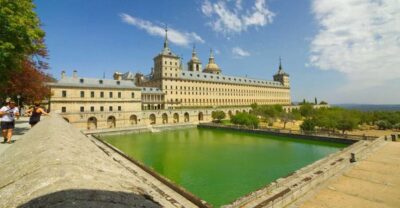
El Escorial and Valley’s Basilica Half Day Tour
Read our review →
Salamanca Sightseeing Walking Tour with Local Guide. Spanish
Read our review →
Avila & Salamanca Tour with Tickets to Cathedral + Medieval Wall
Read our review →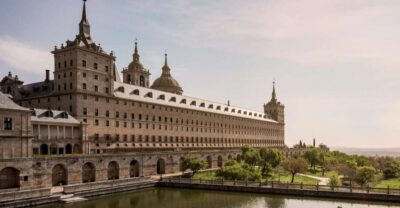
Royal Site of San Lorenzo de El Escorial Entrance Ticket
Read our review →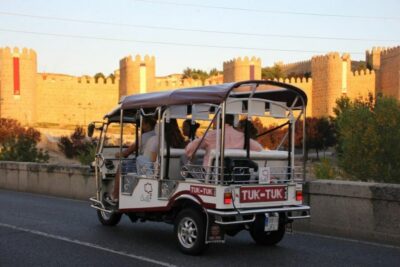
Tour Guiado En Tuk Tuk Recorre Avila De La Forma Mas Comoda
Read our review →
Browse the lists this tour appears in