
Reviewed · WALKING TOURS
Barcelona 2-Hour Gothic Walking Tour
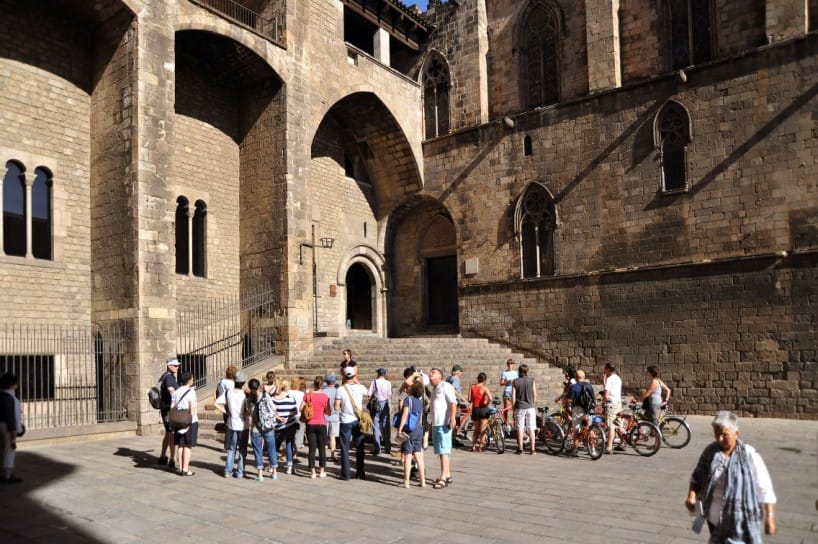
Barcelona’s Gothic Quarter makes more sense when someone points out what you would otherwise walk past: a Roman column tucked into a courtyard, the royal halls of Palau Reial Major, or bomb scars on the walls of Plaça Sant Felip Neri. This two-hour walking tour links those fragments into one clear story, from Roman Barcino to medieval Catalonia and the city you see today.
I like the compact route and the guide’s focus on details you would likely miss alone. I also like the English tour’s free visit to Museu Frederic Marès, a useful cultural extra after the walk. The main drawback is simple: two hours on uneven Gothic Quarter streets can feel tiring, especially in summer, and the tour leaves little time for lingering at each site.
Key points to know before you book
- Roman Barcelona appears in unexpected corners: See the Temple of Augustus and traces of ancient Barcino hidden among later buildings.
- The Cathedral gets more than a quick photograph: The guided visit includes its atmospheric cloister.
- Royal and religious history share the route: Visit Palau Reial Major, the Chapel of Santa Àgata, and Saló del Tinell.
- Plaça Sant Felip Neri adds emotional weight: Its church and war-damaged walls give the walk a quiet, serious moment.
- English tours include Museu Frederic Marès: After the walk, you receive free admission and time to explore its unusual collection.
- The tour has earned a 4.7 rating from 317 reviews: Praise centers on clear explanations, friendly guides, a good pace, and value.
Why the Gothic Quarter is better with a guide
The Barri Gòtic is easy to enter and surprisingly hard to read. You can wander through narrow lanes, admire carved doorways, and photograph balconies without understanding which walls are Roman, medieval, or much newer. A guide gives you the clues.
This tour is built around connections. Roman ruins do not appear as a separate museum lesson. They turn up inside the medieval city. Gothic churches sit near royal buildings. Quiet squares carry memories of political conflict and civil war. The result is less a parade of monuments and more a lesson in how Barcelona grew in layers.
The strongest part of the experience is the storytelling. Guides such as Olga Escribano, Jordi, Alex, Pilar, Olga, and others have been praised for explaining history clearly, answering questions, and keeping the tone lively. The quality of any walking tour depends on the person leading it, but this experience has repeatedly been valued for guides who bring humor and personal enthusiasm to the subject.
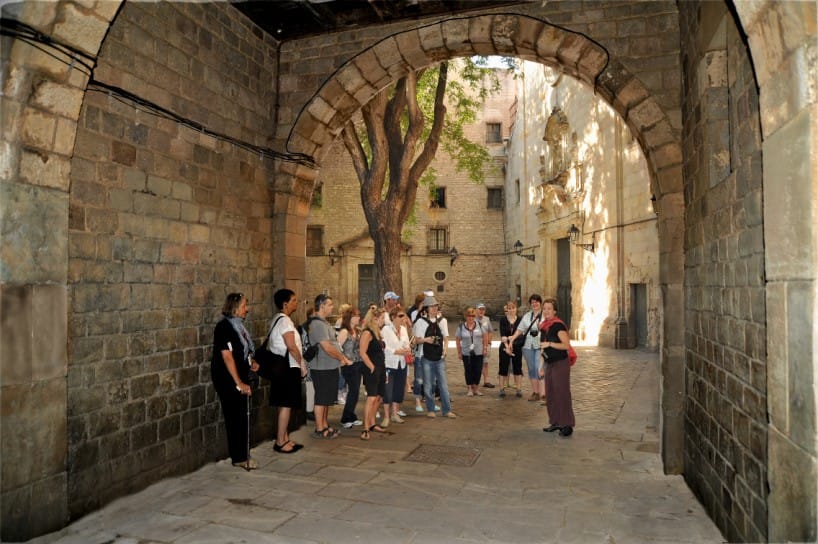
You should still expect an actual walking tour, not a short sightseeing loop. The route remains in the old quarter, so you do not cover huge distances. But the streets are paved with cobblestones, and the schedule keeps moving. Wear shoes with a firm sole, bring water, and eat beforehand. One useful bit of advice from the tour experience is not to arrive hungry. History is harder to enjoy when lunch is an urgent matter.
More Walking Tours in Barcelona
- Barcelona Tapas and Wine Experience Small-Group Walking Tour
★ 5.0 · 5,804 reviews - Barcelona: Tapas Walking Tour with Food, Wine, and History
★ 4.8 · 4,261 reviews - Barcelona Tapas Walking Tour: Food, Wine & History
★ 4.5 · 1,928 reviews
Starting at Plaça de la Seu
The meeting point is at the tourist information office near Plaça de la Seu. Look for the familiar i symbol. This is a practical place to begin because you are already beside Barcelona Cathedral and in the heart of the old quarter.
The opening moments should help you get your bearings. The guide introduces the Gothic Quarter as a historic district rather than just a photogenic maze. You begin to notice how the street plan, building fronts, and small squares preserve different periods of Barcelona’s past.
The exact starting time varies, so you need to check availability when booking. The tour ends back at Plaça de la Seu, making it easy to continue sightseeing nearby afterward. Since the beginning and end are in the same area, you do not need to arrange transport between the tour and your next stop.
Roman Barcino behind medieval walls
One of the best reasons to take this walk early in your Barcelona visit is the Roman background. The Gothic Quarter is not only about Gothic architecture. It grew over the remains of Barcino, the Roman settlement that formed the foundation of the city.
The Roman Temple of Augustus is a particularly rewarding stop. Its columns sit in a medieval setting, tucked away from the broad streets and easy to miss if you do not know where to look. A guide can explain why this ancient structure matters and how Roman remains survived as Barcelona changed around them.
That contrast is the real attraction. You are not looking at a Roman ruin in isolation. You are seeing ancient stone surrounded by later streets, homes, and public spaces. The guide helps you picture the long sequence of construction and reuse.
This portion suits history-minded visitors, but it is not only for specialists. The explanations are designed to make the visible details easier to understand. If you usually walk past old stones wondering what they mean, this tour supplies the missing context.
Barcelona Cathedral and the cloister
Barcelona Cathedral is one of the route’s main anchors. Its Gothic exterior is impressive, but the guided visit to the cloister gives you a closer and quieter look at the building.
The cloister adds a different mood from the streets outside. You can study architectural details at a slower pace and see how the Cathedral functioned as a religious center, not merely as a dramatic backdrop. The tour presents the building as part of the city’s social and political story.
Because the tour lasts only two hours, you should not expect a full, unhurried visit to every part of the Cathedral. This is an orientation and interpretation visit, not a substitute for spending half a day inside the complex. Still, the cloister makes the stop more substantial than a quick exterior explanation.
The Cathedral area can be busy, and the group needs to stay together. Listen carefully at meeting points and keep close enough to hear the guide. Some tours use audio equipment, which can help in rain or around street noise, though equipment is not specifically guaranteed for every departure.
Same base in Barcelona, a completely different kind of day:
- Barcelona: Sagrada Familia Entry Ticket with Audio Guide
★ 4.6 · 105,312 reviews - Barcelona: Park Güell Admission Ticket
★ 4.4 · 76,534 reviews - Barcelona: Casa Batlló Entry with Self-Audioguide Tour
★ 4.7 · 25,359 reviews - Barcelona: 24 or 48-Hour Hop-On Hop-Off Bus Tour
★ 4.4 · 20,872 reviews
Palau Reial Major and the Saló del Tinell
The route also reaches the former royal center of Barcelona, the Palau Reial Major. This is where the walk shifts from religious architecture to royal power and Catalan political history.
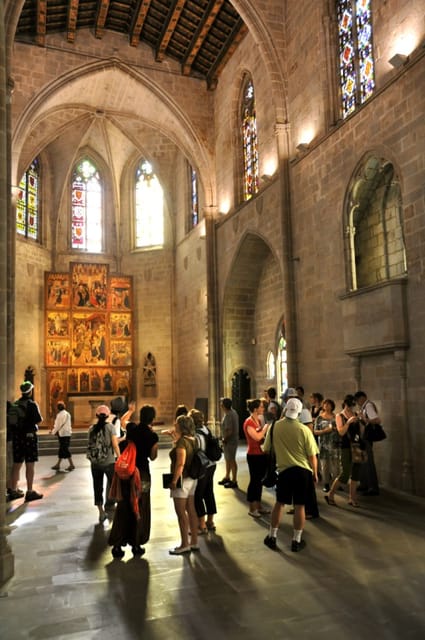
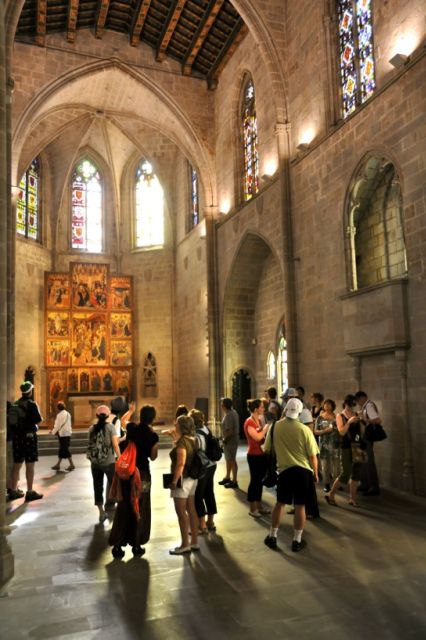
The Saló del Tinell is especially important. Its large medieval hall recalls the period when Catalan kings held court and major events unfolded in the royal complex. The guide connects the building to the wider story of the Crown of Aragon and to the famous meeting between Ferdinand and Isabella and Christopher Columbus after his return from the Americas.
You do not simply pass a grand façade and move on. The value lies in understanding who used these rooms and why the site mattered. Even if you have limited interest in royal history, the setting helps explain Barcelona’s role as a center of power.
The visit to the Chapel of Santa Àgata adds another layer. Its intimate scale contrasts with the larger royal spaces nearby. Together, the chapel, hall, and palace show how closely religion and government were linked in the medieval city.
Plaça del Rei and Carrer del Bisbe
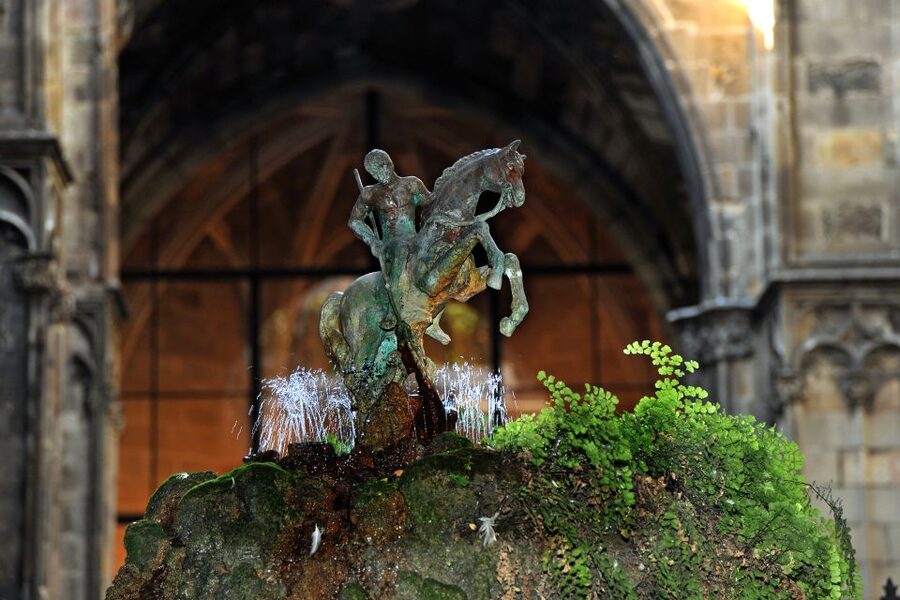
Plaça del Rei is one of the most atmospheric spaces on the route. The square has the kind of enclosed medieval character that makes the Gothic Quarter feel distinct from Barcelona’s broad modern avenues.
Here, the guide can help you read the façades and understand how the square fits into the royal quarter. It is also one of the better places for photographs, though the compact setting can make it difficult to find an empty view at busy times.
Carrer del Bisbe provides another memorable pause. Its Gothic-looking bridge and decorated façades have become among the most photographed details in the old quarter. The street is narrow, so the group may need to stop along the side while the guide explains what you are seeing.
This is a good example of why a guide adds value. You get the photograph, but also the story and the architectural setting behind it. The walk encourages you to look above eye level, where balconies, stone details, and old façades reward attention.
Plaça Sant Felip Neri and the city’s painful past
Plaça Sant Felip Neri is one of the most affecting stops. It is quieter than the main streets, with a baroque church and walls marked by damage from Spanish Civil War bombings.
The square is not presented as decoration. Its scarred walls give the city’s history a human and political dimension. Children may play there, and musicians may perform, but the marks remain a reminder of violence and loss.
This stop also provides a useful change of pace. After Roman remains, Gothic buildings, and royal history, you reach a place where the past feels close and visible. I appreciate tours that allow room for this kind of serious moment instead of rushing from one pretty façade to the next.
The square is also a reminder that the Gothic Quarter is not a preserved stage set. It remains part of everyday Barcelona. People live, work, pass through, and gather in these old spaces.
The English tour’s Museu Frederic Marès visit
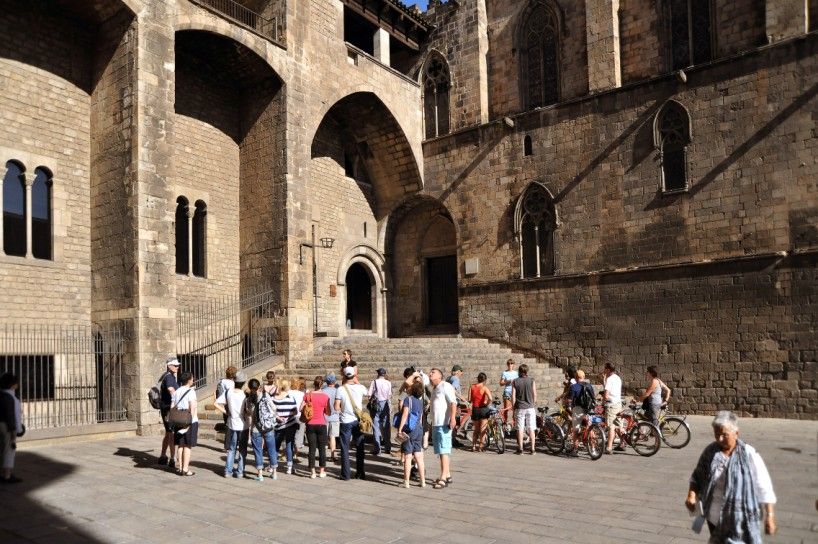
If you book the English-language departure, the experience includes free admission to Museu Frederic Marès after the walking tour. The museum is housed in a medieval palace and contains sculpture, religious art, antique curiosities, and everyday objects collected by Frederic Marès.
This is not a standard art museum with one simple theme. Its appeal comes from the range of objects and the personal nature of the collection. You might move from medieval sculpture to small domestic items and 19th-century curiosities. That variety makes it a good follow-up to the walking tour, since you continue seeing how people in different periods made, used, and valued objects.
The museum visit is free time rather than another fully guided section of the walk. That gives you flexibility, but it also means you need to manage your own attention and timing after the main tour. If museums are not your priority, you can treat it as an optional extra. If you enjoy unusual collections and historic interiors, it adds real value to the $32 price.
The supplied itinerary also names the Museu d’Història de Barcelona among the guided stops. The exact presentation of museum-related sites can depend on the departure and guide, so check the current booking details if a particular museum is essential to your plans. The English Museu Frederic Marès inclusion is the clearest extra attached to the English tour.
Pace, group comfort, and practical realities
Two hours is a smart length for this subject. You get enough time to connect the main sites without giving up an entire day. Several departures have been praised for a steady pace, and one tour experience specifically described the route as suitable for someone with movement difficulty, thanks to an understanding guide.
That does not mean the walk is effortless. You will be on your feet for two hours, and the Gothic Quarter’s old paving can be uneven. The route is compact, but compact does not mean flat or smooth. If you have mobility concerns, contact the provider before booking and ask about the specific departure.
Weather can affect the experience. Rain has not stopped every tour, and an umbrella and listening device can make a wet walk manageable, but outdoor sightseeing is less comfortable in poor weather. A past tour had a tower closed because of rain, showing that weather can also affect access to particular features.
The tour is conducted in English with a live local guide. Guide names have included Olga Escribano, Jordi, Alex, Pilar, Luca, Val, Miguel, Theo, and others. You should not book expecting one specific person unless the current departure identifies the guide, but the repeated praise for friendly explanations and good answers is encouraging.
Is $32 a fair price?
At $32 per person, this tour offers solid value if you want historical context rather than a simple walk through pretty streets. The price includes an official local guide, two hours of interpretation, the Cathedral and major Gothic Quarter stops, and free admission to Museu Frederic Marès on the English tour.
You are paying for structure and access to a good story. Without a guide, you can visit some of the same streets and squares for free. What you cannot easily reproduce is the order of the route, the explanation of the Roman remains, and the links between the palace, Cathedral, chapels, and public squares.
The value is strongest on a first visit to Barcelona. After the tour, you can return to the places that interested you most, now knowing what you are looking at. It is also useful for families with older children and teenagers, since the stories and unusual details can make the old quarter more engaging than a list of dates.
If you already know Barcelona’s medieval history or prefer to explore alone, the price may feel less necessary. You can also spend two hours wandering without a schedule. This tour earns its cost when you want a clear introduction and someone to point out the details you would otherwise miss.
Who should book this Gothic Quarter walk?
I would choose this tour for a first or second day in Barcelona, especially if you want to understand the city before visiting more major sights. It gives you a strong sense of place without taking over your schedule.
It suits:
- First-time visitors who want historical context
- People interested in Roman, medieval, royal, and religious history
- Families with older children or teenagers
- Museum lovers who will use the Museu Frederic Marès admission
- Visitors who like guided storytelling and local recommendations
- Anyone who wants a compact introduction to the old city
I would think twice if you dislike walking on old paving, need long breaks, or want a slow architectural photography session. The route covers plenty in two hours, but that means stops are purposeful and time is limited.
You can cancel up to 24 hours before the tour for a full refund, and the reserve-now, pay-later option keeps your plans flexible. Those terms help if your Barcelona schedule is still changing.
Should you book it?
Book it if you want the Gothic Quarter to become more than a maze of narrow streets and attractive façades. The Roman Temple of Augustus, the Cathedral cloister, Saló del Tinell, Santa Àgata Chapel, and Plaça Sant Felip Neri give the route real variety. The English Museu Frederic Marès visit makes the price even easier to justify.
I would especially recommend it for a first visit, and I would schedule it near the start of your stay so you can use the guide’s historical and local suggestions afterward. Bring water, wear comfortable shoes, and arrive ready to walk rather than simply pose for photographs.
FAQ
How long is the Barcelona Gothic walking tour?
The guided walking tour lasts two hours.
How much does the tour cost?
The listed price is $32 per person.
What language is the tour conducted in?
The tour is offered in English with a live guide.
Where does the tour meet?
The meeting point is at the tourist information office. Look for the i symbol.
Where does the tour finish?
The listed drop-off location is Plaça de la Seu, the same area as the meeting point.
Does the tour visit Barcelona Cathedral?
Yes. The Cathedral is included as a guided stop, including a closer visit to its cloister.
Is the Chapel of Santa Àgata included?
Yes. The Chapel of Santa Àgata is named as one of the guided stops.
Does the route include the Saló del Tinell?
Yes. The tour passes important historic monuments including the Saló del Tinell.
Is Museu Frederic Marès included?
The English tour includes free admission and free time at Museu Frederic Marès after the walking tour.
Can I cancel for a full refund?
Yes. You can cancel up to 24 hours in advance for a full refund.
More 2-Hour Experiences in Barcelona
- Barcelona: Two-Hour Midday or Sunset Sailing Cruise
★ 4.8 · 1,732 reviews - Barcelona: 2-Hour City Sights Guided Segway Tour
★ 4.9 · 453 reviews - Barcelona: 2-Hour Sailboat Tour with Snacks and Drinks
★ 4.8 · 357 reviews - Barcelona: Jewish Quarter 2-Hour Walking Tour
★ 4.8 · 333 reviews
Recently added around Barcelona
- Park Guell Guided Tour with Skip the Line Tickets★ 4.0 · 739 reviews
- Entrance to the Mirador Torre Glories Barcelona★ 4.5 · 193 reviews
- Bohemian Barcelona Neighborhood Evening Tapas & Wine Tour★ 5.0 · 419 reviews
- Transfers From Cruise Port to Barcelona Airport★ 4.5 · 155 reviews
- Authentic Flamenco Show Barcelona : Intimate Casa Sors Experience★ 5.0 · 809 reviews
- Barcelona Expert Tour with Local Guide in Eco Tuk Tuk Private★ 5.0 · 216 reviews
- Barcelona Sunset Cruise with Light Snacks and Open Bar★ 5.0 · 476 reviews
- Barcelona: Sagrada Familia, Park Guell & Tapas Private Tour★ 5.0 · 903 reviews
Walking Tours, compared.

Barcelona Tapas and Wine Experience Small-Group Walking Tour
Read our review →
Tapas Walking Tour with Food, Wine, and History
Read our review →
Albaicín and Sacromonte Guided Sunset Walking Tour
Read our review →
Toledo Tour & Vineyard Walk with Wine Tasting from Madrid
Read our review →

Barcelona Tapas Walking Tour: Food, Wine & History
Read our review →
Madrid Old Town & Royal Palace Walking Tour Skip the Line Ticket
Read our review →
Browse the lists this tour appears in