
Reviewed · GAUDI ARCHITECTURE TOURS
Barcelona: 2.5-Hour Gaudí Segway Tour
Barcelona’s Gaudí buildings are spread across a wide part of the city, and this 2.5-hour Segway tour lets you see many of them without wearing out your feet. You start at Arc de Triomf, then roll along Passeig de Gràcia, reach Sagrada Familia, and make a short escape into the old village streets of Gràcia.
I like the way the route pairs famous sights with lesser-known Modernisme buildings, especially Casa Amatller and Casa de les Punxes. I also like the small-group setup, with two to six people per guide, since it gives you more room to ask questions and learn to handle the Segway safely.
The main drawback is that you do not go inside Sagrada Familia, Casa Batlló, or Casa Milà. This is an exterior sightseeing tour, so you will need separate tickets and more time if you want to explore the interiors.
Key points to know before you book
- Arc de Triomf is your starting point: Meet at Passeig de Lluís Companys 10, close to the monumental red-brick arch.
- The route covers several Modernisme landmarks: See Casa Milà, Casa Batlló, Casa Amatller, Casa de les Punxes, and Sagrada Familia.
- Gràcia adds a local feel: Stop at Plaza de la Vila de Gràcia, with its bell tower, former town hall, small alleys, shops, and cafés.
- Training is part of the experience: You receive instruction, a helmet, safety equipment, insurance, and a Segway i2.
- The tour suits confident, mobile riders aged 16 and over: You must be at least 110 centimeters tall and weigh between 35 and 120 kilograms.
- The $42 price is fair for a city overview: It works best if you want to cover a lot of ground and do not need interior admissions included.
Why a Segway works well for Gaudí’s Barcelona
Gaudí’s Barcelona is not arranged around one single sight. Sagrada Familia sits northeast of the old center, while Casa Batlló and Casa Milà line Passeig de Gràcia, and Gràcia lies farther north. Walking between all of these places takes time, especially in warm weather.
A Segway gives you a practical middle ground. You cover more ground than you could on foot, but you still move slowly enough to look up at balconies, chimneys, stonework, and unusual windows. You are not sealed inside a vehicle, so the city remains part of the experience.
You should not expect a quiet ride through empty streets. Barcelona traffic and pedestrians are part of the setting, and you need to stay alert. The guides place safety first, provide training before departure, and split larger groups among several guides.
The first few minutes matter. Several people found the Segway easy to learn after instruction, but one person noted that the ride could be hard on the knees. You need to make movements similar to climbing and descending stairs without help, so this is not a good choice if you have mobility limits.
More Segway Tours in Barcelona
- Barcelona Segway Tour
★ 5.0 · 680 reviews - Barcelona Segway Tour
★ 4.7 · 630 reviews - Barcelona: City Highlights Guided Segway Tour
★ 4.9 · 624 reviews
Arc de Triomf sets the tone
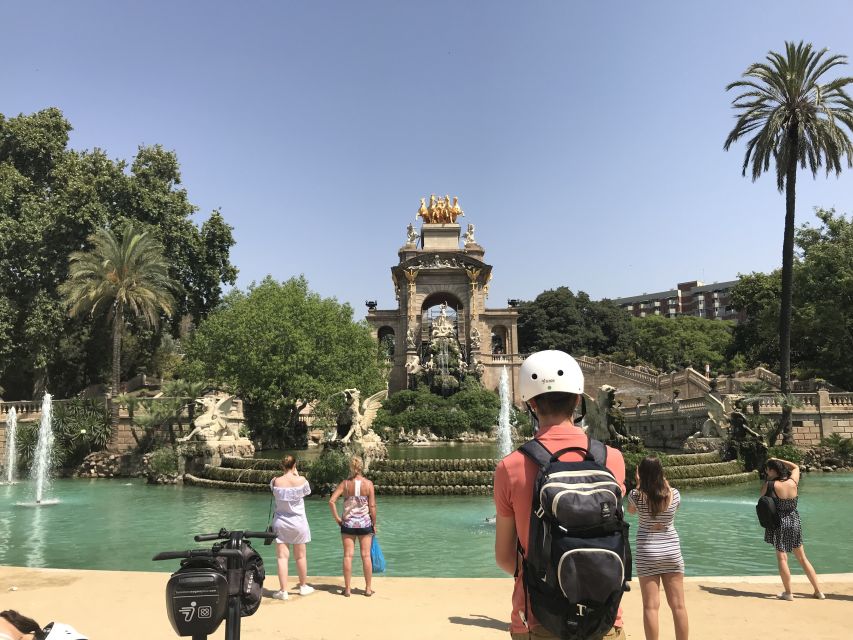
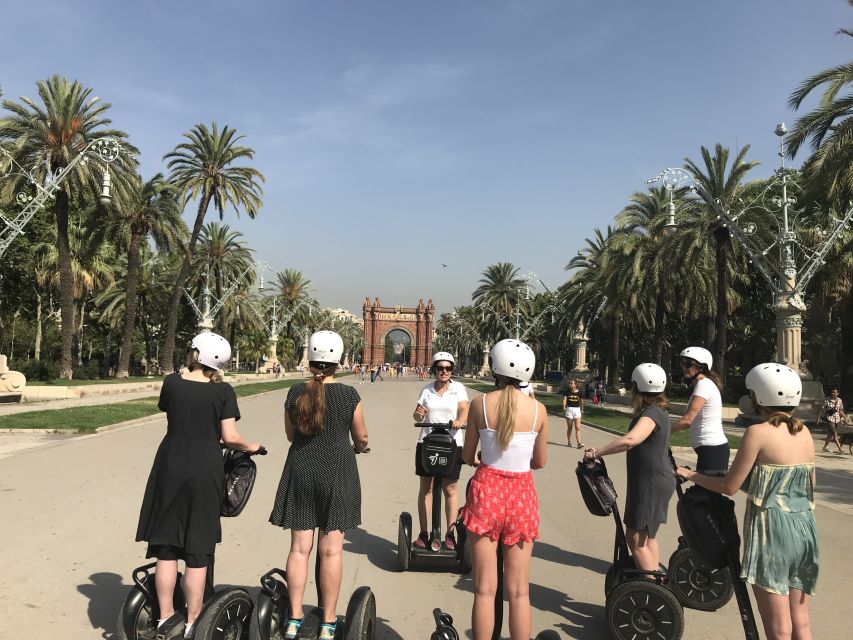
The meeting point is the activity provider’s office at Passeig de Lluís Companys 10. From there, the tour begins at Arc de Triomf, a broad ceremonial gateway built for Barcelona’s 1888 Universal Exposition.
This is a useful place to start because the avenue gives you room for the safety briefing and initial practice. Your guide explains how to mount, steer, stop, and manage the Segway around pedestrians and traffic. You also receive a helmet and other safety equipment.
The small groups are a real benefit here. With two to six people per guide, the instructor can watch each rider more closely. If your party is larger, the group is divided and accompanied by more than one guide.
Guides work in Dutch, English, French, German, Italian, Portuguese, Russian, and Spanish. Specific guides praised for patience, instruction, and city knowledge include Alex, Edwin, Daniel, Stephan, Virginia, David, Fabio, Maria, and Nico. Guide assignments can change, but the pattern is clear: the guide is not simply there to lead the way. You can ask about buildings, food, and places to visit during the rest of your stay.
Passeig de Gràcia turns architecture into a street show
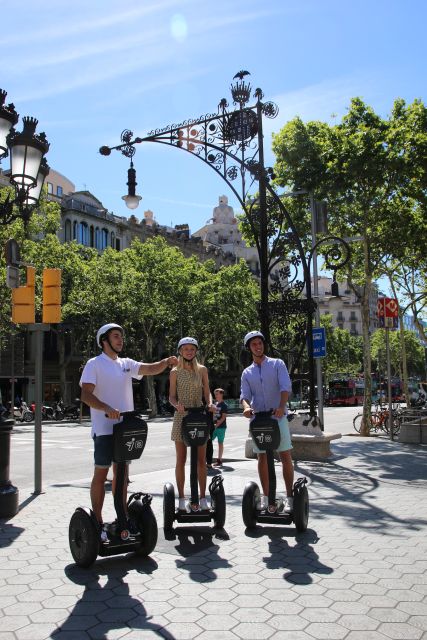
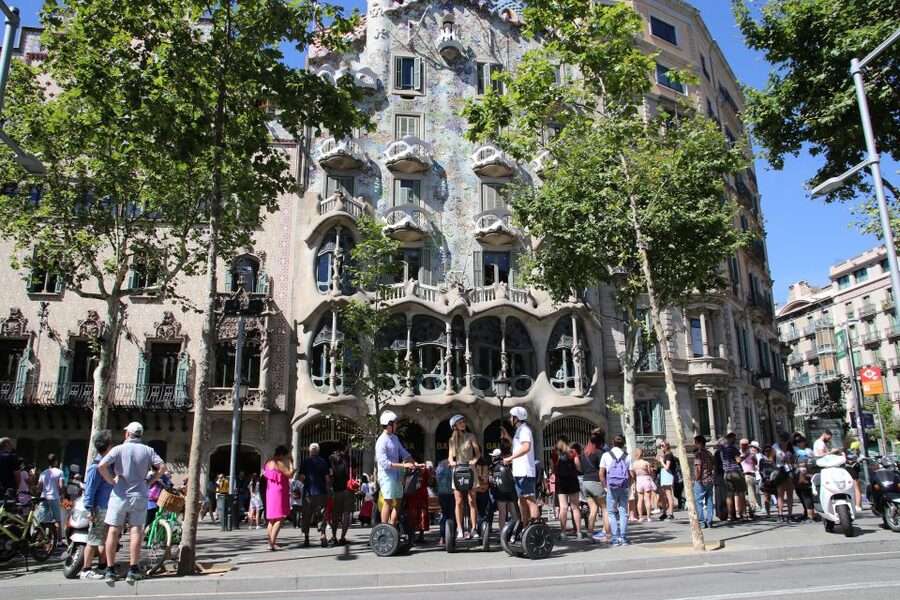
The route heads toward Passeig de Gràcia, Barcelona’s grand boulevard and the best part of the ride for comparing Modernisme façades. You pass some of the city’s most famous private residences, where architecture takes over the full front of each building.
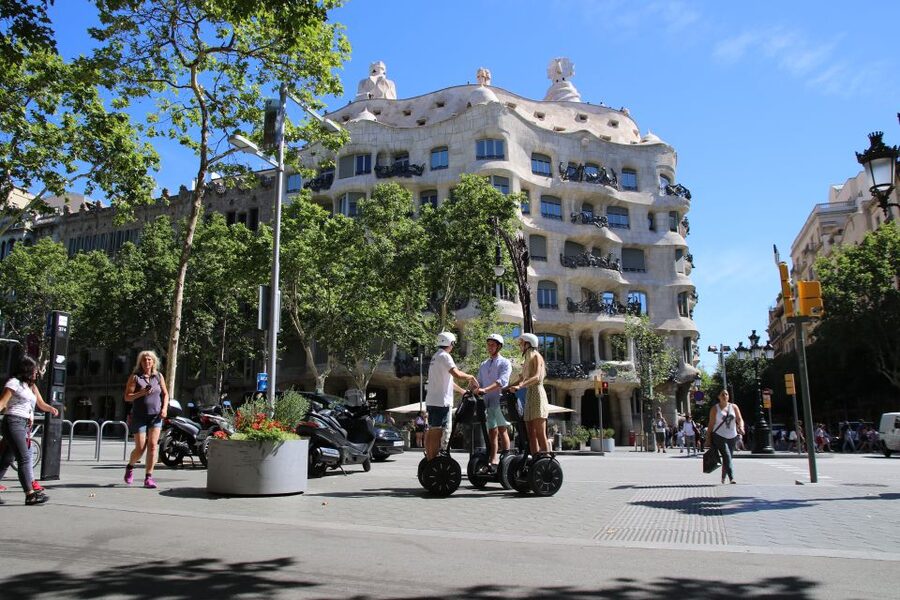
Casa Milà, better known as La Pedrera, is the first major stop in the listed route. Antoni Gaudí designed it as an apartment building, but its rolling stone façade and sculptural rooftop made it one of Barcelona’s most recognizable works.
You get about 10 minutes here for the guided visit and photographs. That is enough to hear why the building looks so unusual and to study the façade, but not enough for a full interior visit. If you want the rooftop, courtyard, or exhibition spaces, plan a separate visit.
Casa Batlló follows, also with about 10 minutes of riding and sightseeing around the building. Its curved balconies, colorful surface, and dragon-like roofline make it one of Gaudí’s most playful designs.
The short stop is useful for an overview, but the exterior deserves time. Your guide can point out details that are easy to miss from street level. You should not treat this portion as an entrance ticket. The tour takes you to the building and explains what you are seeing, but interior access is not included.
Casa Amatller and Casa de les Punxes widen the story
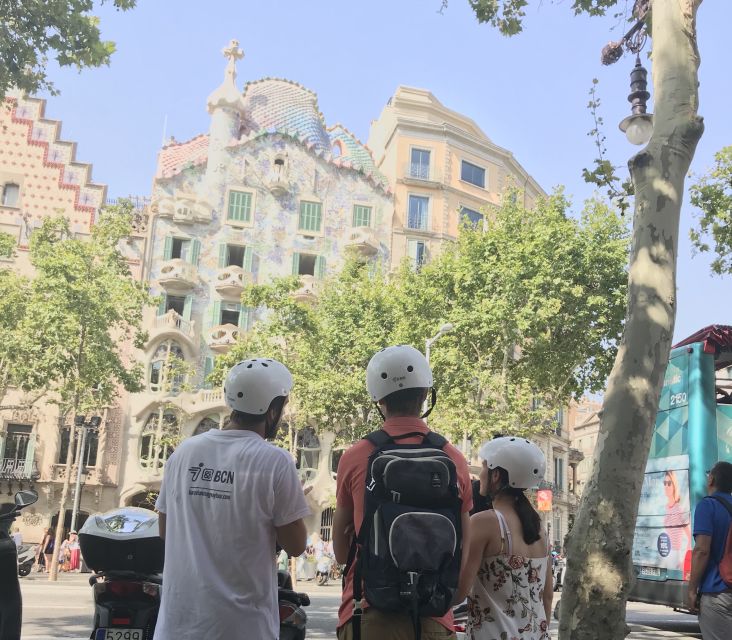
Gaudí gets most of the attention in Barcelona, but Catalan Modernisme was not the work of one architect. The route makes that clear with stops connected to Josep Puig i Cadafalch and Lluís Domènech i Montaner.
Casa Amatller sits beside Casa Batlló and adds a different architectural voice to the same boulevard. It was commissioned in 1898 by a wealthy chocolate maker, so you can read the building as both a family home and a public statement of success.
Look for the more geometric treatment and the distinctive roofline. It is easy to rush past while focusing on Casa Batlló, so having a guide explain the contrast gives this stop real value.
Casa de les Punxes offers another change in mood. Its pointed towers and medieval-looking details make it resemble a city palace or storybook castle. The name refers to the building’s points, and its silhouette is much easier to appreciate from the street than from a guidebook photograph.
These stops matter because they keep the tour from becoming a simple Gaudí checklist. You see how different architects interpreted the same period, the same city, and the same appetite for decorative buildings.
More Gaudi houses worth a ticket:
- Barcelona: Casa Batlló Entry with Self-Audioguide Tour
★ 4.7 · 25,359 reviews - Barcelona: Park Güell and Gaudí House Museum Entry Ticket
★ 4.5 · 6,326 reviews - Barcelona: La Pedrera Night Experience
★ 4.4 · 4,633 reviews - Barcelona: Palau de la Música Self-Guided Tour
★ 4.6 · 3,603 reviews
Sagrada Familia is the main event
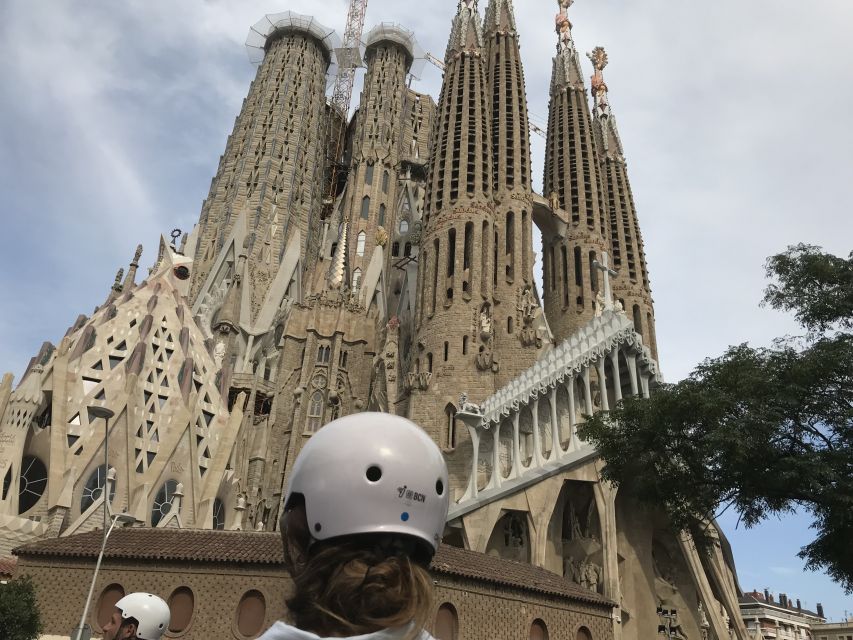
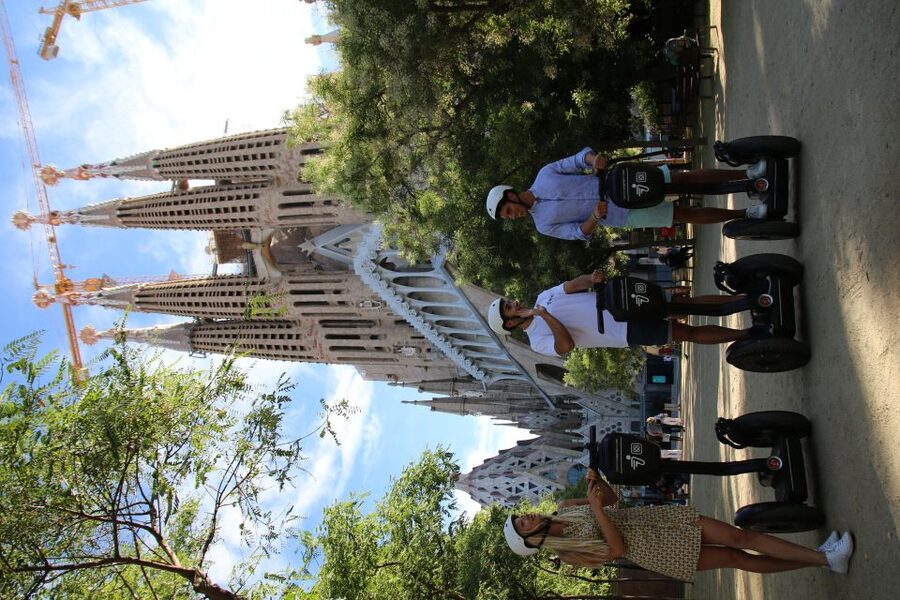
The ride continues toward the Sagrada Familia neighborhood, with roughly 15 minutes for sightseeing and free time. This is the tour’s biggest visual payoff.
Gaudí began work on the church in 1882, and construction continued long after his death. The building remains unfinished, which is part of its identity. From outside, you can compare the older Nativity façade with the later Passion façade and look up at the towers and dense sculptural work.
The tour does not include entry. That is important. Sagrada Familia requires more than a quick photo stop if you want to understand the interior, where the columns and colored light create a very different experience from the exterior.
Still, the stop gives you a useful first look and helps you decide if you want to return. If you already have an admission time, do not assume this tour will replace it. The group spends only a limited period in the neighborhood before continuing.
The guide can also help you read the building as more than an enormous church. You get context about Gaudí’s ideas, the long construction process, and the role of the basilica in modern Barcelona.
La Monumental adds a sharp piece of local history
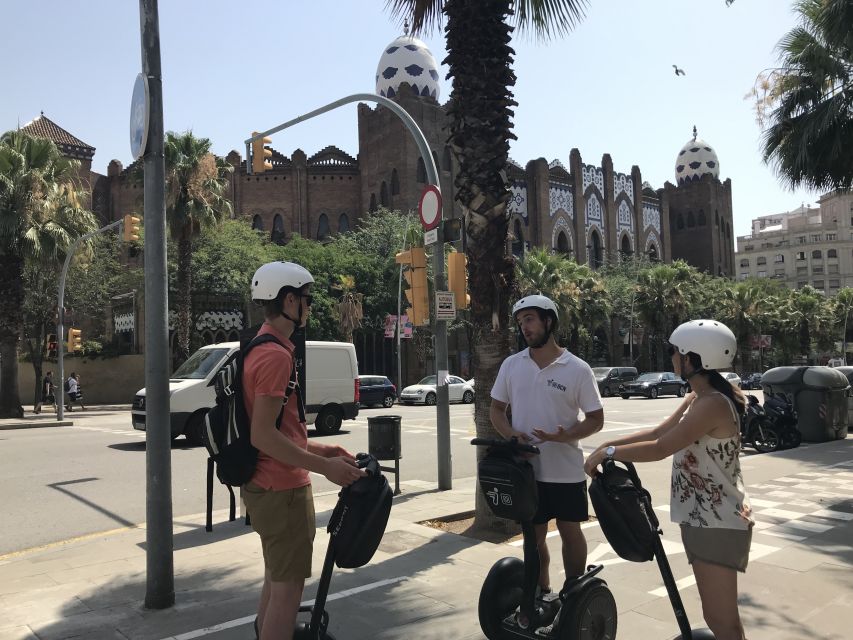
La Monumental is another photo stop along the route. This large bullfighting arena was the last place in Catalonia where bullfights were held before the regional parliament banned them.
The building gives you a chance to discuss a part of Barcelona’s past that is more complicated than its Gaudí image. It is also a reminder that public traditions change, and that the city’s architecture can carry political and cultural meaning.
You will not spend the tour inside the arena, and this is not a separate museum visit. Think of it as a brief stop with historical context and a chance to see another major structure from the street.
Gràcia feels different from central Barcelona
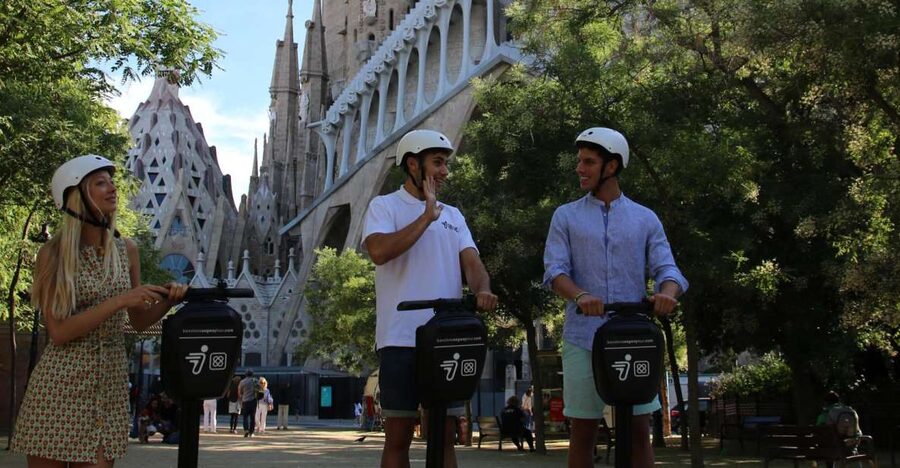
The tour then makes a quick escape into Gràcia, ending at Plaza de la Vila de Gràcia. This district began as a separate settlement in the 17th century and remained an independent municipality until Barcelona annexed it in 1897.
That background explains why Gràcia feels different from the broad avenues of Eixample. Its central square has a distinctive bell tower and the former town hall, La Casa de la Vila de Gràcia. Around it, smaller streets lead to local shops, restaurants, and small art galleries.
This is one of my favorite parts of the route because it gives you a glimpse of daily Barcelona beyond major monuments. The tour is still brief, so you do not get a long neighborhood walk or a full meal stop. But the square gives you a useful sense of how a former village became part of a major city while keeping its own character.
If you have spare time afterward, Gràcia is a good place to return on foot. The Segway tour helps you get oriented, then you can explore the narrow streets at a slower pace.
What the $42 price really covers
At $42 per person, the tour is priced as a city orientation experience rather than a collection of paid admissions. The fee includes the Segway i2, helmet, training, safety equipment, insurance, a guide, and one drink.
The value is strongest if you have only a short stay in Barcelona. You can see several major buildings in 2.5 hours, learn how they fit into the city, and mark places you want to revisit. One person specifically used the tour to cover more ground during a brief visit, which is exactly where the price makes sense.
The value is weaker if your main goal is entering the monuments. You will need to pay separately for Sagrada Familia, Casa Batlló, and Casa Milà, and each interior visit can take considerable time.
You also pay for the moving experience. If riding a Segway sounds fun, the transport is part of the appeal. If you prefer long explanations at each building, the short stops may feel rushed.
Who will enjoy this tour most
I would choose this for a first visit to Barcelona, especially if you want a clear overview before spending later days inside individual sights. It also works well for couples, families with older teenagers, and small groups that enjoy an active way to see a city.
The minimum age is 16 under local Segway regulations. Younger participants can join on high-end electric bicycles at discounted rates, but that arrangement should be confirmed when booking.
You need comfortable clothing and shoes. In winter, warm, water-resistant clothing and gloves are recommended. Pregnant women are advised not to take part, and the activity is not suitable for people with mobility impairments.
The tour requires a minimum height of 110 centimeters and a weight between 35 and 120 kilograms. You also need enough balance and leg movement to get on and off safely.
Guide quality makes the difference
The guide shapes this experience more than any single stop. Alex was praised for offering food suggestions and ideas for the next few days. Edwin was noted for keeping the group moving at a good pace while explaining the sights. Virginia combined Segway instruction with architecture and city history.
Stephan received particular praise for taking time to discuss each building, while Fabio handled a group of five friends with a mix of information and humor. Maria was singled out for cultural knowledge and careful attention to safety.
These details point to a useful strength: the tour can be adjusted slightly to the group’s pace and questions. Faster riders may cover a little more ground, while a guide can spend more time helping beginners feel comfortable.
The experience carries a 4.8 rating from 114 ratings, with strong praise for guide friendliness, safety instruction, and the amount of Barcelona covered in a short period. You should still remember that a Segway tour is an active outing, not a traditional walking lecture.
Should you book it?
Book this tour if you want to see Barcelona’s major Modernisme buildings from the outside, cover more ground than walking allows, and enjoy an activity that feels different from a standard sightseeing bus.
I would especially recommend it for a first or short visit. The combination of Sagrada Familia, Passeig de Gràcia, La Monumental, and Gràcia gives you a strong city introduction for $42.
Skip it if you want deep interior visits, dislike riding near city traffic, or have difficulty with balance, stairs, or knee movement. In that case, spend the same time on a walking tour and buy timed tickets for the buildings you most want to enter.
For everyone else, the best plan is to use this as an orientation. Ride, take notes, ask your guide for restaurant and neighborhood suggestions, then return to your favorite building on foot.
FAQ
Where does the Barcelona Gaudí Segway tour start?
Meet your guide at the activity provider’s office at Passeig de Lluís Companys 10. The route begins near Arc de Triomf.
How long does the tour last?
The tour lasts 2.5 hours.
What Barcelona districts does the tour visit?
The route focuses on Eixample and Vila de Gràcia. It also visits the Sagrada Familia neighborhood and begins near Arc de Triomf.
Does the tour enter Sagrada Familia?
No. The tour provides guided sightseeing, photographs, and free time around the Sagrada Familia neighborhood, but admission inside the basilica is not included.
Are Casa Batlló and Casa Milà included inside the ticket?
No. The tour stops outside Casa Batlló and Casa Milà for sightseeing and explanations. Interior admission is not listed as included.
What equipment is provided?
The activity includes a Segway i2, helmet, safety equipment, training, insurance, a guide, and one drink.
What is the minimum age?
Participants must be at least 16 years old under local Segway regulations. Younger participants may be able to join on high-end electric bicycles at discounted rates.
What languages are available?
Guides are available in Dutch, English, French, German, Italian, Portuguese, Russian, and Spanish.
How large are the groups?
Small groups have two to six people per guide. Larger groups are split among several guides for safety.
Can I cancel the booking?
You can cancel up to 24 hours before the activity for a full refund. Reserve now and pay later is also available.
Recently added around Barcelona
- Park Guell Guided Tour with Skip the Line Tickets★ 4.0 · 739 reviews
- Entrance to the Mirador Torre Glories Barcelona★ 4.5 · 193 reviews
- Bohemian Barcelona Neighborhood Evening Tapas & Wine Tour★ 5.0 · 419 reviews
- Transfers From Cruise Port to Barcelona Airport★ 4.5 · 155 reviews
- Authentic Flamenco Show Barcelona : Intimate Casa Sors Experience★ 5.0 · 809 reviews
- Barcelona Expert Tour with Local Guide in Eco Tuk Tuk Private★ 5.0 · 216 reviews
- Barcelona Sunset Cruise with Light Snacks and Open Bar★ 5.0 · 476 reviews
- Barcelona: Sagrada Familia, Park Guell & Tapas Private Tour★ 5.0 · 903 reviews
Gaudi Architecture Tours, compared.
Park Güell and Gaudí House Museum Entry Ticket
Read our review →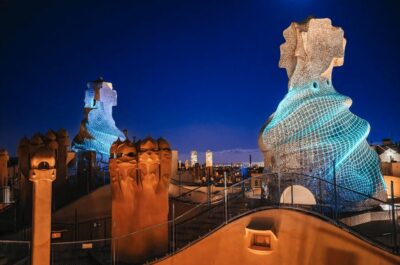

Gaudi’s Casa Vicens Skip-the-Line Entrance Ticket
Read our review →
Casa Batllo Admission Ticket with Intelligent Audio Guide
Read our review →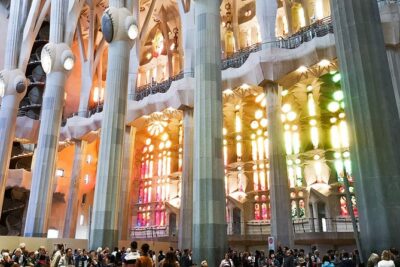
Sagrada Familia & Gaudi Tour Private or Small Group with Tickets
Read our review →Browse the lists this tour appears in