
Reviewed · TAPAS TOURS
Spanish Cooking Class Paella Tapas and Sangria in Madrid
Madrid’s best cooking lesson is the one that gets you away from watching and into the work. Here, you shop for ingredients in a local market on the morning class, then prepare paella, gazpacho, and sangria with an English-speaking chef. The evening class shifts to tapas, with dishes such as tortilla, garlic shrimp, chorizo in cider, patatas bravas, and crema Catalana.
I like the small maximum of 12 people, which leaves room for real help at the stove. I also like the useful market stop, where chefs such as Angel, Teresa, Elisa, and Eduardo explain Spanish ingredients before you cook them. The main thing to watch is the menu choice: the evening class is tapas, not a paella class, so read the option carefully before booking.
Key points at a glance
- Morning means paella and a market visit: Shop for fresh ingredients, then make paella, gazpacho, and sangria.
- Evening means a full tapas meal: Cook tortilla, garlic shrimp, chorizo in cider, patatas bravas, tomato bread with ham, crema Catalana, and sangria.
- You do the cooking: Ingredients are prepared for the class, but you still chop, stir, season, and take part in the recipes.
- The group stays small: Cooking Point limits the class to 12 people and pairs solo participants with a cooking buddy.
- The meal is part of the lesson: After cooking, you sit down with the group and eat what you made.
- The price covers more than food: At $102.79 per person, you also get a local guide, drinks, and a recipe booklet.
Choosing between the morning paella class and evening tapas
The first decision is simple, but important. Pick the morning paella class if paella is your main reason for booking. Pick the evening tapas class if you want a broad sampling of small Spanish dishes and a longer list of recipes to try at home.
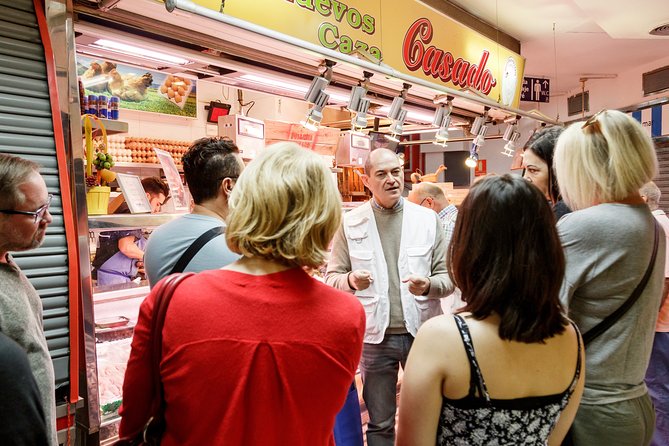
The morning option includes a visit to a local market before cooking. You shop for fresh ingredients as a group, and the chef explains how produce, seafood, and meat fit into everyday Spanish eating. This gives the class a useful local setting instead of beginning with a pile of ingredients already waiting on the counter.
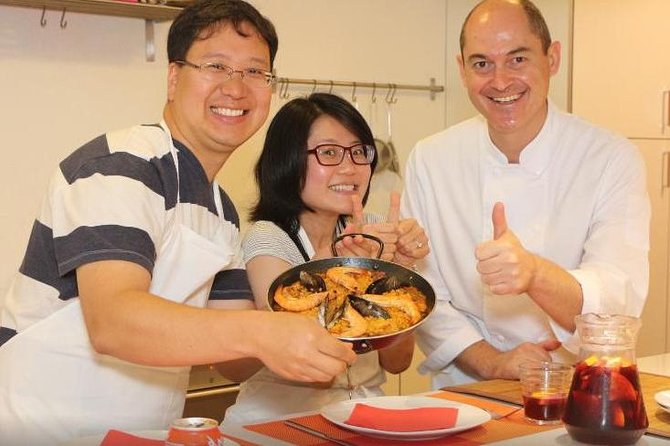
Once back in the cooking space, the menu includes paella and gazpacho, with sangria prepared as part of the meal. The exact ingredients can be adjusted for dietary needs, so you should give those details when booking. The result is a substantial lunch rather than a quick demonstration.
The evening menu is more varied. You may prepare Spanish potato omelet, garlic shrimp, chorizo in cider, patatas bravas, tomato bread with ham, crema Catalana, and sangria. That is a lot of food for one class, but the work is shared between pairs, and the chef guides the group through the steps.
There is one practical trap here. If you expect the tapas class to include paella too, you may be disappointed. The two formats are separate, so choose based on the menu rather than the broad title of the experience.
More Cooking Classes in Madrid
- Paella Cooking Class in Madrid with Bottomless Wine Pairing
★ 5.0 · 985 reviews - Madrid Tapas & Paella Cooking Experience with Local Market Visit
★ 5.0 · 432 reviews - Taste of Spain: Tapas Cooking Class with Bottomless Wine Pairing
★ 5.0 · 414 reviews
Meeting the chef at Cooking Point
The class begins at Cooking Point, at C. de Moratín, 11, in Madrid’s Centro district. The activity ends at the same place, and the meeting point is near public transportation. Hotel pickup and drop-off are not included, so you need to make your own way there.
The class is offered in English, a useful feature when cooking terms and timing matter. The named instructors include Angel, Teresa, Elisa, and Eduardo. Each brings a slightly different style, but the strongest pattern is clear: expect active guidance, humor, cultural explanation, and patience when a recipe needs correcting.
Angel is described as especially engaging during the market visit and paella preparation. Teresa brings energy and clear instruction, with a good balance between helping and letting you work. Elisa is noted for her humor and friendly manner, while Eduardo is praised for giving people room to create rather than taking over.
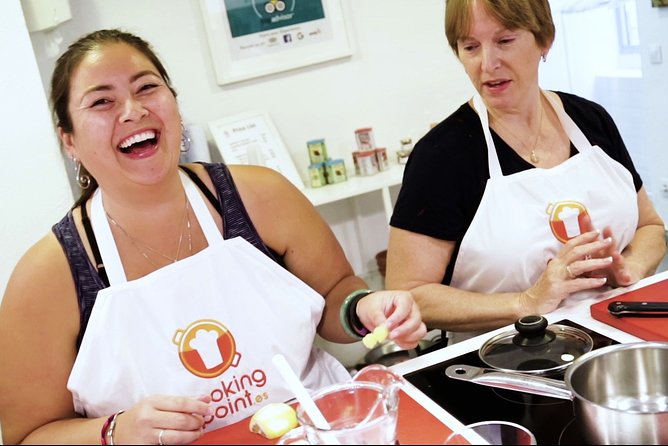
That last point matters. Many cooking demonstrations leave you holding a glass while the chef does the real work. This class is designed differently. The preparation is organized in advance, but you still handle the cooking. You can ask questions, make mistakes, and learn why a dish is treated in a certain way.
The morning market visit and fresh ingredients
The market stop is the most distinctive part of the morning class. You walk there as a group, then look at the ingredients needed for the meal. The chef explains Spanish produce, seafood, and meat, along with the way local people shop and eat.
This is not just a shopping errand. It gives you a better sense of what goes into Spanish food before you try to reproduce it. You see the raw ingredients in context, then return to the kitchen and use them.
The market visit is also useful if you are staying nearby. It helps you understand the neighborhood and gives you a place to return to for ingredients or a quick look around during the rest of your Madrid stay.
The exact length and pace of the market portion are not specified, so do not treat it as a separate guided market tour. Its purpose is to prepare you for the cooking class, not to cover every stall or market in Madrid.
Cooking paella, gazpacho, and sangria
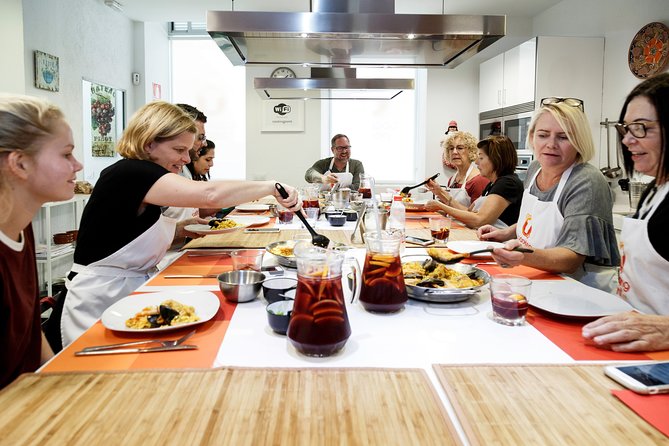
The paella class gives you a clear progression from fresh ingredients to a shared Spanish meal. You start with the market, then work in pairs under the chef’s direction. You prepare the ingredients, follow the cooking stages, and learn about different types of paella and where the dish fits into Spanish food culture.
Paella rewards attention. Timing, heat, and the order of ingredients matter, which makes it a good dish for a hands-on lesson. You may leave feeling that you can attempt it at home, though you should expect the recipe to need practice in your own kitchen.
Gazpacho adds a cooler, simpler contrast to the paella. It is also one of the more practical recipes to recreate at home. Sangria rounds out the class and gives the meal a social feel, especially when you sit down with the other pairs after cooking.
The food is plentiful. Several people have found they had enough left over to take home, though the supplied details do not promise takeaway portions. Plan to arrive hungry and avoid scheduling a heavy meal immediately afterward.
More Paella Classes in Madrid
- Madrid: Paella and Sangria Workshop in the City Center
★ 4.9 · 1,264 reviews - Madrid: Paella and Sangria Workshop with Tapas
★ 4.9 · 128 reviews
Making an evening meal from Spanish tapas
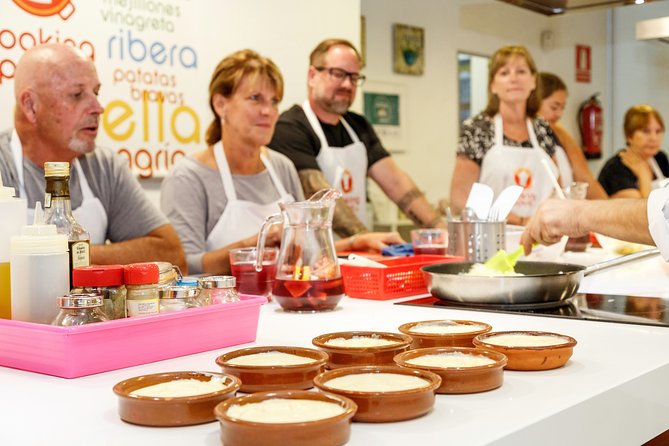
The evening class is a good choice if you want variety. Instead of putting most of the focus on one large dish, you move through several familiar tapas and finish with dessert.
The Spanish potato omelet teaches a basic dish with wide appeal. Garlic shrimp and chorizo in cider bring stronger flavors, while patatas bravas offers the familiar combination of potatoes and sauce. Tomato bread with ham keeps the spread simple, and crema Catalana adds a sweet finish.
Because the menu is shared across pairs, you may not personally handle every dish from start to finish. Still, the class format gives you more than a chef’s demonstration. You work through the recipes with direction, then taste the whole meal together.
This option suits a group with mixed tastes. One person may prefer shrimp, another the potato omelet, and someone else may be most interested in dessert. It also gives you several recipes to carry home instead of one centerpiece dish.
Again, check the selected class carefully. The tapas session and paella session are different products. If you want both, the supplied information does not indicate that one booking includes both menus.
What the small-group format really adds
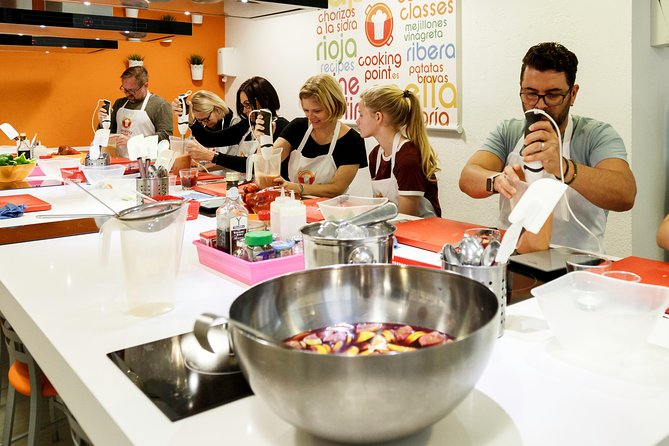
The maximum group size is 12, with participants working in pairs. If you arrive alone, the organizer will match you with a cooking partner. That makes the class workable for couples, families, and solo visitors.
A small group also affects the teaching. The chef can move between workstations, answer questions, and notice when someone needs help. You are less likely to be lost in the back of a large demonstration.
The class is family-friendly, and children can take part. One six-year-old was included successfully in an evening class, but the information does not set a minimum child age. If you are booking with young children, it is sensible to ask the operator about the specific session.
The social side is part of the appeal. After the cooking, everyone sits down to share the meal and talk about food, travel, and Madrid. This can be a pleasant way to meet people, but it also means the experience is not a private lesson. If you want one-on-one instruction, this is not the right format.
Dietary needs, drinks, and the final meal
Cooking Point says it can accommodate dietary requirements, and you should report allergies or other needs when booking. That is a strong practical advantage, but you should still explain the restrictions clearly rather than assuming the kitchen will know them.
The class includes drinks, including sangria. The minimum drinking age is 18. Since sangria is part of both sample menus, guests who do not drink should state that in advance and ask what alternatives are available. The supplied details confirm dietary accommodation, but they do not specify nonalcoholic drink choices.
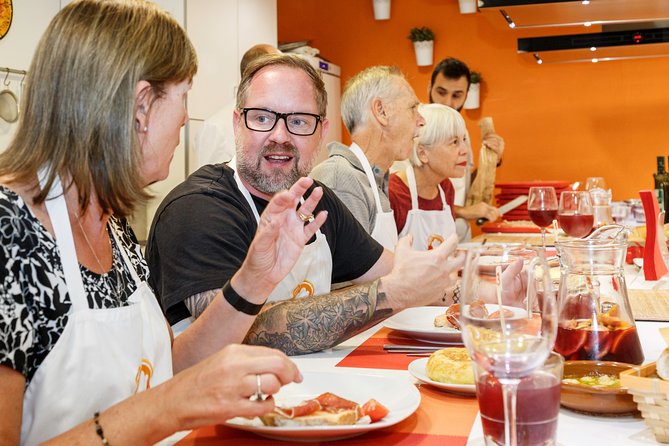
At the end, you eat together at the cooking point. The meal is not an afterthought. It lets you compare the results of your work and see how the separate dishes fit into a Spanish-style spread.
You also receive a recipe booklet with the dishes prepared in class. This adds real value. A cooking class is much more useful if you can remember the method after returning home, particularly for paella, gazpacho, sangria, or crema Catalana.
Is $102.79 a fair price?
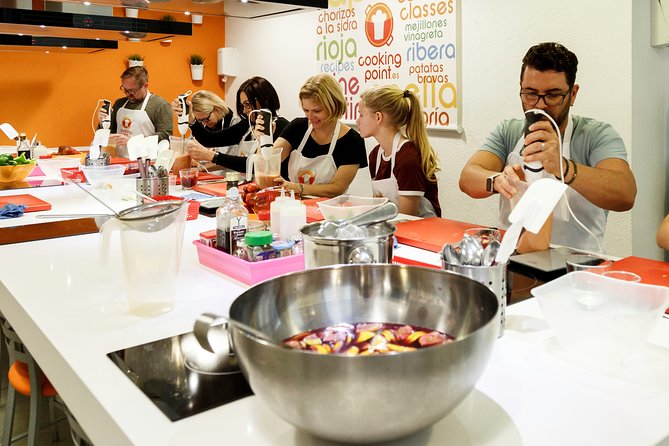
At $102.79 per person, this is not a cheap meal. It is fair value if you treat it as a four-hour activity, cooking lesson, guided food experience, drinks, and lunch or dinner in one package.
The price includes the cooking class, local guide, drinks, and recipe booklet. The morning option also includes the market visit. Hotel transportation is not included, but the central meeting point and nearby public transport keep that extra cost manageable.
I would compare this with the price of a good meal in Madrid plus a separate cooking lesson. You are paying for instruction and participation, not just for food. The value is strongest if you want to learn techniques and recreate the dishes later.
It is less useful for someone who only wants to eat paella or tapas. Madrid has many restaurants for that. Book this if the process matters to you, especially if you enjoy cooking with other people.
Timing, booking, and cancellation
The experience lasts about four hours, with a choice of morning or evening scheduling. The morning session works well as a substantial lunch, while the evening version fits better as a social dinner activity.
This is a popular experience, so advance planning is sensible. It is booked an average of 37 days ahead. That does not guarantee that every date requires a month of planning, but it does suggest that popular times can fill early.
You receive confirmation at booking unless you reserve within one day of departure. In that case, confirmation arrives as soon as possible and depends on availability.
Free cancellation is available up to 24 hours before the start time for a full refund. Cancellations or changes inside that 24-hour window are not accepted for a refund. The cut-off uses Madrid local time, so check the time carefully if you are booking from another time zone.
Who should book this Madrid cooking class?
I would recommend the morning paella class to anyone who wants a practical introduction to Spanish cooking and values the market visit. It is especially suited to couples, families, and solo participants who like learning by doing.
Choose the evening tapas class if you prefer small dishes, a wider range of recipes, and a relaxed meal with drinks. It is also a good fit if paella is not your priority.
This is not ideal for a rushed schedule. Four hours is a meaningful block of a Madrid day, and you should allow extra time to reach C. de Moratín, 11. It is also not the best choice if you dislike shared activities, pairing with another person, or eating with a group.
The strongest reasons to book are the hands-on format, small group, market visit, and recipe booklet. The main reason to pause is the price, followed by the need to select the right menu. Get those two points right, and this is a useful way to turn Spanish food from something you order into something you understand.
FAQ
Where does the cooking class begin?
It begins at Cooking Point, C. de Moratín, 11, Centro, 28014 Madrid, Spain.
Where does the activity end?
The class ends back at the meeting point at Cooking Point.
How long does the class last?
The experience lasts approximately four hours.
Is the class offered in English?
Yes. The class is offered in English with a local English-speaking chef.
How many people can join?
The class has a maximum of 12 participants.
What does the morning class include?
The morning class includes a local market visit, paella, gazpacho, and sangria as the sample menu.
What does the evening class include?
The sample evening menu includes Spanish potato omelet, garlic shrimp, chorizo in cider, patatas bravas, tomato bread with ham, crema Catalana, and sangria.
Can the class accommodate dietary requirements?
Yes. You should provide your dietary requirements when booking.
Is there a minimum drinking age?
Yes. The minimum drinking age is 18.
Is hotel pickup included?
No. Hotel pickup and drop-off are not included.
What is included in the price?
The price includes the cooking class, drinks, a local guide, and a recipe booklet.
Can I cancel for a full refund?
Yes. You can cancel at least 24 hours before the start time for a full refund. Changes or cancellations made less than 24 hours before the experience are not accepted for a refund.
More Tapas Tours in Madrid
- Madrid: Small Group of Prado Museum Tour & Optional Tapas
★ 4.6 · 2,437 reviews - Madrid: Tapas & Wine Tasting Tour with Local Guide
★ 4.8 · 2,171 reviews - Madrid Tapas & Wine Tour with Rooftop Views and Local Guide
★ 5.0 · 2,047 reviews - Madrid by Night Small Group Tour: Stories, Sights and Tapas Bites
★ 5.0 · 1,956 reviews
Recently added around Madrid
- Tour Madrid: Secrets in a Electric Tuk Tuk★ 4.6 · 155 reviews
- Madrid: Tasty Tapas Tour & Visit to a Terrace with Views★ 4.5 · 118 reviews
- Madrid: Flamenco Show&Drink at Tablao 1911 (World’s Oldest)★ 4.7 · 253 reviews
- Small Group Prado Museum Guided Tour with Skip the Line★ 4.2 · 106 reviews
- Madrid: Street Art Tour with Local Graffiti Hunter★ 4.8 · 270 reviews
- Madrid: Afternoon Prado Museum Tour with Skip-the-Line Entry★ 4.4 · 491 reviews
- Madrid: Royal Palace Guided Tour with Skip-the-Line Entry★ 4.5 · 780 reviews
- Secret Food Tours Madrid★ 4.9 · 134 reviews
Tapas Tours, compared.
Montserrat & Cogwheel Train, Gourmet Wine Tasting & Tapas/Lunch
Read our review →
Barcelona Tapas and Wine Experience Small-Group Walking Tour
Read our review →
Montserrat with Black Madonna & Medieval Winery with Tapas/Lunch
Read our review →
Montserrat and Winery Tour with Tapas or Lunch
Read our review →
Tapas Walking Tour with Food, Wine, and History
Read our review →
Sevilla Food Tour: Tapas, Wine, History & Traditions
Read our review →
Valencia Old Town Tour with Wine & Tapas in 11th Century Historic Monument
Read our review →
Sunset or Day Catamaran Cruise with Tapa & Drink
Read our review →Browse the lists this tour appears in