
Reviewed · HOP-ON HOP-OFF BUS TOURS
Barcelona: Hop-On Hop-Off Bus & Aquarium Tour
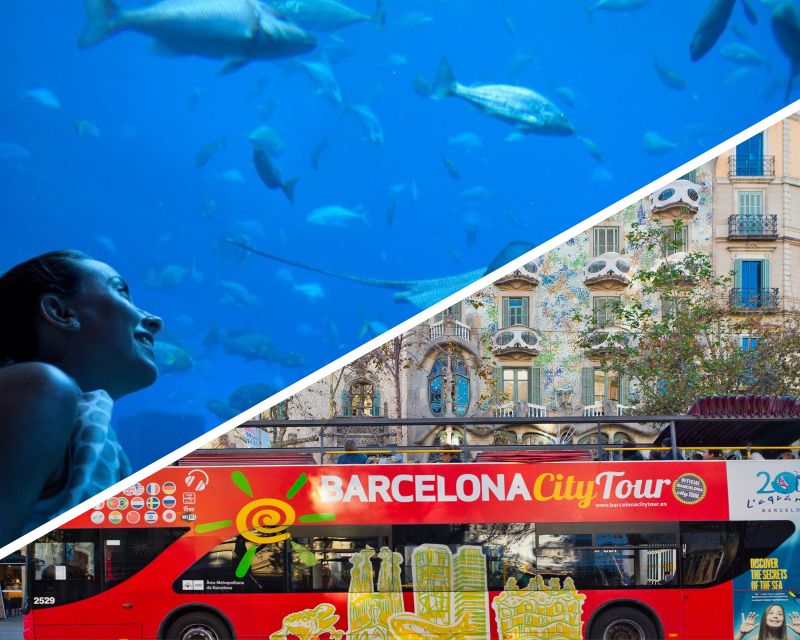
Barcelona’s best feature here is the combination of city views and sea life. You can ride both sightseeing routes, get off near major sights, then visit the Barcelona Aquarium when it fits your day. The bus gives you a quick sense of the city’s shape, while the aquarium provides a calm indoor break.
I like the two-route coverage, which reaches Montjuïc, the Gothic waterfront, Gaudí’s major works, Camp Nou, and the northern coast. I also like the aquarium’s focus on Mediterranean species, especially the long acrylic tunnel through the Oceanarium, where sharks pass overhead.
The main drawback is practical: finding the correct bus stop after getting off can be confusing. Stop signs are not always easy to spot, so keep the route guide with you and confirm the stop before leaving the bus. At $73 per person, this works best if you use the bus often and make full use of the aquarium ticket.
Key points to know before you go

- Two complete routes on one ticket: The orange West route and green East route each take about two hours if you stay aboard.
- Major Gaudí stops included: You can reach Sagrada Familia, Park Güell, La Pedrera, and Casa Batlló without arranging separate city transport.
- One aquarium visit included: Your admission is valid once, so plan it for the part of your day when you want a break from sightseeing.
- Service runs roughly from 9:00 AM to 7:00 PM: Buses generally arrive about every 30 minutes, though seasonal frequency can range from 5 to 30 minutes.
- The bus is a sightseeing tool, not a private transfer: You must reach a stop yourself, and pickup or hotel drop-off is not included.
How the Barcelona bus and aquarium combination works

You can begin at Plaça Catalunya, the main stop, or board at any Barcelona City Tour stop. Your pass lasts for one or two consecutive days, depending on the option you choose, and it covers both routes.
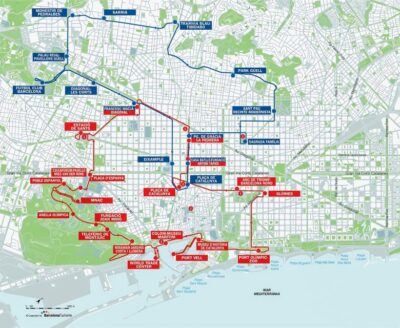
The two circuits make a rough loop through central Barcelona, Montjuïc, the waterfront, the northern neighborhoods, and the city’s best-known modernist buildings. Each route takes around two hours without getting off. That matters because a full circuit is a useful orientation ride, but it is too long to treat as simple transportation between every stop.
Buses generally operate from 9:00 AM until around 7:00 PM, with the last return at about that time. Frequency varies by season. Around 30 minutes is a reasonable working estimate, but the stated range is 5 to 30 minutes, so you should not plan a tight connection to a timed attraction.
The multilingual audio guide is included. It is available in English, Catalan, Spanish, French, German, Russian, Portuguese, Chinese, Japanese, Dutch, Hebrew, Italian, Arabic, Swedish, Norwegian, and Turkish. The audio system also includes a multilingual looping system adapted for people with auditory disabilities.
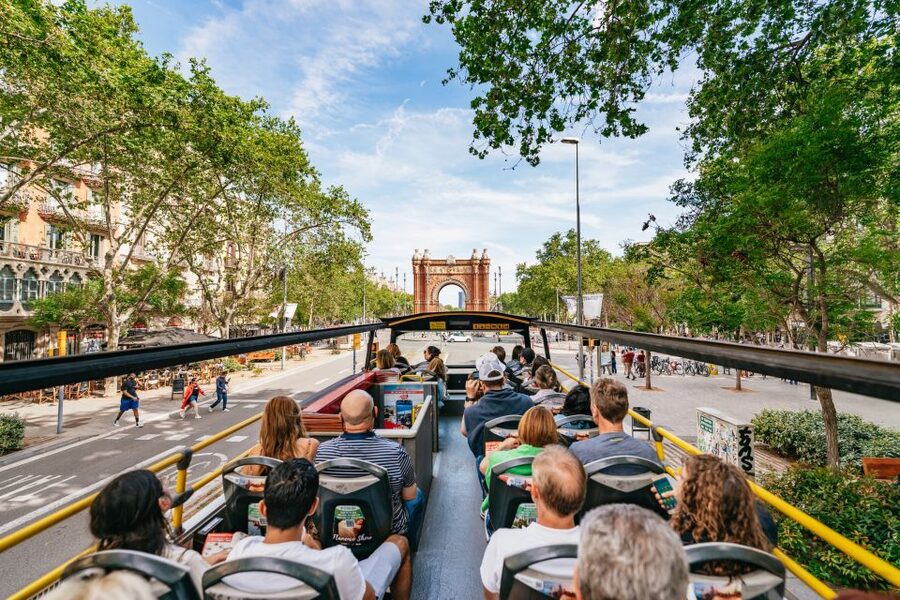
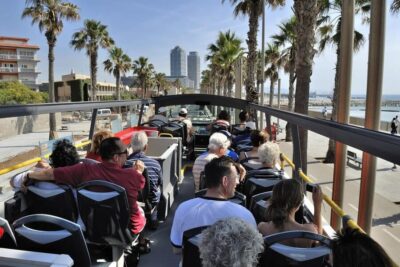
The vehicles are air-conditioned double-decker coaches with open sections. For the best sightseeing, sit upstairs when the weather is comfortable. If the sun is strong or the air turns chilly, the lower level gives you a more sheltered ride.
More Hop-On Hop-Off Buses in Barcelona
- Barcelona: 24 or 48-Hour Hop-On Hop-Off Bus Tour
★ 4.4 · 20,872 reviews - Barcelona: City Sightseeing Hop-On Hop-Off Bus Tour
★ 4.4 · 10,061 reviews - City Sightseeing Barcelona Hop-On Hop-Off Bus Tour: 24 or 48-Hour
★ 4.0 · 5,250 reviews
Orange West route: Montjuïc, museums, and Camp Nou
The orange route is the better choice for Barcelona’s hilltop sights, major museums, the stadium district, and the western part of the city. It also reaches the Sagrada Familia before continuing toward the coast.
World Trade Center to Plaça de Colom
The route begins around the port at the World Trade Center, then passes Jardins de Miramar and the Fundació Joan Miró. This opening section introduces Barcelona as a port city before climbing toward Montjuïc.
Jardins de Miramar offers a useful stop if you want broad views over the harbor. The Fundació Joan Miró is the natural choice for modern art, while the nearby Anella Olímpica brings you to the Olympic area.
Anella Olímpica, MNAC, and Poble Espanyol
The Anella Olímpica and Museu Nacional d’Art de Catalunya, usually called MNAC, are among the most worthwhile stops on this route. MNAC is set high on Montjuïc, and its position gives you a strong city view as well as access to its art collection.
Poble Espanyol is a purpose-built complex of recreated Spanish architectural styles, with shops, food, and cultural displays. It is easy to spend more time here than expected, so do not combine it with too many other stops if you have only one day.
Caixafòrum and the nearby Mies van der Rohe Pavilion suit visitors interested in architecture and design. The pavilion is known for its clean modern lines, making it a sharp contrast to Barcelona’s ornate modernist buildings.
More aquariums in Barcelona:
- Barcelona Aquarium: Entry Ticket
★ 4.3 · 13,335 reviews - Barcelona Aquarium Skip the Line Ticket
★ 4.0 · 109 reviews - Mallorca: Palma Aquarium Entry Ticket w/ Optional 3D Cinema
★ 4.5 · 2,280 reviews - Seville Aquarium Admission Ticket
★ 4.6 · 1,947 reviews
Plaça d’Espanya and Estació de Sants
Plaça d’Espanya is one of the city’s major junctions and a practical place to pause before continuing. It connects the Montjuïc sights with the broad avenues leading into central Barcelona.
Estació de Sants is primarily a transport hub rather than a sightseeing stop. It can still be useful if you are combining the bus with rail travel or need to rejoin the route from the western side of the center.
Camp Nou and Diagonal
The Camp Nou stop serves the FC Barcelona stadium and museum. The included bus ticket does not include stadium admission, so treat this as a convenient drop-off rather than a complete football visit.
The route then reaches Plaça Pius XII, L’Illa Diagonal, and Avinguda Diagonal. This part of the ride shows a more modern commercial side of Barcelona, with wide avenues and large shopping areas rather than the narrow streets of the old center.
La Pedrera, Sagrada Familia, and Estació del Nord
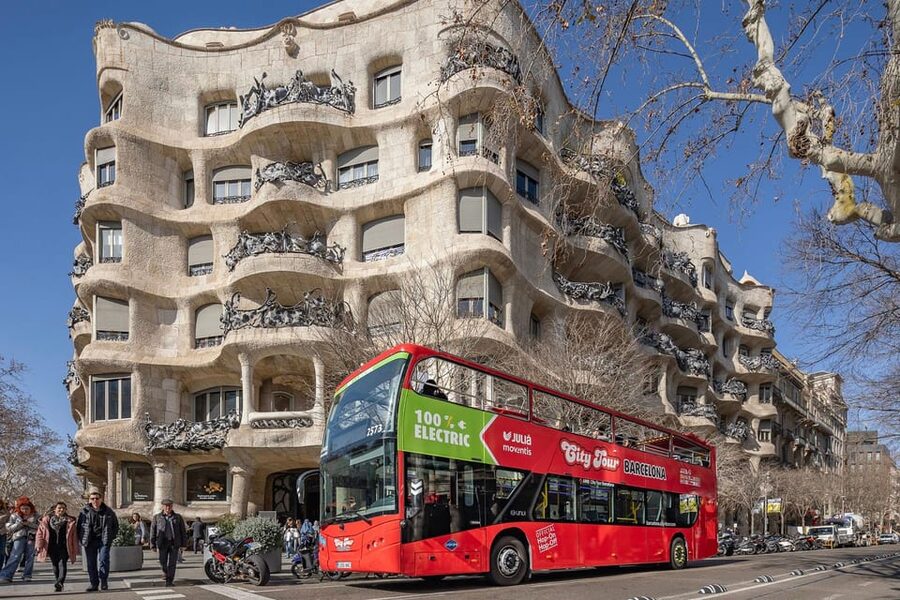
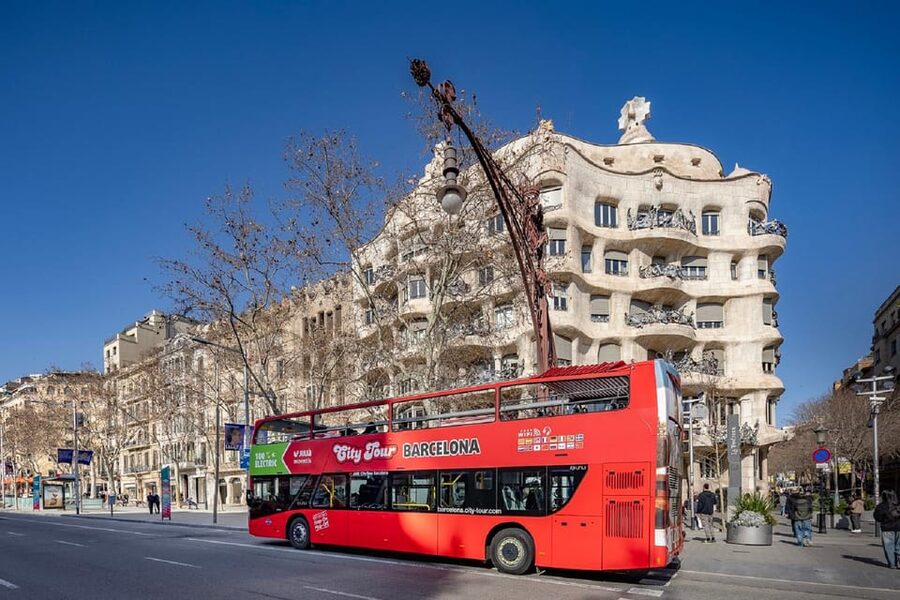
La Pedrera, also called Casa Milà, is one of Antoni Gaudí’s best-known apartment buildings. The undulating stone facade and sculptural roof make the stop worthwhile even if you do not enter.
Sagrada Familia is the route’s biggest attraction. The bus stop is especially useful because it links the two routes. Orange-route passengers can connect toward Park Güell without riding all the way to Port Olímpic, while green-route passengers can reach Sagrada Familia without taking the full route toward La Pedrera.
You should still arrange any separate attraction admission in advance if you want to go inside. This combination ticket covers the bus and aquarium, not entry to Gaudí’s buildings.
Estació del Nord is close to the Arc de Triomf and the eastern side of the city center. It can be a convenient point for changing your sightseeing plan, though stop markings may not be obvious once you have left the bus.
Zoo, Port Olímpic, and Passeig de Colom
The orange route continues past the Zoo and Poblenou to Port Olímpic, then Pla de Palau and Passeig de Colom. These stops bring you back toward the waterfront.
Port Olímpic works well as a lunch or promenade break, though food is not included in the ticket. Passeig de Colom is a useful base for exploring the port, the lower end of La Rambla, and the old harbor area before returning to the bus.
Green East route: beaches, Gaudí, and the old city

The green route focuses on the seafront, Poblenou, modern architecture, Park Güell, and central Barcelona. If your main interests are Gaudí and the coast, this is the route you will probably use most.
Pla de Palau and Barceloneta
Pla de Palau and Barceloneta put you close to the old port and the city’s traditional waterfront district. Barceloneta is the natural stop for a walk toward the beach, though the ticket does not include food, drinks, or any beach service.
The route continues to Port Olímpic, Platja del Bogatell, and Nova Mar Bella. These stops give you access to several stretches of Barcelona’s coast, with a less central feel than the port near La Rambla.
Fòrum and Torre Glòries
Fòrum marks the northern end of the coastal section. It is a modern part of the city and can feel quite different from the Gothic center or Gaudí’s residential buildings.
Torre Glòries is one of Barcelona’s most recognizable modern towers. From the bus, you get a useful view of how the newer districts fit around the older center. It is a good stop for architecture fans, but it may not be a priority if your time is limited to one day.
Recinte Modernista de Sant Pau and Park Güell
The Recinte Modernista de Sant Pau is a major modernist complex, and its stop is a good alternative to the better-known Gaudí sites. Its decorative facades and hospital buildings show how broad Barcelona’s modernist movement was.
Park Güell is one of the route’s key stops. It is located uphill, so plan extra time and energy for the visit. The route guide is particularly useful here because the bus can connect Park Güell with the Sagrada Familia through the designated route links.
The bus ticket does not include entry to Park Güell. You can still use the stop for the park area, but any admission requirement remains separate.
La Pedrera and Casa Batlló
The green route then reaches La Pedrera and Casa Batlló. These are two of the clearest examples of Gaudí’s imaginative residential architecture.
Casa Batlló is near Plaça Catalunya and Passeig de Gràcia, making it easy to combine with central shopping streets and a walk through the Eixample district. La Pedrera is nearby, so you can compare the two buildings in one outing if you have separate admission.
This is one place where the bus is most useful as a sightseeing frame. You can see the buildings, hear background commentary, and decide which interiors deserve your time and entrance fee.
Plaça Catalunya, Arc de Triomf, and El Born
Plaça Catalunya is the main starting point and the easiest place to get your bearings. It links the old city with the Eixample and is a practical place to begin or finish the ride.
Arc de Triomf leads toward the El Born district and Parc de la Ciutadella. El Born offers a more intimate walking area than the broad avenues around Plaça Catalunya, while the park gives you room to slow down after a day on the bus.
The route uses a connection system around this section. Green-route passengers can reach Sagrada Familia without taking the full route to La Pedrera, using the designated connection. Pay attention to the route color and destination on the bus before boarding.
Inside Barcelona Aquarium
The aquarium ticket is valid for one use only, so do not activate it casually if you have a packed schedule. The aquarium is beside the waterfront and fits naturally with the Port Vell, Barceloneta, World Trade Center, and Passeig de Colom parts of the bus routes.
Its focus is the Mediterranean. You will see species arranged around different marine communities, with information about the traits of animals living in each habitat. Two areas draw special attention to protected parts of Spain’s coast: the Ebro Delta and the Medes Islands.
The main attraction is the Oceanarium. Its acrylic tunnel runs through the tank, giving you the feeling of moving beneath the water while sharks pass around and above you. This is the part most likely to hold a child’s attention, but it also gives adults a clear look at the scale of the habitat.
The aquarium is a smart rainy-day or hot-afternoon choice because it provides an indoor change of pace. It also breaks up a long day of bus riding. I would pair it with a waterfront walk rather than trying to squeeze it between two distant inland stops.
The aquarium is not a guided tour, and no meal or drink is included. You control the pace inside, which makes the single-use ticket easier to fit around the bus schedule.
Is the $73 price good value?

At $73 per person, the package is not an automatic bargain. Its value depends on how much of the bus service you use and whether you already planned to visit the aquarium.
For one day, you need to ride enough of both routes to justify paying for the convenience. A single full circuit on each route gives you roughly four hours of city sightseeing, though staying seated that long leaves little time for major attractions. Add the aquarium and a few carefully chosen stops, and the price becomes easier to defend.
The 48-hour option offers better practical value if you want to visit several places without rushing. You can use one day for Montjuïc, MNAC, Poble Espanyol, and Camp Nou, then use the other for Park Güell, Sagrada Familia, the coast, and the central Gaudí buildings.
The bus also saves you from piecing together separate transport across Barcelona. That convenience matters most on a first visit, with children, or when you want broad city views without walking between every district.
It is weaker value if you plan to spend most of your time inside ticketed attractions or exploring one compact neighborhood on foot. It is also less useful if you need early morning or late evening transport, since the stated operating window ends around 7:00 PM.
Small practical details that affect your day
Start at Plaça Catalunya if you want the clearest introduction to the routes. If you are already near another stop, you can board there, but confirm the route color and direction before you get off.
Keep the stop guide with you. A Portuguese booking note specifically pointed to poor stop signage after getting off, and that is a fair warning for anyone unfamiliar with the city. Take a quick look around before leaving the bus so you can identify the return stop.
Do not build a rigid timetable around the bus. Service can vary by season from about 5 to 30 minutes, and city events, demonstrations, sports, or cultural events can alter the route.
The discount booklet may reduce the cost of other city activities, but the available discounts are not specified here, so I would treat them as a possible bonus rather than part of your main calculation.
Free cancellation is available up to 24 hours before the activity, and you can reserve now and pay later. Those terms are useful if your Barcelona schedule is still shifting.
Who should book this combination?
I would recommend it for a first visit when you want to see Barcelona’s major districts quickly. It suits families and visitors who prefer a seated overview before choosing which buildings, museums, beaches, or parks deserve a longer visit.
It also works well for a two-day stay because the 48-hour pass lets you split the city into manageable sections. The aquarium adds a clear indoor activity that does not require another transport arrangement.
I would be more cautious if you are a confident walker who plans to stay around the Gothic Quarter, El Born, and central Eixample. In that case, the bus may spend too much of your budget on routes you will not use.
Should you book it?
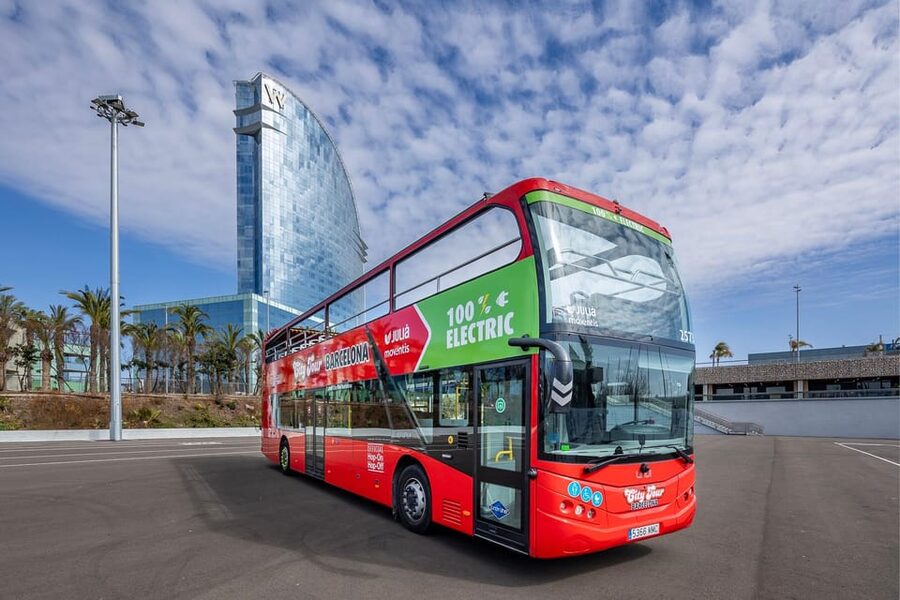
Book this tour if you want broad coverage, simple sightseeing, and a single aquarium visit folded into your transport plan. Use the bus for orientation and long cross-city journeys, not as your only way to move between nearby sights.
Choose the 48-hour option if your schedule allows it and you want Montjuïc, Gaudí’s buildings, Park Güell, the waterfront, and the aquarium without racing the clock. Choose one day only if you are ready to plan a tight route and make several stops.
The strongest reason to book is the mix of two full city circuits and the Mediterranean aquarium. The strongest reason to skip it is the price if you will ride only once or twice. Keep the stop guide handy, allow for changing bus intervals, and this can be a useful first look at Barcelona.
FAQ

Where can I start the Barcelona City Tour bus?
You can start at Plaça Catalunya, the main stop, or board at any stop served by the Barcelona City Tour.
How long is the bus ticket valid?
The ticket is valid for one or two consecutive days, depending on the option selected.
Does one ticket cover both bus routes?
Yes. The same ticket covers all stops on both the orange West route and green East route.
How often do the buses run?
Buses operate approximately every 30 minutes in the stated operating period, though frequency can vary by season from about 5 to 30 minutes.
What time does the bus operate?
Barcelona City Tour operates from about 9:00 AM, with the last return around 7:00 PM.
Is Barcelona Aquarium included?
Yes. Aquarium admission is included, but the ticket is valid for one visit only.
Does the ticket include Park Güell or Sagrada Familia admission?
No. The bus stops near these attractions, but admission to Park Güell and Sagrada Familia is not included.
What languages are available for the audio guide?
Audio commentary is available in English, Catalan, Spanish, French, German, Russian, Portuguese, Chinese, Japanese, Dutch, Hebrew, Italian, Arabic, Swedish, Norwegian, and Turkish.
Recently added around Barcelona
- Park Guell Guided Tour with Skip the Line Tickets★ 4.0 · 739 reviews
- Entrance to the Mirador Torre Glories Barcelona★ 4.5 · 193 reviews
- Bohemian Barcelona Neighborhood Evening Tapas & Wine Tour★ 5.0 · 419 reviews
- Transfers From Cruise Port to Barcelona Airport★ 4.5 · 155 reviews
- Authentic Flamenco Show Barcelona : Intimate Casa Sors Experience★ 5.0 · 809 reviews
- Barcelona Expert Tour with Local Guide in Eco Tuk Tuk Private★ 5.0 · 216 reviews
- Barcelona Sunset Cruise with Light Snacks and Open Bar★ 5.0 · 476 reviews
- Barcelona: Sagrada Familia, Park Guell & Tapas Private Tour★ 5.0 · 903 reviews
Hop-On Hop-Off Bus Tours, compared.


City Sightseeing Barcelona Hop-On Hop-Off Bus Tour: 24 or 48-Hour
Read our review →

Granada City Train 1 or 2-Day Hop-On Hop-Off Ticket
Read our review →
Barcelona City Tour Hop-On Hop-Off with Optional Boat
Read our review →Browse the lists this tour appears in