

Reviewed · CITY TOURS
City Sightseeing Barcelona Hop-On Hop-Off Bus Tour: 24 or 48-Hour
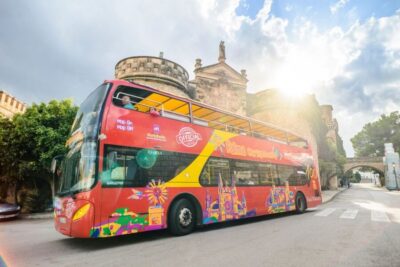
Barcelona is spread across hills, broad avenues, old lanes, and a long waterfront. This open-top double-decker bus gives you a quick look at the whole city without asking you to master the Metro on day one. The two routes reach places that are awkward to connect on foot, including Montjuïc, Park Güell, Tibidabo, Sagrada Família, and the beaches.
I like the freedom to ride both circuits first, then use the pass as a sightseeing shuttle. I also like the 360-degree views and the audio system, which offers 16 languages with headphones. The main drawback is traffic. A loop can take about two hours, and a Red Route ride has taken some passengers closer to two and a half hours, even before time spent visiting sights.
Key points at a glance
- Two routes cover different Barcelonas: The Red Route focuses on Montjuïc, the waterfront, the Gothic center, Sagrada Família, and the eastern coast. The Blue Route reaches Park Güell, Tibidabo, Pedralbes, Camp Nou, and the Diagonal district.
- A good first-day orientation: Stay aboard for a full circuit, then mark the places you want to revisit on foot.
- The upper deck is best for views: It is excellent for photos, but wind, rain, and cold can make it uncomfortable even when the roof is covered.
- The pass is flexible: Choose 24 or 48 hours and hop on or off at any stop during the operating period.
- The price can work well for active sightseers: At about $39.54 per person, the pass is most useful if you ride several times and visit areas far apart.
- Allow extra time: Barcelona traffic, traffic lights, and crowded roads can slow the bus. Walking is sometimes faster for short central-city hops.
Why the bus works well in a spread-out city

Barcelona is easy to walk in sections, but not easy to cross quickly from one end to the other. The hop-on hop-off bus links the historic center with Montjuïc, the northern Gaudí sights, the Olympic waterfront, and the beaches.
I would use it as a sightseeing tool, not as a replacement for every Metro ride. If you are moving from Plaça de Catalunya to Sagrada Família, walking or public transportation may be quicker. If you want to see how the city fits together, the bus is far more useful.
The first full ride helps you understand the shape of Barcelona. You can see the grid of Eixample, the rise toward Montjuïc, the long coastal strip, and the way major landmarks sit beyond the old center. Then you can return to the stops that caught your eye.
You receive a mobile ticket, and printed vouchers are also accepted. The ticket can be redeemed at any stop. A coupon booklet offers more than 200 euros in possible discounts at Barcelona attractions, but check each discount before counting it as part of the ticket’s value. Attraction admission is not included.
More City Tours in Barcelona
- Barcelona: City Sightseeing Hop-On Hop-Off Bus Tour
★ 4.4 · 10,061 reviews - Barcelona City Tour Hop-On Hop-Off with Optional Boat
★ 4.0 · 3,012 reviews - Barcelona: Private City Tour by Eco Tuk Tuk
★ 4.9 · 1,339 reviews
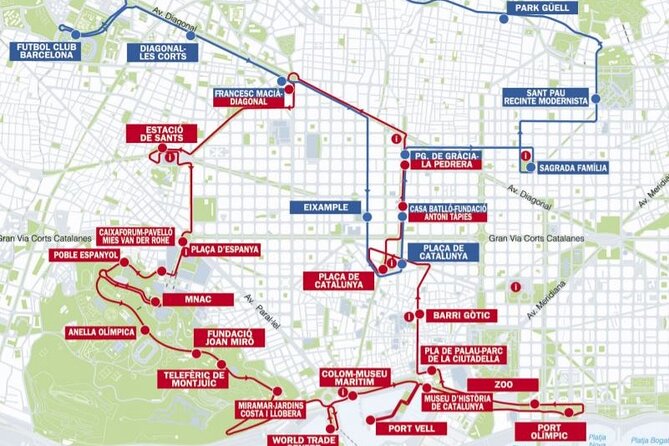
Red Route: from Plaça de Catalunya to Montjuïc

The Red Route starts at Plaça de Catalunya, the large central square where the old city meets Eixample. It is a practical place to begin, though finding the correct bus can be confusing because different sightseeing services operate around the square. Look for the pink and blue Bus Turistic vehicles and confirm the route before boarding.
The next stop, Passeig de Gràcia, puts you near Casa Batlló and the Fundació Antoni Tàpies. This is one of Barcelona’s grandest avenues, lined with Modernisme architecture and high-end shops. It is a good place to get off if you want to see Gaudí’s Casa Batlló or continue toward La Pedrera.
The bus then passes Eixample and Estació de Sants. These stops are less about sightseeing than orientation. Sants is Barcelona’s main rail station, so this part of the route can help you understand connections between the center and the wider city.
Plaça d’Espanya is one of the more useful stops. The broad square leads toward the former exhibition grounds, CaixaForum, the Mies van der Rohe Pavilion, and Montjuïc. You can also use it as a gateway to the National Art Museum of Catalonia, or MNAC.
Poble Espanyol is a purpose-built collection of Spanish architectural styles, craft shops, and restaurants. It can be worth your time if you want a compact cultural stop, though it is not an untouched old neighborhood. The nearby MNAC offers grand views over Plaça d’Espanya and the city.
The Anella Olímpica marks the Olympic facilities on Montjuïc. Continue to the Joan Miró Foundation if modern art interests you, or get off at the Montjuïc Cable Car stop. The cable car is a separate attraction, and admission is not part of the bus ticket.
The Montjuïc section is scenic but hilly. The bus saves you a hard uphill walk, especially in hot weather. At Miramar and the Costa i Llobera gardens, you get views toward the port and access to a quieter garden area. This is one of the places where the bus provides transport that ordinary city sightseeing on foot does not.
Red Route: port, beaches, and the eastern city
After Montjuïc, the Red Route descends toward the World Trade Center and the Columbus Monument at the lower end of La Rambla. From the Colom stop, you can walk into the Gothic Quarter or along La Rambla. The old center is best explored on foot, since the bus cannot take you through its narrow medieval lanes.
The Museu d’Història de Catalunya sits near the port and offers a useful introduction to Catalan history. Port Olímpic follows, with the waterfront, restaurants, and the legacy of the 1992 Olympic redevelopment.
The beach stops include Bogatell and Nova Mar Bella. These are useful if you want sea air, a stroll, or a break from the stone streets of the center. Do not expect the bus to function like a beach shuttle on a tight schedule. Traffic and stop times can stretch the ride.
The route continues toward the Forum, Parc Diagonal Mar, Poblenou, and Torre Glòries. Poblenou gives you a look at a former industrial district that has changed into a mixed residential and creative area. Torre Glòries is an easy landmark to spot, though the stop is more useful for orientation than for a full sightseeing visit.
The route then returns through Sagrada Família and Arc de Triomf before reaching Plaça de Catalunya again. The Sagrada Família stop is one of the busiest and most useful on the entire service. You can see the exterior without a ticket, but entry to the basilica is separate and timed admission is usually something you should arrange in advance.
Arc de Triomf provides a pleasant walk toward the old city and Ciutadella Park. This final section connects major sights, but it is also where congestion can make the bus feel slow.
Blue Route: Gaudí, Tibidabo, and Pedralbes
The Blue Route begins near Plaça de Catalunya and Passeig de Gràcia, then continues toward La Pedrera. Casa Milà, commonly called La Pedrera, is another essential Gaudí stop, with its wave-like stone facade and famous rooftop forms.
The bus continues to the Sant Pau Recinte Modernista. This former hospital complex is one of Barcelona’s finest Modernisme sites, with decorated buildings, gardens, and tiled details. It is close to Sagrada Família, but the Blue Route gives it its own stop and makes it easier to plan as a separate visit.
Park Güell is the major northern stop. Gaudí’s tiled terraces and unusual structures are among Barcelona’s most recognizable sights. The bus gets you into the general area, but the stop does not include admission. Build in time for walking from the stop and for the attraction itself.
The route then climbs toward the Tramvia Blau and Tibidabo area. This is a very different side of Barcelona, with higher ground and wider views. The historic tram and Tibidabo attractions are separate experiences, and operating details are not part of this bus ticket, so check before making a special trip.
Sarrià and the Pedralbes Monastery offer a quieter contrast to the central districts. The Monestir de Pedralbes is a historic religious complex with a calm setting and artistic details. It is a good choice if you want a break from Gaudí and the central crowds.
The Palau Reial and Güell Pavilions stop reaches the western side of the city. The route continues to the FC Barcelona stop, useful for anyone visiting the football club’s facilities, then runs along Diagonal and through Eixample before returning to the center.
The Blue Route is especially helpful if you want Park Güell, Tibidabo, Pedralbes, and the western districts in one broad outing. It is less useful if your plans are limited to the Gothic Quarter and waterfront.
More Hop-On Hop-Off Buses in Barcelona
- Barcelona: 24 or 48-Hour Hop-On Hop-Off Bus Tour
★ 4.4 · 20,872 reviews - Barcelona: Hop-On Hop-Off Bus with Sailing Cruise
★ 4.3 · 412 reviews - Barcelona Hop-On Hop-Off Bus and FC Barcelona Immersive Tour
★ 4.2 · 362 reviews - Shore Excursion: Barcelona City Tour Hop-On Hop-Off
★ 4.0 · 280 reviews
How to plan 24 or 48 hours
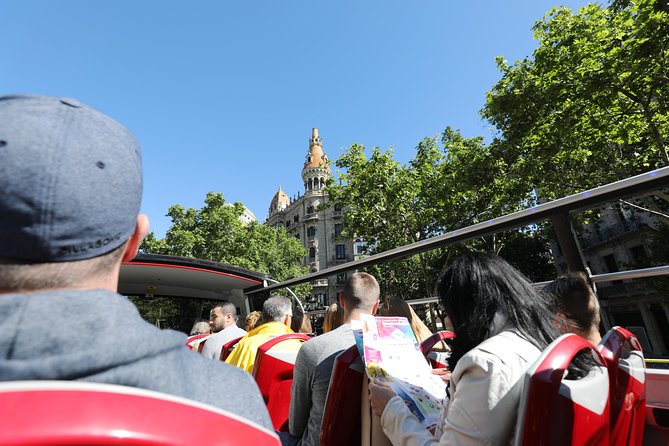
A 24-hour pass can be enough if you have one full sightseeing day and a clear plan. I would ride one complete circuit early, then hop off at two or three places that matter most to you. Trying to visit every major stop in a single day will leave you watching the clock from the top deck.
The 48-hour pass gives you a better pace. Use the first day for a broad overview and the second day for targeted stops. For example, spend one day on Montjuïc and the waterfront, then use the next for Sagrada Família, Sant Pau, or Park Güell.
Buses are listed as departing from the first stop at 9 a.m., with the last departure at 7 p.m. The standard information gives a frequency of about every 20 minutes, while high-season service may run as often as every five minutes. Service can vary, so use the official map or app on the day you ride.
The advertised tour duration is about 120 minutes, but traffic makes that an estimate. A full circuit is not a timed transfer. If you have a reserved entry time, leave a generous buffer and do not rely on the bus for the final connection.
The upper deck, audio, Wi-Fi, and weather

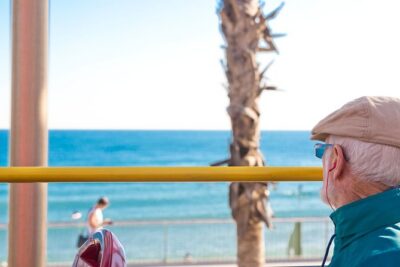
The upper deck gives you the best view of Barcelona’s architecture. It is easy to see Casa Batlló, Sagrada Família, Montjuïc, and the waterfront from above street level, and the open sides make taking photos simple.
That same openness creates the main comfort problem. Wind chill can be strong, and a covered roof does not protect you from sideways rain. On a cold or wet day, sit downstairs if seats are available and bring a layer even when the forecast looks mild.
The audio commentary comes through supplied headphones in 16 languages. It gives useful context while you ride, though it is not the same as having a live guide point out an upcoming stop or answer questions. You also receive onboard Wi-Fi, which is handy for checking maps and opening times, but you should not plan your entire day around a perfect connection.
Bring or request the route map when you board. Stop locations have caused confusion, particularly around Plaça de Catalunya and other busy squares. A quick check of the stop name, route color, and direction can save you a long walk in the wrong direction.
Value at about $39.54 per person
At roughly $39.54 per person, the ticket is not automatically a bargain. Its value depends on how much ground you cover and how often you use it. If you ride both routes, hop off several times, and use the bus to reach Montjuïc or Park Güell, the cost can make sense.
If you only want a two-hour city overview and plan to walk everywhere afterward, compare the price with other transport options. The coupon booklet may improve the value if one of its discounts matches an attraction already on your list. Remember that food, drinks, hotel transport, and attraction admission are extra.
The best value comes from treating the pass as both a tour and transport. I would not buy it only to move between nearby central stops. I would buy it for the broad routes and the ease of reaching places spread across the city.
Who should book this bus
I would recommend it to first-time visitors, families, people with limited time, and anyone who wants a simple introduction before exploring on foot. It also suits you if hills or long connections make regular sightseeing tiring.
It is less suitable if you dislike slow road travel, need exact arrival times, or prefer a live guide. Barcelona’s traffic is a real part of the experience. Staff can be helpful, but service is not always consistent, and the tour depends heavily on recorded commentary.
Passengers using certain in-the-ear or completely-in-canal hearing aids should contact the operator before booking. The supplied headphones may not fit over those devices, and over-ear alternatives have not always been available. This should be clarified in advance rather than discovered after boarding.
The service generally operates all year except January 1 and December 25. Keep your ticket safe, since replacing a lost ticket may require buying another one. Free cancellation is available if you cancel at least 24 hours before the start time. Inside that window, the fare is not refunded.
Should you book the Barcelona Bus Turistic?

Book it if you want a broad view of Barcelona and plan to use both routes. The bus is especially useful for connecting Gaudí sights, Montjuïc, the waterfront, Park Güell, and western Barcelona without piecing together every connection yourself.
Skip it if your visit centers on a small walkable area or if you need fast, precise transport. My practical choice would be the 48-hour pass for a relaxed visit, or the 24-hour pass for one focused day. Start early, confirm the stop on the map, dress for wind, and allow extra time for traffic. Used that way, this is a useful city orientation with real sightseeing value, not simply a ride around town.
FAQ
How long does a full bus route take?
The stated tour duration is about 120 minutes. Traffic can make a full circuit longer, and the Red Route has taken about two and a half hours in some conditions.
Can I choose between 24-hour and 48-hour tickets?
Yes. You can choose a 24-hour or 48-hour pass, with unlimited travel on both routes during the selected period.
How many routes are included?
Both the Red Route and Blue Route are included in the pass.
Where does the bus start?
The main starting point is Plaça de Catalunya. Additional stops are available throughout Barcelona, including stops near major attractions.
What time does the service operate?
The first bus departs from Stop 1 at 9 a.m., and the last bus departs from Stop 1 at 7 p.m. Service frequency is listed as about every 20 minutes, with more frequent departures during high season.
Is admission to Sagrada Família or Park Güell included?
No. The bus ticket provides transport to stops near the attractions, but attraction entry is not included.
Is the audio guide available in English?
Yes. The audio guide is available in 16 languages, including English, and headphones are provided.
Can I cancel for a refund?
Yes, if you cancel at least 24 hours before the experience start time. Cancellations made less than 24 hours in advance are not refundable.
Recently added around Barcelona
- Park Guell Guided Tour with Skip the Line Tickets★ 4.0 · 739 reviews
- Entrance to the Mirador Torre Glories Barcelona★ 4.5 · 193 reviews
- Bohemian Barcelona Neighborhood Evening Tapas & Wine Tour★ 5.0 · 419 reviews
- Transfers From Cruise Port to Barcelona Airport★ 4.5 · 155 reviews
- Authentic Flamenco Show Barcelona : Intimate Casa Sors Experience★ 5.0 · 809 reviews
- Barcelona Expert Tour with Local Guide in Eco Tuk Tuk Private★ 5.0 · 216 reviews
- Barcelona Sunset Cruise with Light Snacks and Open Bar★ 5.0 · 476 reviews
- Barcelona: Sagrada Familia, Park Guell & Tapas Private Tour★ 5.0 · 903 reviews
City Tours, compared.

Granada City Train 1 or 2-Day Hop-On Hop-Off Ticket
Read our review →
Barcelona City Tour Hop-On Hop-Off with Optional Boat
Read our review →
Browse the lists this tour appears in