
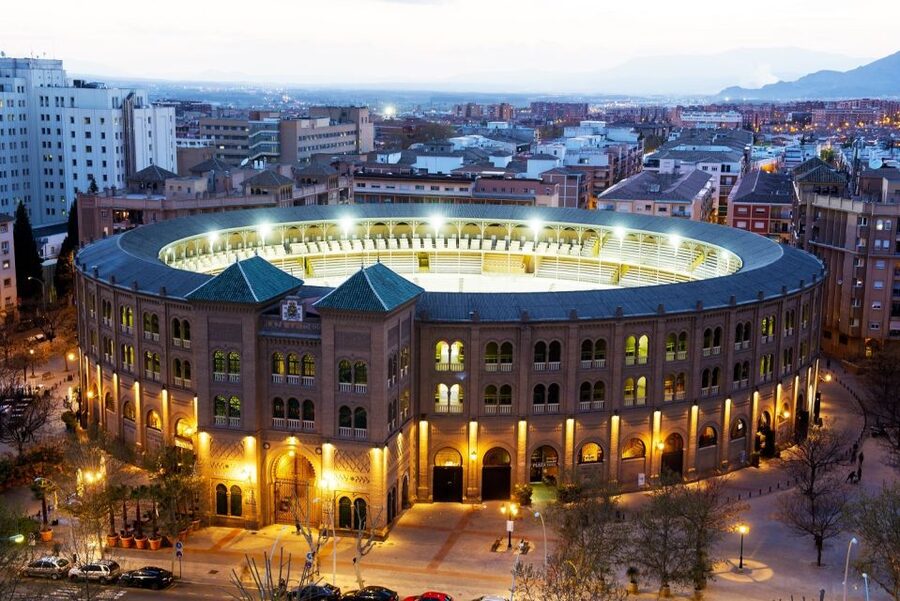
Reviewed · CITY TOURS
Granada City Train 1 or 2-Day Hop-On Hop-Off Ticket
Granada’s little city train tackles the city’s steep hills and narrow old streets, taking you from the Alhambra down to the Cathedral and across viewpoints that would require plenty of uphill walking. I like the broad city overview and the chance to use the train as practical transport, not just a sightseeing ride. The $8 price also makes it an easy choice for a first look at Granada.
The catch is capacity. Trains can fill quickly, especially on holidays and in summer, so you may wait 30 to 45 minutes, or longer when demand is high. The ride is also bumpy on old cobblestones, and you need your own headphones for the audio guide.
Key points to know before you ride
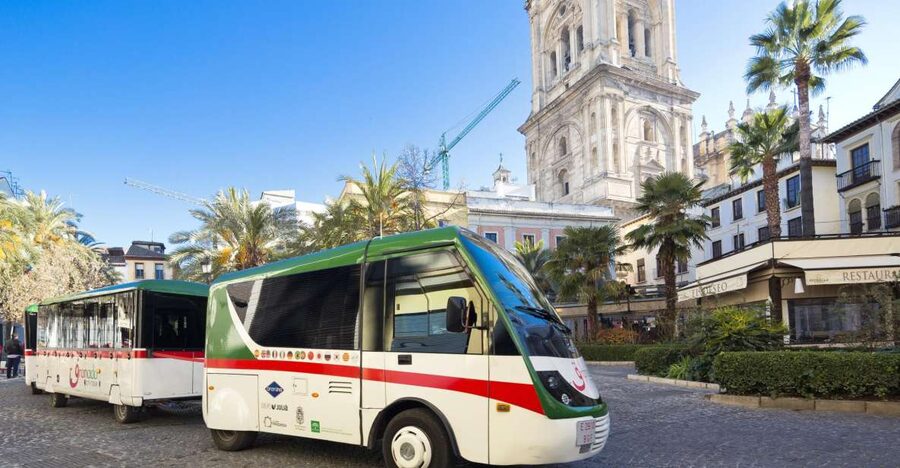
- The Alhambra Route reaches the top of the city: Stops include Alhambra Generalife, Puerta de la Justicia, and Carmen de Los Mártires.
- You get more than a bus ride: The open carriage and narrow streets give you close views of Granada’s old quarters.
- The best first move is one complete circuit: See the layout before deciding where to get off.
- The audio guide covers 12 languages: Spanish, Catalan, Chinese, English, French, German, Italian, Japanese, Arabic, Portuguese, Russian, and Korean.
- Waiting time can shape your day: Trains run about every 30 to 45 minutes, but full carriages may leave you behind.
- Bring headphones: They are not included, and the vehicle can be noisy.
Why the Granada City Train is useful
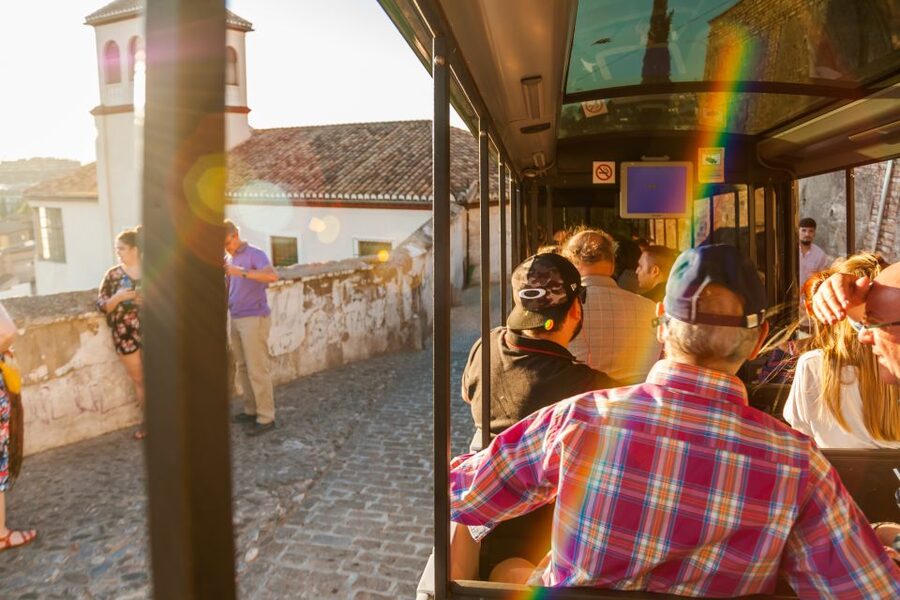
Granada is compact, but it is not flat. The Alhambra sits above the center, the Albaicín climbs sharply toward its viewpoints, and several attractive streets are tiring on foot. The Granada City Tour train gives you a simple way to connect these areas while adding recorded commentary along the route.
I especially like it as a first activity in town. One full circuit helps you understand where the Alhambra sits in relation to Plaza Nueva, the Cathedral, the old city gates, and the hilltop viewpoints. You can then return to the places that interest you most.
The train is not a quiet luxury vehicle. It rattles over stone streets, makes sudden stops, and can feel rough if you have back problems. One carriage door was reported to open while moving, so pay attention and keep children seated. Still, the open-sided design gives you a much better view than a standard enclosed vehicle.
At $8 per person, the value is strong if you use the train for both sightseeing and getting around. A single ride is useful for orientation, but the one-day pass gives you much more freedom. A two-day pass makes sense if you want to break up visits to the Alhambra, Cathedral, Albaicín area, and viewpoints.
More scenic train rides in Granada:
- Montserrat & Cogwheel Train, Gourmet Wine Tasting & Tapas/Lunch
★ 5.0 · 6,290 reviews - From Málaga: Ronda+Setenil de las Bodegas with Little Train
★ 4.6 · 4,115 reviews - Mallorca: Island Tour with Boat, Tram & Train from the South
★ 4.4 · 3,888 reviews
Start at Alhambra Generalife
The official starting point is the ticket office at Stop 1, Alhambra Generalife. This is a practical place to begin because you can combine the ride with a visit to the Alhambra complex, though the train ticket does not include Alhambra admission.
From here, the route runs toward Alhambra and Puerta de la Justicia. The climb is one of the main reasons to use the train. You save your legs for the palace and gardens instead of spending energy getting uphill.
Keep in mind that the train does not replace an Alhambra reservation. You still need separate entry arrangements for the monument. The city train simply gets you close to the access points and gives you a useful view of the surrounding area.
From Monday to Friday, there is no regular train ride to the Alhambra from 2:00 to 2:30 p.m. because the Cuesta del Caidero access closes under municipal rules. Outside that half-hour period, the normal route resumes.
Alhambra and Puerta de la Justicia
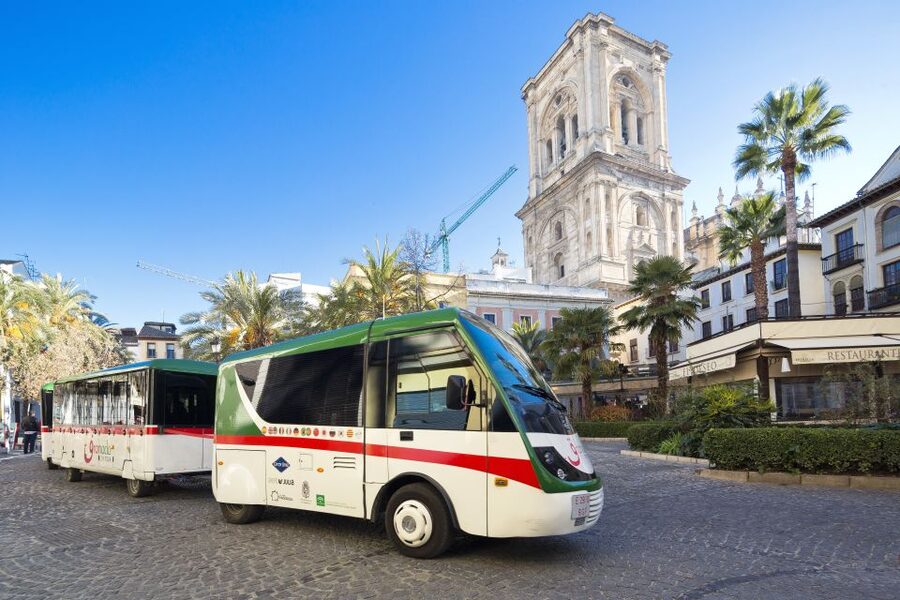
The Alhambra stop is the most important one on the route, but it is also where planning matters most. You can get off near the monument, visit if you have an entry reservation, and later use the train to return toward the center.
Puerta de la Justicia is one of the historic gateways into the Alhambra grounds. Even if you are not entering the palaces at that moment, the stop puts you in the right area to see the fortress walls and understand how the complex connects with the city below.
A useful plan is to ride uphill first, then walk downhill later if you prefer. That approach saves effort and leaves you with an easier return route. The train is especially helpful for anyone who finds Granada’s slopes difficult, though you should allow time for a full carriage if you plan to leave from the Alhambra.
Plaza Nueva, Granada’s natural meeting point
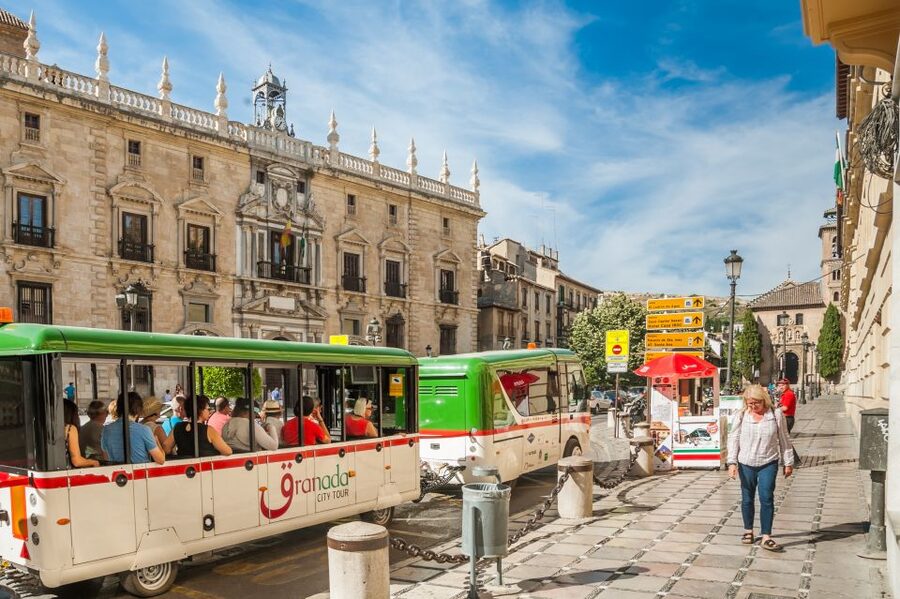
Plaza Nueva is one of the most useful stops for a short visit. It is Granada’s oldest square and a good place to pause for coffee, find a meal, or begin exploring the central streets on foot.
The square also works well as a transport base. From here, you can walk toward the Cathedral, continue along Calle Reyes Católicos, or head toward the Albaicín and the river area. The train gives you the option of seeing the center without committing to a long walk right away.
This is a good stop for a first-day orientation. Get off, spend some time in the square, then continue on foot through the nearby streets. If your ticket is valid for the day, you can later board again at one of the marked stops.
More Hop-On Hop-Off Buses in Granada:
- Barcelona: 24 or 48-Hour Hop-On Hop-Off Bus Tour
★ 4.4 · 20,872 reviews - Barcelona: City Sightseeing Hop-On Hop-Off Bus Tour
★ 4.4 · 10,061 reviews - Valencia: 24 or 48-Hour Hop-on Hop-off Bus Ticket
★ 3.9 · 5,611 reviews - City Sightseeing Barcelona Hop-On Hop-Off Bus Tour: 24 or 48-Hour
★ 4.0 · 5,250 reviews
Alhóndiga and the Cathedral area
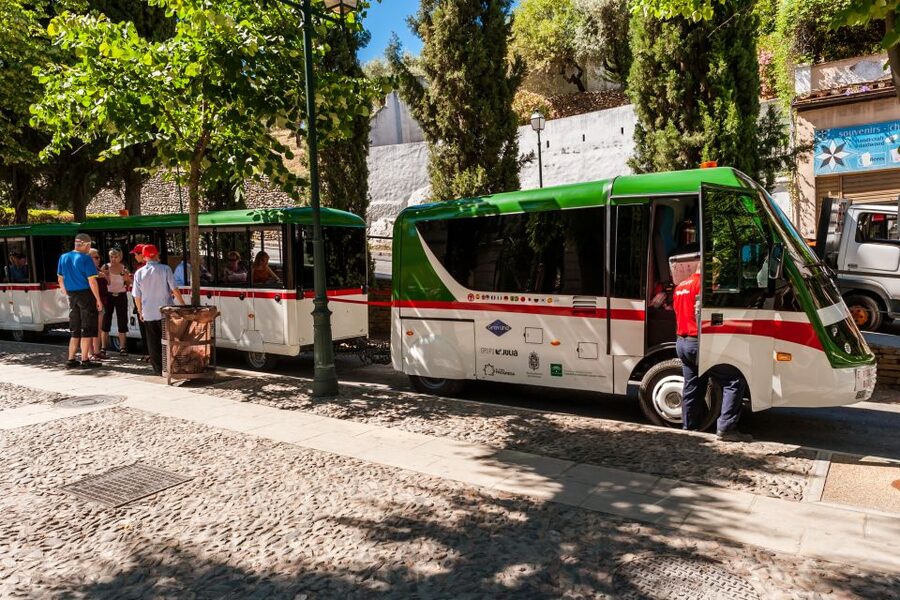
The Alhóndiga stop brings you into the central shopping and dining area. It is a useful break between the upper Alhambra route and the main monuments in the city center.
The next stop, Catedral and Capilla Real, is one of the best for Granada’s major religious buildings. The Cathedral is one of the city’s defining sights, while the Royal Chapel contains the tombs of Ferdinand and Isabella. The train itself does not include admission, but it puts you close to both.
This is also an easy section to explore on foot. The streets around the Cathedral are relatively central, and you can combine the stop with Plaza Nueva and Calle Reyes Católicos. If you have only one day, this central cluster gives you more sightseeing for less waiting.
Mirador de San Cristóbal and Jardines de Zoraya
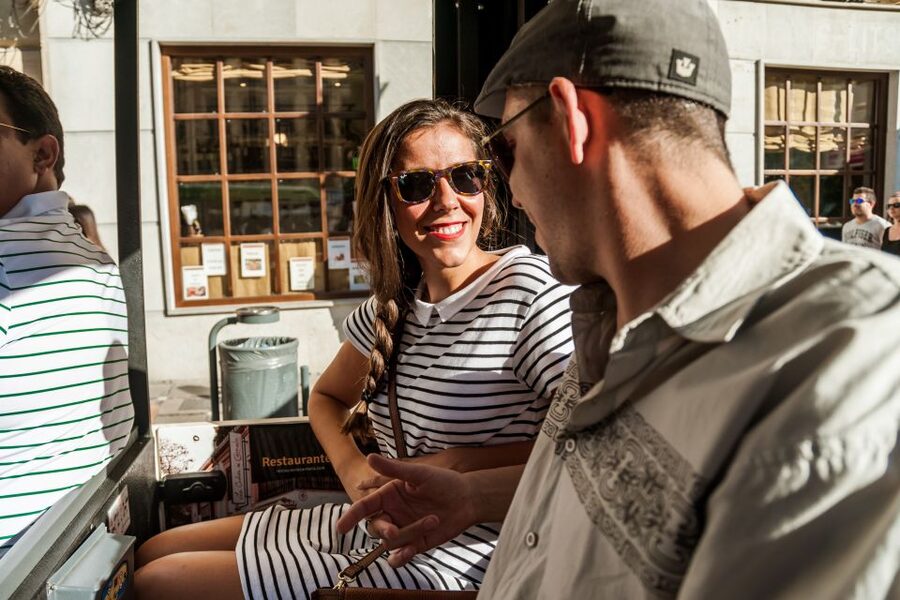
The Mirador de San Cristóbal stop offers one of the route’s strongest views. It is a good place to look across Granada and see how the city rises toward the hills. The nearby Jardines de Zoraya adds another point of interest for anyone exploring the Albaicín side of town.
The viewpoint is particularly appealing near sunset, although the train schedule and available seating matter at that time. You may need to wait for the next carriage if many people are heading up for the same view.
The surrounding streets are narrow and uneven. That is part of the charm, but it explains the slow, jerky ride. You are traveling through old quarters where a large sightseeing bus could not go.
Arco de Elvira and Hospital Real
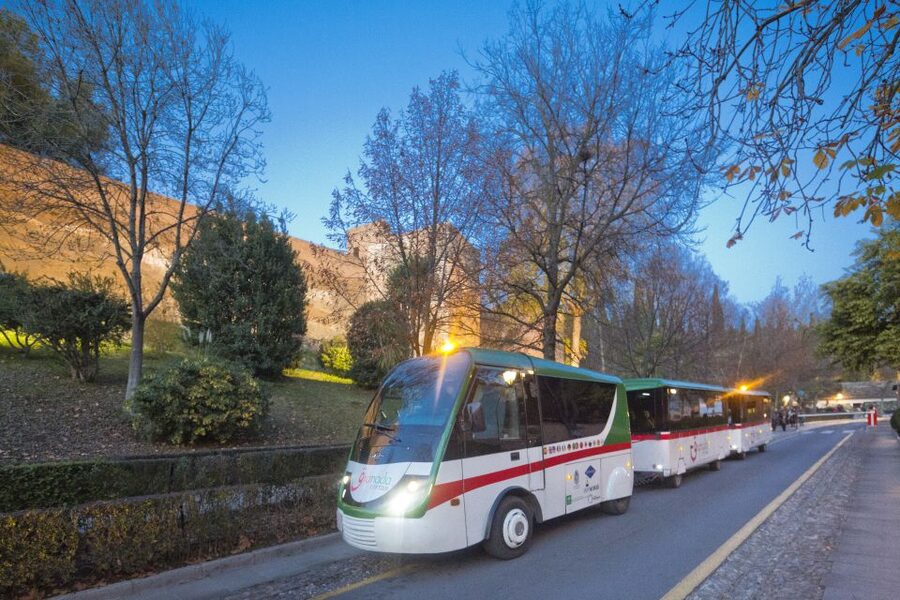
The Arco de Elvira stop takes you toward one of Granada’s historic gateways. The arch once marked an important entrance to the city and remains a useful reference point for understanding the old urban layout.
Nearby Hospital Real is now associated with the University of Granada. This stop gives you a different view of the city, away from the main tourist center and Alhambra approach.
The route’s value here is less about getting off for one famous monument and more about seeing how Granada’s neighborhoods fit together. You pass from the central core toward areas shaped by older walls, university buildings, and traditional streets.
Calle Reyes Católicos and Plaza Isabel la Católica
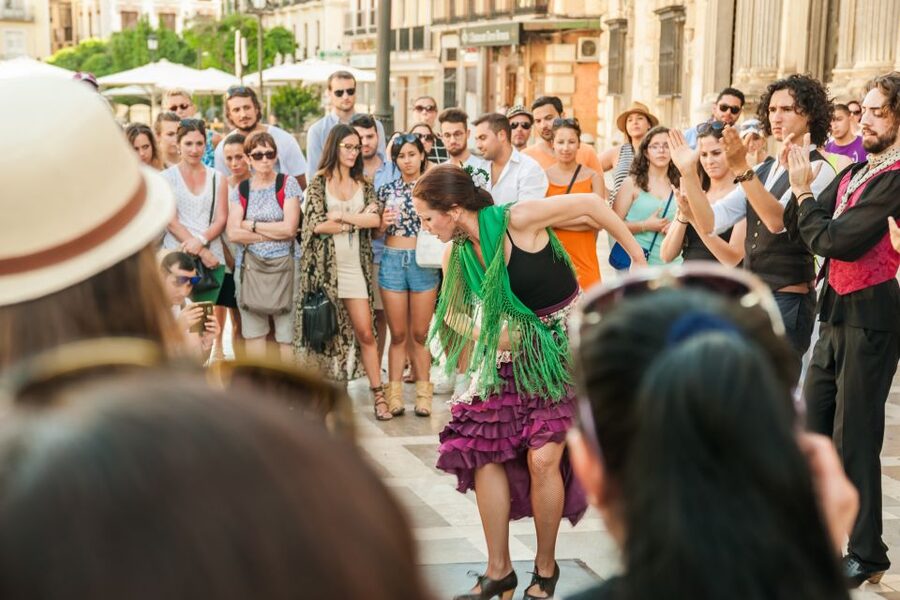
This stop sits along one of the city’s main central corridors. Calle Reyes Católicos leads through the commercial heart of Granada, while Plaza Isabel la Católica is a convenient point for continuing toward Plaza Nueva and the Cathedral.
If you want a short ride with easy access to central sights, this is one of the most practical stops. You can use it to shorten a walk, especially after spending time on the hills.
The route can be affected by city events, traffic, or other conditions outside the operator’s control. Central streets may also slow the train, so do not plan a tightly timed connection immediately after the ride.
Calle Molinos and Campo del Príncipe

Calle Molinos leads toward Campo del Príncipe, a pleasant square in the Realejo district below the Alhambra. This area gives you a closer look at Granada’s everyday neighborhoods, not just its headline monuments.
The stop is helpful if you want to explore the old Jewish quarter area and walk through streets with a quieter feel than the main center. The train’s narrow carriage is well suited to this part of the city, where regular large buses would be awkward.
Because the streets are uneven, the ride here can be noisy and bumpy. Sit securely, keep loose belongings close, and expect frequent braking as the driver negotiates tight corners and passing traffic.
Carmen de Los Mártires and the ride back
Carmen de Los Mártires sits close to the Alhambra area and provides another way to approach the upper part of the city. The word carmen refers to Granada’s traditional hillside homes with gardens, and this stop places you near one of the city’s attractive green spaces.
This is a good final stop if you are making a complete circuit and want to finish near the Alhambra. It also helps you understand the area beyond the palace entrance, where the city’s slopes and gardens shape the experience.
A complete circuit takes about an hour and a half according to one practical use of the service, though the exact time varies with traffic and stops. I would not treat the timetable as exact. Use the first circuit to learn the route, then make your more important stops once you know how the service behaves.
How the audio commentary works
An audio guide is included in 12 languages: Spanish, Catalan, Chinese, English, French, German, Italian, Japanese, Arabic, Portuguese, Russian, and Korean. It adds context as you pass monuments and districts, making the ride more useful than simple transport.
Bring your own headphones. They are not included, and the open carriage can be noisy because of the engine, street traffic, cobblestones, and passenger conversation. Several people found the audio clear when they had the right equipment, but it is less useful if you try to listen without headphones.
You may also find the commentary more helpful during the first circuit than during repeated rides. On later trips, the views and practical transport may matter more than hearing the same information again.
One trip, one day, or two days
The one-trip ticket is best for a quick overview. Ride the full route without getting off, note the stops you want to revisit, and use your remaining time for walking. It is a sensible choice if you have only a few hours in Granada.
The one-day ticket offers the best balance for most visitors. You can ride up toward the Alhambra, get off at the Cathedral or Plaza Nueva, continue to a viewpoint, and use the train again when your feet need a rest.
The two-day ticket suits a slower visit. You can use the first day to learn the route and see the city from the carriage, then use the second day to connect selected sights. Some people use it almost like local transport, though waits and full trains make it less predictable than a regular city bus.
Timing, crowds, and comfort
The advertised interval is about 30 to 45 minutes. That sounds manageable until a full train passes without room for you. At busy stops, you may need to wait for the next one, and holiday weekends can create waits of an hour or more.
My advice is simple: take a complete circuit early in your stay, then avoid planning your entire day around exact boarding times. If you see a train arrive with no seats, waiting can be wiser than standing through the hills and sharp turns.
The train is open and exposed to the weather. That makes it pleasant on a hot day, but special hours apply during Easter week and the Christmas period. During the listed holiday dates, service runs on reduced schedules, including 9:00 a.m. to 3:00 p.m. on April 10 to 16, 4:00 to 8:00 p.m. on April 17, and 10:00 a.m. to 4:00 p.m. on December 24, December 31, and January 5.
Folded baby strollers are allowed if they stay within 35 centimeters in height and 55 centimeters in width. The train can be rough for anyone with a chronic back problem, so consider that before choosing it as your main way around town.
Who should book this Granada train?
I would recommend it to first-time visitors, people with limited time, anyone who wants help with Granada’s hills, and families who like a simple sightseeing ride. It is also useful if you want to reach several neighborhoods without walking between every stop.
I would be more cautious if you need a smooth ride, dislike waiting, or want a quiet guided tour. The train is modest, noisy, and dependent on street conditions. It is best viewed as a low-cost mix of orientation, transport, and open-air sightseeing.
Cancellation is free up to 24 hours before the activity, and you can reserve now and pay later. Bring your booking confirmation and headphones. The service begins at the Alhambra Generalife ticket office, Stop 1.
Should you book the Granada City Train?
Book it if you want an inexpensive first look at Granada and need help with the climb to the Alhambra. The strongest plan is to ride the full route once, then use a one-day pass to get off at Plaza Nueva, the Cathedral, Mirador de San Cristóbal, and the Alhambra area.
Skip it if your main priority is speed or a smooth ride. Crowds can produce long waits, and the cobblestones are not gentle. At $8, though, the price leaves plenty of room for patience. For most visitors, the train is a practical way to get oriented, save energy, and see more of Granada in a short stay.
FAQ
Where does the Granada City Train start?
The route starts at the ticket office at Stop 1, Alhambra Generalife.
How long is the ticket valid?
You can choose a one-trip ticket, a one-day ticket, or a two-day ticket. The one-day and two-day options are valid for the selected period.
How often do the trains run?
Trains on the Alhambra Route generally run every 30 to 45 minutes.
Which route does this ticket cover?
This activity covers the Alhambra Route, also called the Green Line.
Does the train stop at the Alhambra?
Yes. Stops include Alhambra Generalife and Alhambra, Puerta de la Justicia.
Does the ticket include entry to the Alhambra?
No. The ticket provides transport and sightseeing on the city train. Admission to the Alhambra is not included.
Is an audio guide included?
Yes. Audio commentary is included in 12 languages: Spanish, Catalan, Chinese, English, French, German, Italian, Japanese, Arabic, Portuguese, Russian, and Korean.
Do I need to bring headphones?
Yes. Headphones are not included, so bring your own if you want to use the audio guide.
Can I bring a baby stroller?
Yes, provided the stroller is folded and does not exceed 35 centimeters in height and 55 centimeters in width.
Can I cancel the booking?
Yes. You can cancel up to 24 hours in advance for a full refund.
Recently added around Granada
- Canyoning Adventure Rio Verde in Granada★ 5.0 · 136 reviews
- Granada: Alhambra and Nasrid Palaces Private Tour★ 4.9 · 242 reviews
- Granada: Sacromonte Caves Flamenco Show with Dinner★ 4.4 · 156 reviews
- From Granada: Alpujarra Villages Guided Day Tour★ 4.8 · 217 reviews
- Malaga: Granada Day Trip with Alhambra, Palaces and Gardens★ 4.5 · 197 reviews
- From Granada: Alpujarra Mountain Villages Tour★ 4.7 · 298 reviews
- Granada: Historic Center and Lower Albaicin Walking Tour★ 4.7 · 136 reviews
- Granada: Alhambra Palace Guided Tour★ 4.3 · 224 reviews
City Tours, compared.
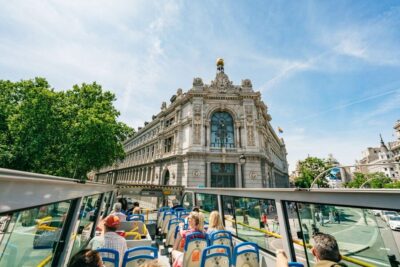
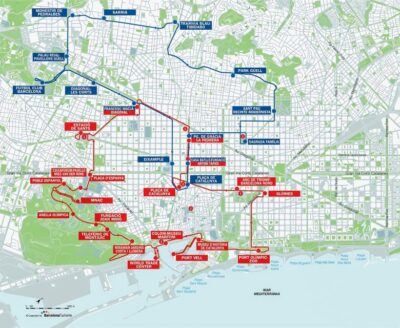

City Sightseeing Barcelona Hop-On Hop-Off Bus Tour: 24 or 48-Hour
Read our review →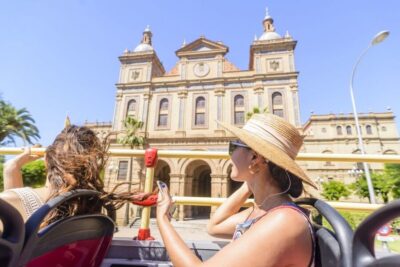


Barcelona City Tour Hop-On Hop-Off with Optional Boat
Read our review →
Browse the lists this tour appears in