
Reviewed · WALKING TOURS
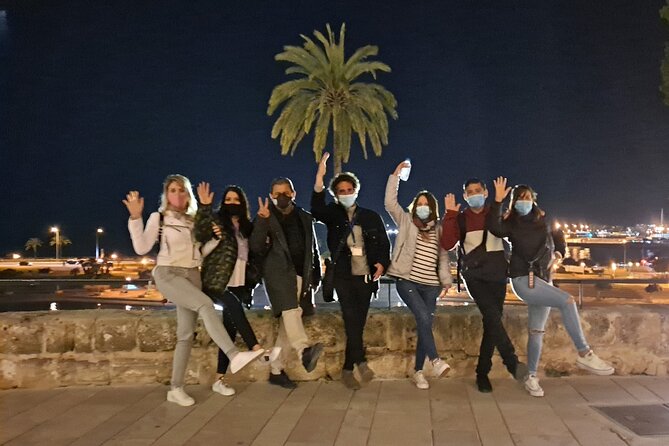
Private walking tour in Palma de Mallorca with local guides.
Palma’s old town packs royal power, Gothic stonework, Jewish heritage, Catalan Modernism, and everyday market life into a compact center. This private walking tour links those pieces in about two hours, with your guide able to slow down for questions or keep moving when the sun and children say otherwise.
I like the small-group format, which keeps the commentary audible and lets you set the pace. I also like the mix of major sights and less obvious details, from the Xueta story at Can Bordils to a face carved into Can Forteza Rey.
The main trade-off is time. Two hours gives you a useful orientation, not a full museum visit. Several buildings may be viewed from outside, and entrance fees are not included, so you may want to return later for the cathedral or Almudaina Palace.
Key points at a glance
- A private route through Palma’s old center: Only your group participates, with space for up to six people.
- Major sights in a short walk: See Sa Llotja, Almudaina Palace, Mallorca Cathedral, the town hall, Plaça Major, and Olivar Market.
- More than grand monuments: The route includes Mallorcan patios, the former Jewish quarter, Catalan Modernist buildings, and local expressions tied to Santa Eulàlia.
- Useful for families: Guides such as Carlos have adjusted the pace and tried to engage children during a hot day.
- English commentary: You can ask questions throughout instead of listening to a fixed group presentation.
- Good booking flexibility: You receive confirmation within 48 hours, and cancellation is free up to 24 hours before the start time.
Why this private Palma walk works
I see this tour as a way to get your bearings quickly. Palma can feel like a maze of narrow lanes, grand squares, church towers, and handsome courtyards. A guide gives those streets a thread, connecting the medieval city with its royal, religious, Jewish, and modern sides.
The private setup matters most if you are traveling with family or friends. You are not waiting for a large group to gather, and you can ask about the details that catch your eye. If one person wants more time at a chapel, while another needs a shorter stop in the heat, your guide can respond more easily than on a fixed group walk.
The guides named in the available feedback, Carlos and Maria, were praised for making the introduction friendly and useful. You should not assume you will receive one of them, but their approach gives you a sense of the intended style: clear background, room for questions, and an effort to connect with different ages.
At $266.16 for up to six people, the value depends on your group size. Six people pay about $44.36 each for two hours. Two people pay about $133.08 each, which is a much bigger outlay than a standard group walk. The price makes the most sense if privacy, a flexible pace, and direct access to the guide matter to you.
More Private Tours in Mallorca
- El Arenal: Private Mallorca Boat Rental (No License Needed)
★ 4.8 · 343 reviews - The Award-Winning PRIVATE Food Tour of Mallorca: The 10 Tastings
★ 4.5 · 317 reviews - Mallorca: Hot Air Balloon Flight with Private Options
★ 4.8 · 195 reviews
Sa Llotja and the first glimpse of Palma’s power
The walk begins at Mallorca Free Tour on Carrer del Moll, near the waterfront, and heads to Sa Llotja. This elegant building was designed by Guillem Sagrera, a famous architect from Mallorca, and it gives you an early look at the city’s trading past and architectural confidence.
The stop is listed at about 15 minutes, with free admission. Opening hours matter: Sa Llotja is open Tuesday through Sunday from 10:30 a.m. to 1:30 p.m. and from 5:30 p.m. to 11 p.m. It is closed Mondays. If the building is central to your plans, check your tour time against those hours.
This is a good opening stop because it is visually strong without requiring a long indoor visit. You begin with a focused explanation, then move into the old center rather than spending your short tour in one building.
The Almudaina Palace and Mallorca Cathedral
The route continues to Palau de l’Almudaina, the royal palace beside the cathedral. Here, the guide covers history, architecture, royal family connections, and anecdotes. The stop is about 10 minutes, and admission is not included.
That short visit is best understood as an outside explanation unless you arrange your own entry. You get the context you need before deciding if you want to return for a longer look. If royal architecture is a major interest, plan extra time and budget for the interior beyond this tour.
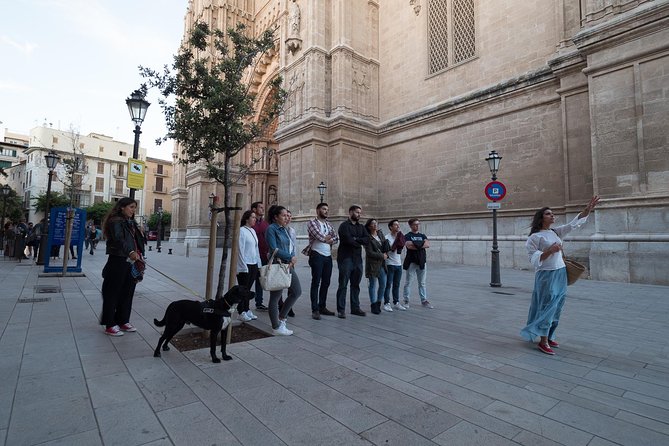
Next comes Mallorca Cathedral, first as an exterior sight. The guide explains its history, unusual details, and recent changes in about 10 minutes. This prepares you for the longer cathedral portion later, when the focus shifts from the building’s broad story to its art and light.
The cathedral is also called La Catedral del mar, a name that hints at its close relationship with Palma’s waterfront setting. The exterior stop helps you take in the scale before entering. You will not need to spend the first few minutes inside wondering what you are looking at.
Forty minutes inside La Catedral del mar
The interior cathedral visit is the longest single stop, at about 40 minutes. Admission is not included, so account for the ticket separately. This is the part of the walk most likely to reward visitors who want more than a quick photograph.
Your guide explains the main artistic styles in different chapels, then turns to the cathedral’s use of light. That focus is helpful because the building can overwhelm you at first. Instead of seeing only a huge Gothic interior, you get a way to read the chapels, decoration, and changing light.
The tour also covers Catalan Modernism and Antoni Gaudí, along with the contemporary work of Miquel Barceló. That combination gives the cathedral a broader time span. You are not being shown one frozen medieval monument. You are seeing how later artists and architects added their own ideas to an older religious building.
Forty minutes is enough for an informed introduction, but not for every chapel or detail. If sacred art is your main interest, return after the walk with more time. If you are traveling with young children, this is the point where a private guide and a flexible pace can make the visit easier.
More Walking Tours in Mallorca:
- Palma de Mallorca: City Walking Tour with The Cathedral
★ 4.0 · 657 reviews - Palma de Mallorca: Foodie Walking Tour of the Old Town
★ 4.6 · 372 reviews - Palma, Cathedral & Valldemossa: Guided walking Tour
★ 4.1 · 182 reviews - Barcelona Tapas and Wine Experience Small-Group Walking Tour
★ 5.0 · 5,804 reviews
Mallorcan patios and the Xueta story
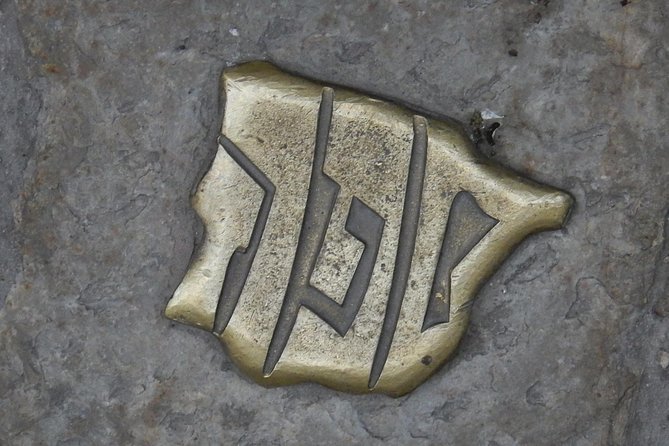
After the cathedral, the route moves into Palma’s lanes and courtyards. Ca’n Oms takes about seven minutes, with attention to the Mallorcan patio and the building both inside and outside. These patios offer a more intimate view of the city than the big monuments. You see how architecture shaped daily movement through old homes and civic buildings.
Can Bordils receives about 20 minutes. The stop includes another Mallorcan patio and the interpretation center for Palma’s Jewish quarters, when it is open. The center is available only during the week and in the mornings, so this part is conditional rather than guaranteed at every tour time.
The guide also explains the Jewish community of Mallorca and the Xuetas. That term refers to descendants of the island’s Jewish converts, a subject that adds an important layer to Palma’s past. It is one of the more distinctive parts of the walk because it shifts the focus from royal and church history to community, identity, and memory.
You should check your start time if this subject is a priority. An afternoon or weekend tour may still pass through the area, but the interpretation center itself may not be open.
Santa Eulàlia and the Modernist city
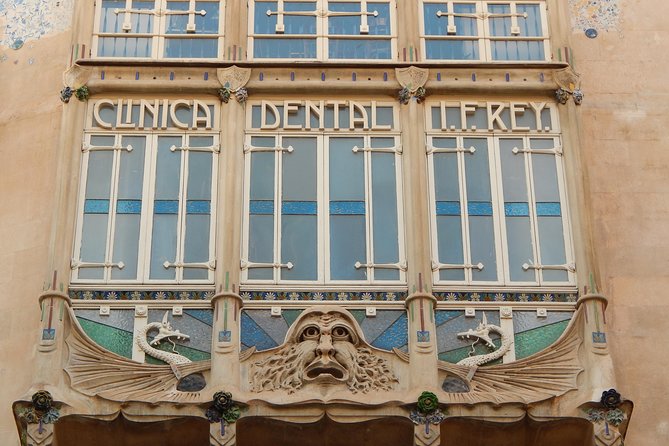
At Santa Eulàlia, the guide discusses the parish church and local expressions. The stop lasts about 10 minutes and is free. This is another chance to see how Palma’s religious buildings connect with local speech and custom, rather than treating the church only as an architectural object.
Can Corbella brings a different style. The stop lasts about 15 minutes, and admission is not included. The building is tied to Catalan Modernism and forms part of the Jewish quarter area. It helps show that Palma’s character is not confined to old Gothic stone. Later architectural movements added ornate and imaginative details to the same historic streets.
Can Forteza Rey is a very short five-minute stop, focused on Catalan Modernism and a face on the building. That face is the sort of small detail you could easily miss alone. Short stops like this are useful reminders to look up, check corners, and notice decoration above street level.
The sequence works well for an introduction because it alternates between major sights and smaller discoveries. You get the cathedral, then a patio, then Jewish history, then Modernist façades. The pace keeps the walk from becoming a string of similar church explanations.
Town hall, Plaça Major, and the city’s everyday center
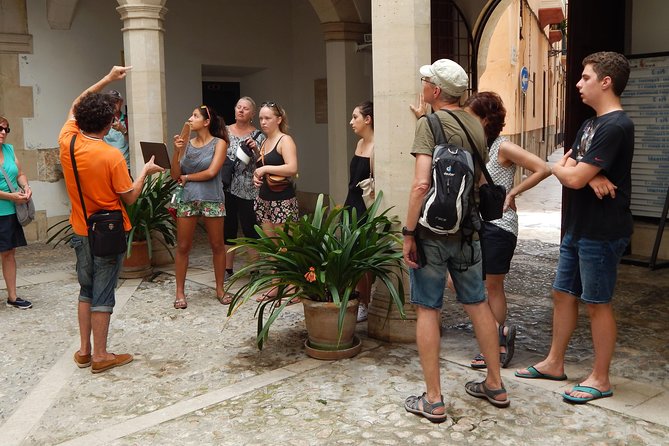
The Ajuntament de Palma, or town hall, receives about 15 minutes. The guide covers the building, the main square, and the Banc de sino fos. This is a good place to connect local government with the public life of the old city.
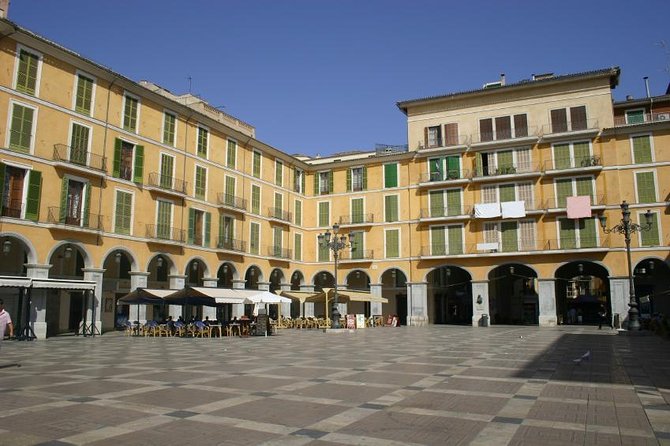
The route then reaches Plaça Major, with about 10 minutes for the surroundings, history, and recent changes. The stated endpoint is at Plaça Major, but the ending point can be adapted to your group. That flexibility is useful if you want to continue toward another part of central Palma rather than retracing your steps.
Near the square, Banc de s’Oli Oleoteca takes about five minutes. The guide shares anecdotes about the area and its orange trees. It is a small stop, but it brings street-level texture to a route otherwise filled with formal buildings and institutional history.
Finally, Mercat de S’Olivar offers a look at Palma’s main municipal and local market. It is open Monday through Saturday from 7:30 a.m. to 2:30 p.m., and admission is free. A morning walk is best if you want to see the market open. On a later tour, you may still learn about its role, but you should not expect the same market visit if the doors are closed.
The market makes a sensible finish. After churches, palaces, and grand façades, you end with a place tied to ordinary shopping and local food. It helps keep Palma from feeling like a museum set.
What the two-hour schedule really means
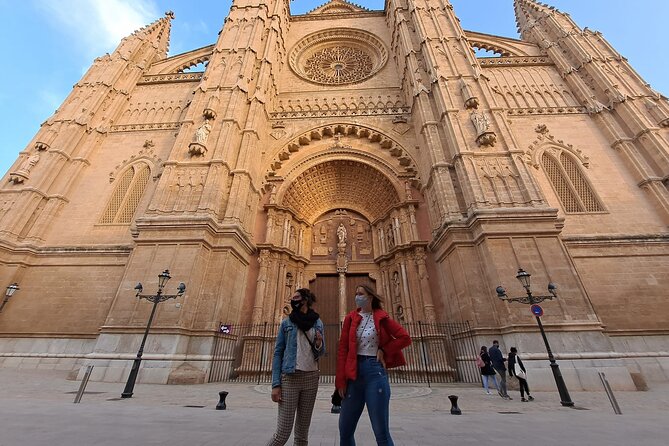
The listed stops add up to more than a simple two-hour stroll if every explanation receives its full stated time. In practice, the schedule should be treated as an approximate route with flexible stop lengths. Some locations are brief exterior pauses, while the cathedral receives the largest block.
That distinction matters when you plan your day. You will get a broad introduction to many places, but you will not have time for long independent visits at each one. The strength is range. The limitation is depth.
I would use the walk early in a Palma stay, or early in your day, then return to the cathedral, Almudaina Palace, Sa Llotja, or the market according to your interests. The guide helps you decide which places deserve a second look.
The route also involves walking through the old center, and the information says most people can participate. Service animals are allowed, and the starting point is near public transportation. Wear comfortable shoes and consider the heat, especially if children are with you. One family used the tour as a surface-level introduction during an overheated day, which is a practical clue: the private format can help, but the weather still affects comfort.
Who should book this Palma tour?
This experience fits you best if you want a fast, private orientation and plan to explore independently afterward. It is especially useful for first-time visitors, families, couples who prefer questions over a scripted talk, and small groups arriving with different interests.
You will get the most from it if you care about context. The route is not just a checklist of postcard sights. It links Guillem Sagrera, royal history, cathedral art, Gaudí, Miquel Barceló, Jewish Palma, Xueta identity, Modernist architecture, orange trees, and the municipal market.
It is less suitable if you want long interior visits, a slow photography walk, or a full museum-style study of the cathedral. Admission costs are separate, and the tour cannot linger everywhere. You may also find the price hard to justify for one or two people unless private guiding is a high priority.
The booking terms are simple. Confirmation arrives within 48 hours, subject to availability. You can cancel for a full refund up to 24 hours before the local start time. Changes or cancellations inside that window are not refunded.
Should you book it?
Book this private Palma walk if you want the old town explained by an English-speaking guide, prefer your own group, and have only a short time to get oriented. The best reasons are the flexible format, the mix of famous sights and small architectural details, and the unusual attention to Jewish Palma and the Xueta story.
Think twice if your group is small and cost is your main concern, or if you want every building visited in depth. For up to six people, the price becomes much more reasonable. For a family, the ability to ask questions and adjust the pace may be worth the premium. Use the tour as your introduction, then spend the rest of your Palma time returning to the places that caught your attention.
FAQ
How long does the private Palma walking tour last?
The tour lasts approximately two hours.
How many people can join the private tour?
The price covers one private group of up to six people. Only your group participates.
Is the tour offered in English?
Yes. The experience is offered in English.
Are entrance tickets included?
Admission is free at several stops, including Sa Llotja, Ca’n Oms, Can Bordils, Santa Eulàlia, Ajuntament de Palma, Plaça Major, and Mercat de S’Olivar. Admission is not included for Palau de l’Almudaina, Mallorca Cathedral, and Can Corbella.
Is the Jewish quarters interpretation center open on every tour?
No. The interpretation center at Can Bordils is available only during the week and in the mornings.
Where does the tour start and end?
It starts at Mallorca Free Tour, Carrer del Moll, 3, Palma. The listed ending point is Plaça Major, though the ending location can be adapted to your group.
Recently added around Mallorca
- Cap de Formentor: Market, Beach, and Alcudia Tour★ 4.3 · 620 reviews
- Mallorca: Caves of Drach Tour from the North with Boat Trip★ 3.9 · 395 reviews
- Mallorca: Snorkeling in a Beautiful Nature Reserve★ 4.7 · 493 reviews
- Mallorca: Sea Cave Kayaking Tour with Snorkeling and a Snack★ 4.7 · 502 reviews
- Mallorca: Scenic Full-Day Tour from the North★ 4.6 · 632 reviews
- Santa Ponta/Peguera: Dragonera Island Cruise with Swim Stop★ 4.3 · 544 reviews
- Santa Ponsa: Try Scuba Diving in a Marine Reserve★ 4.9 · 172 reviews
- Santa Ponsa: Snorkeling Tour in a Marine Reserve★ 4.5 · 134 reviews
Walking Tours, compared.

Barcelona Tapas and Wine Experience Small-Group Walking Tour
Read our review →
Tapas Walking Tour with Food, Wine, and History
Read our review →
Albaicín and Sacromonte Guided Sunset Walking Tour
Read our review →
Toledo Tour & Vineyard Walk with Wine Tasting from Madrid
Read our review →

Barcelona Tapas Walking Tour: Food, Wine & History
Read our review →
Madrid Old Town & Royal Palace Walking Tour Skip the Line Ticket
Read our review →
Browse the lists this tour appears in