
Reviewed · SURF LESSONS
Group Surfing Lesson at Playa de las Américas, Tenerife
Learning to stand on a surfboard is the main event here, but the clever part comes before you reach the sea. Tenerife Surf Point takes you through basic theory and dry-land practice first, then sends you into the water with an instructor close by. The gradual lesson suits first-timers, and the small groups are capped at six people.
I like the included board and wetsuit rental, since you can arrive without hauling sports gear around Tenerife. I also like the photo analysis at the end, which turns a fun hour in the water into useful coaching. The only real drawback is that Playa de las Américas can have several surf schools working in the same stretch of beach, so the water may feel busy at times.
Key points at a glance
- Beginner-first teaching: Learn the theory and standing position on land before entering the water.
- About one hour in the sea: The 2.5-hour session leaves time for instruction, changing, water practice, and feedback.
- Small maximum group: No more than six people are scheduled for the lesson.
- Photos included: The instructors take pictures during the session and use them to explain your technique afterward.
- Several language options: Lessons can be arranged in English, Spanish, Russian, or Latvian.
- Useful beach facilities: The shop has changing space, showers, toilets, and lockers for your belongings.
A first surf lesson at Playa de las Américas
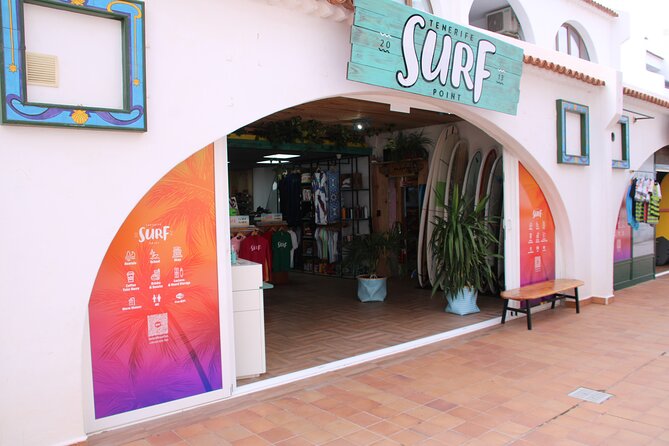
This is a proper introduction to surfing, not a quick rental followed by a vague instruction to paddle out. Your session begins at Tenerife Surf Point on Avenida Rafael Puig Lluvina, close to the beach in Playa de las Américas. The activity returns to this same point at the end.
The total time is about two and a half hours. That matters because beginners need more than water time. You need to understand how to lie on the board, where to place your hands, how to push up, and how to keep your balance before the first small wave reaches you.
The school teaches in English, Spanish, Russian, and Latvian. If language matters to you, the school contacts you after booking to confirm the exact lesson time and check the language you want. The final hour can also depend on weather and instructor availability, so keep some flexibility in your schedule.
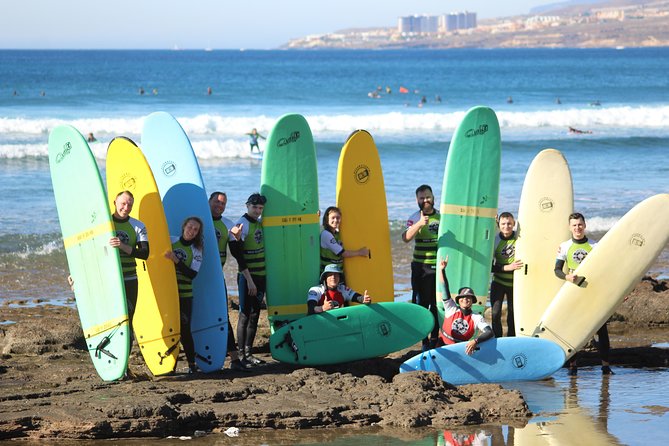
The group limit of six is a good fit for a physical lesson. You are not left in a crowd of dozens, although the beach itself may still be shared with other schools. That distinction matters. Your instructor can give personal help within the group, but the surf zone is not private.
More Surf Lessons in Tenerife:
- Playa de las Américas: Private or Small-Group Surf Lesson
★ 4.8 · 980 reviews - Tenerife: Surfing Lesson for All Levels, Photos included
★ 4.9 · 861 reviews - Private Surfing Lesson at Playa de las Américas
★ 5.0 · 167 reviews
Theory first, then the board on dry land
The lesson starts with an explanation of basic surfing theory. You learn the main steps before you have to think about them in moving water. That preparation is especially useful if you have never handled a surfboard, because the first attempt can otherwise feel like too many instructions arriving at once.
Next comes the standing drill on land. You practice the movement from lying on the board to standing in a stable position. This is not glamorous, but it is where the lesson earns its value. You can work out which foot goes forward and get used to moving quickly without the distraction of waves.
The instructors also explain practical hints as they watch you try. Coaches named in feedback include Tico, Joel, Maurizio, and Sasha, and the teaching style is consistently described as friendly, attentive, and encouraging. Joel is particularly good at helping people in the water, while Maurizio is noted for giving careful hints. You may not have one of these specific instructors, but the school has several staff members working with beginners.
This dry-land section also gives you a chance to ask questions. I would use it to ask about board position, how to fall safely, and what to do when a wave approaches. The more you understand before entering the sea, the more attention you can give to balance once you are out there.
About an hour of practice in the water
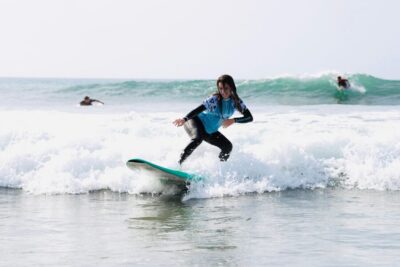
After the land session, you take the equipment to the beach and begin the practical part. Boards and the other surfing gear are included, so you do not need to arrange a separate rental. The boards used for beginners are described as suitable for learning, which usually means the focus is on stability rather than speed.
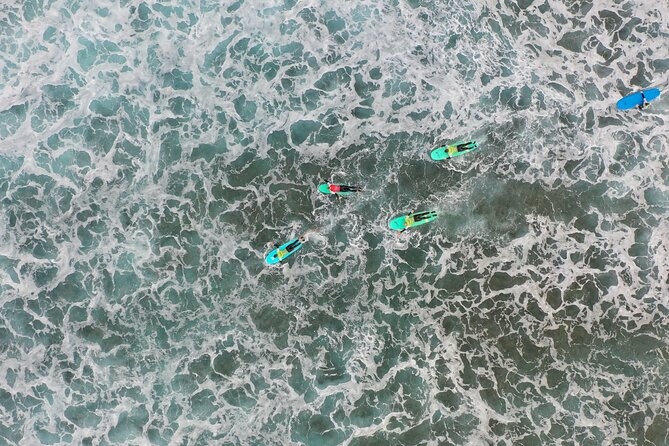
The water session lasts about an hour, according to the detailed account of the timing. That is enough to get repeated attempts without turning the whole activity into a tiring half-day commitment. You will likely spend part of the time paddling, resetting your position, and waiting for a suitable wave. That is normal. Surfing is not simply standing up on demand.
The instructor stays involved rather than sending you off alone. You receive tips as you try, and the coach can help you correct your position or encourage you to try again. For a first lesson, this support is more important than catching a large wave. Your useful goal is to understand the motion and perhaps stand for the first time.
The physical side should not be underestimated. One person with no prior experience found the lesson very enjoyable but noted that it requires a reasonable level of fitness. You will be getting up from the board repeatedly, paddling, carrying equipment, and working against the water. A moderate fitness level is required, and you should be comfortable taking part in an active beach session.
The beach may be shared with other surf schools. At busy times, another group can get in the way. This is a limitation of learning at a popular surf area rather than a flaw unique to Tenerife Surf Point, but it is worth knowing before you book. Pay attention to the instructor, keep your head up, and do not expect an empty stretch of sea.
Photos that make the coaching more useful
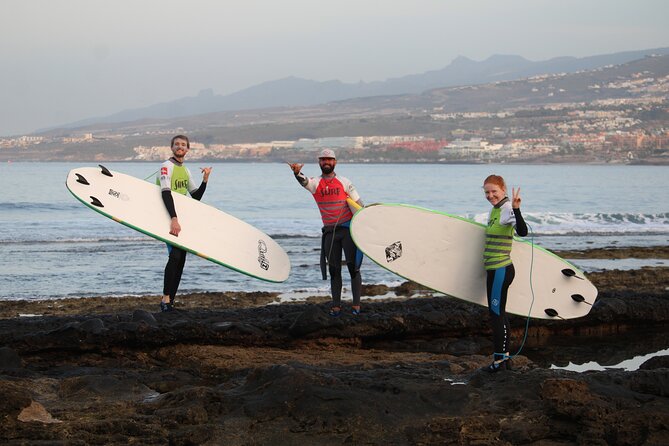
A strong feature of this class is the photography. During the water practice, the team takes pictures of you surfing. Afterward, you look at the images with the instructor and discuss what worked and what needs changing.
For a beginner, photos can explain a problem much faster than spoken advice. You might feel that you stood straight, only to see that your feet were too close together. You might also discover that your shoulders were turning or that you were looking down instead of ahead. The image gives you something concrete to remember for your next attempt.
This session is included rather than treated as an extra purchase. It also makes the lesson feel more complete. You leave with a better idea of your technique, not just the memory of trying to stay upright.
Some sessions finish with hot tea and biscuits while the group reviews the photos. That small touch is welcome after an hour in the sea, especially if the wind picks up. The exact refreshments may depend on the session, but the photo discussion is part of the planned experience.
I would book this lesson early in a Tenerife holiday if surfing interests you. The photo feedback can help you decide if you want another lesson, and several people find that one session makes them want to keep practicing. If you book near the end of your trip, you may not have time to act on that interest.
A few more Tenerife half-days worth comparing
- Siam Park Entry Tickets
★ 4.5 · 15,710 reviews - Tenerife: Eco-Yacht Whale and Dolphin Watching and Swimming
★ 4.7 · 15,619 reviews - Los Cristianos Respectful No-Chase Whale and Dolphin Safari
★ 4.6 · 12,782 reviews - Tenerife: Loro Parque Entry Ticket
★ 4.8 · 12,411 reviews
What the $43.53 price covers
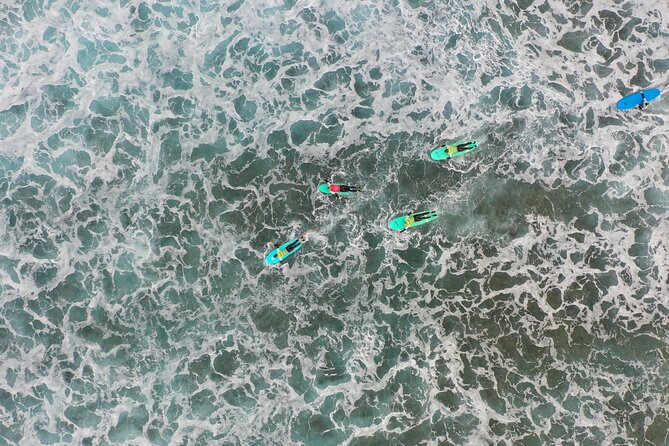
At $43.53 per person, this is a reasonable price for a first surf lesson because the fee combines instruction, equipment, water practice, photography, and feedback. You are not paying only for access to a board. You are paying for a structured introduction with a coach watching your progress.
The small group limit improves the value. Six people is still a group lesson, so do not expect a private coach focused only on you. But it is small enough for the instructor to give individual corrections, especially compared with a large class on a popular beach.
The session also takes up about two and a half hours, rather than only a short demonstration. The included gear saves you from arranging a rental and figuring out which board suits a beginner. The photo review adds another layer of instruction after the sea practice has finished.
The price is less compelling if you already surf confidently. This class is built around basic theory, standing on the board, and first attempts in the water. Experienced surfers may prefer a board rental or a higher-level coaching session, but that is not what this product is designed to provide.
Getting to Tenerife Surf Point
The meeting point is Tenerife Surf Point, Av. Rafael Puig Lluvina, 32, 38650 Playa de las Américas, Santa Cruz de Tenerife. The location is near public transportation, which makes it practical if you are staying in the resort area and do not have a car.
The activity ends back at the same meeting point. That simplifies the day. You do not need to arrange a separate return from another part of the coast, and you can leave your belongings in the shop during the lesson if you use the available lockers.
The facilities are better than you might expect from a basic beach class. The shop has a bathroom, showers, lockers, and a changing area. These details make a difference because you can change before or after the lesson and rinse off the salt and sand.
Bring only what you need for the activity. The lockers are useful, but the safest plan is still to leave valuable items at your accommodation. The provided information confirms lockers are available, but does not specify their size or security arrangements.
Who will enjoy this lesson most
I would choose this experience for a complete beginner, a couple looking for an active holiday activity, or a family with older children who meet the physical requirements. The class has a friendly teaching approach and enough structure to keep a first attempt from feeling chaotic.
It also works well for people who want to try surfing without committing to a full course. You get theory, dry-land practice, water time, and a review of your photos in one session. If you enjoy it, you can decide later if you want more lessons.
The language options are another practical advantage. English, Spanish, Russian, and Latvian are available, but you should state your preferred language when the school contacts you. The exact time is confirmed around the weather and instructor schedule, so do not build a tight plan around an unconfirmed hour.
I would think twice if you dislike group activities, have limited fitness, or want a quiet beach with no other schools nearby. The water area can be shared, and surfing takes effort even when the waves look manageable.
Children can take part, based on the family experiences described, but the supplied details do not give a minimum age. Ask the provider before booking if you are arranging the lesson for a child.
Weather, cancellations, and timing
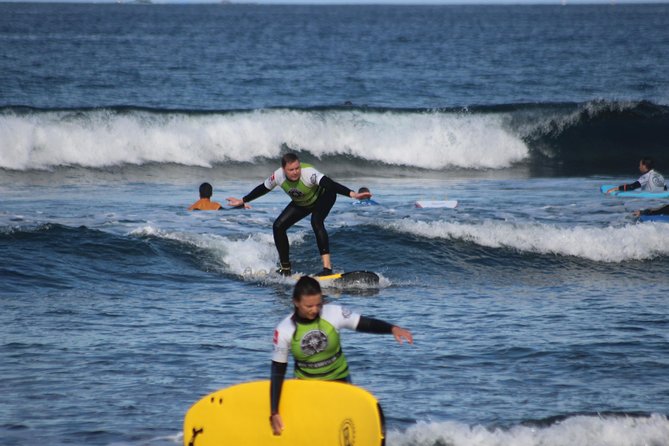
Surfing depends on sea and weather conditions. If poor weather forces a cancellation, you are offered another date or a full refund. That policy is useful, but it also means you should leave some room in your holiday schedule if this lesson is important to you.
You can cancel for a full refund up to 24 hours before the start time. Cancellations or changes made less than 24 hours before the activity are not refunded or accepted. The cut-off follows local Tenerife time.
The school confirms the booking at the time of reservation, then contacts you about the exact lesson hour. Weather and instructor availability can affect the timing. I would avoid booking this immediately before an airport transfer, a fixed dinner reservation, or another timed excursion.
The activity is commonly booked about 16 days ahead. That gives you a useful planning guide, especially during a busy holiday period. Since the group limit is six, popular dates may fill before the day itself.
How this class compares with simply renting a board
A rental gives you freedom, but it also leaves you to work out the basics. For a first attempt, that can mean spending much of your time falling, carrying the board, and repeating the same mistake without knowing why.
This lesson gives you a clear sequence. You learn on land, practice in the water, and then look at photos with an instructor. That sequence is the main reason I would pay for the class rather than rent equipment on my own.
The trade-off is less independence. You follow the school’s timing and share the beach with a group. If you already know how to surf, that structure may feel unnecessary. If you are new to the sport, it provides a safer and more useful start.
The lesson also gives you a social way to try something unfamiliar. The groups are small, and the instructors are described as warm and motivating. You do not need to arrive knowing anyone else.
Should you book the Playa de las Américas surf lesson?
Book it if you want a well-organized first try at surfing, value direct coaching, and like the idea of seeing photos of your technique afterward. The included gear, small group, practical facilities, and roughly one hour in the water make the $43.53 fee fair for a beginner experience.
I would especially recommend it early in your Tenerife stay. If you manage your first stand-up, you may want another lesson, and the photo analysis will show you exactly what to work on.
Skip it if you want a private lesson, already surf well, or need a fixed start time with no weather changes. For everyone else, Tenerife Surf Point offers a sensible and friendly way to meet the Atlantic without pretending that surfing is effortless.
FAQ
Where does the surfing lesson begin?
The lesson begins at Tenerife Surf Point, Av. Rafael Puig Lluvina, 32, 38650 Playa de las Américas, Santa Cruz de Tenerife, Spain.
Where does the activity finish?
The activity ends back at the same Tenerife Surf Point meeting location.
How long does the lesson last?
The experience lasts approximately 2 hours and 30 minutes. About one hour is spent practicing in the water, with the rest used for theory, land practice, changing, and photo feedback.
What languages are available?
The lesson can be arranged in English, Spanish, Russian, or Latvian. The school contacts you after booking to confirm the preferred language and the exact lesson time.
Is surfing equipment included?
Yes. Surfing gear rental is included in the price.
What is the maximum group size?
The lesson has a maximum of six people.
Can I cancel for a full refund?
Yes. You can cancel at least 24 hours before the local start time for a full refund. If poor weather causes the school to cancel, you are offered another date or a full refund.
Recently added around Tenerife
- Las Galletas: Whale & Dolphin Tour with Local Skipper★ 4.8 · 397 reviews
- Tenerife: Teide National Park Guided Buggy Tour★ 4.6 · 299 reviews
- Tenerife: Loro Parque & Siam Park Entry Ticket with Transfer★ 4.6 · 732 reviews
- Tenerife: Teide, Icod de los Vinos & Garachico Full Day Tour★ 4.3 · 602 reviews
- Tenerife: Snorkeling Tour in a Marine Protected Area★ 4.9 · 636 reviews
- Tenerife: Sunset Catamaran Tour with Transfer, Buff & Drinks★ 4.8 · 570 reviews
- Tenerife: Half-Day Snorkeling Tour★ 4.6 · 154 reviews
- Tenerife: Siam Park All-Inclusive Entry Ticket★ 4.7 · 915 reviews
Surf Lessons, compared.
Playa de las Américas: Private or Small-Group Surf Lesson
Read our review →
Lezioni di Surf per Beginner e Intermedi (6 persone a istruttore)
Read our review →
Playa del Inglés Maspalomas: High Quality Surf Classes
Read our review →
Gran Canaria Maspalomas: Surf lessons all levels
Read our review →
Browse the lists this tour appears in