
Reviewed · AUDIO TOURS
Casa de Salinas Entry Ticket with Audio Guide
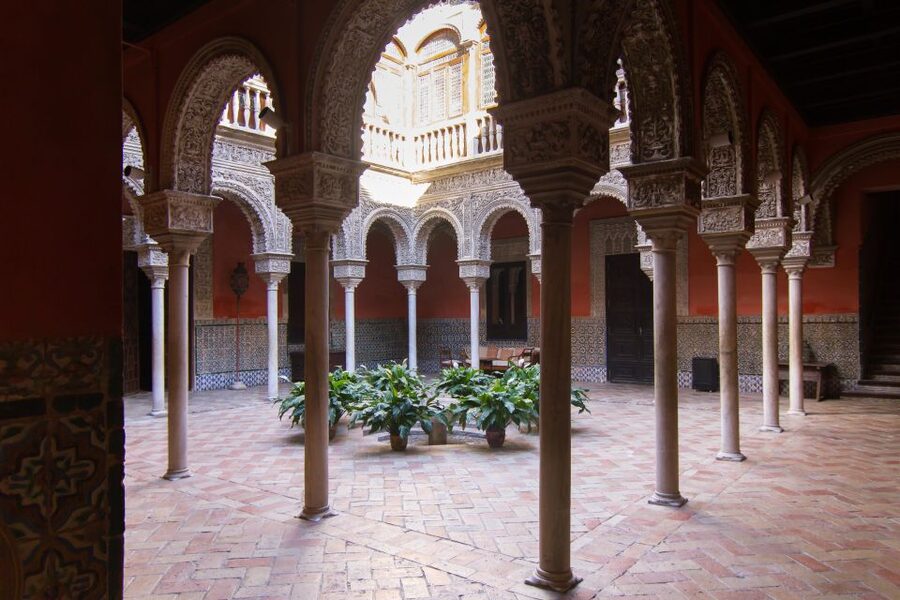
Casa de Salinas gives you a close look at private Seville, not just the grand monuments open to everyone. This compact mansion near the cathedral has 16th-century patios, Mudéjar arches, Roman decoration, original tiles, and painted wooden ceilings, all in a house that remains a family home.
I like the short audio tour, which gives the rooms useful context without taking half your day. I also like the chance to see a smaller, quieter version of the architectural mix found across Seville: Gothic, Renaissance, and Mudéjar work sharing one address. The drawback is its size. If you expect another Alcázar, you may find the visit brief, especially since the audio portion lasts about 25 minutes.
Key points to know before you go
- A compact alternative to the Alcázar: Casa de Salinas offers ornate historic architecture on a much smaller scale and usually with less time required.
- Sixteenth-century Mudéjar work: Look for plasterwork arches and patios that show Seville’s blend of Christian, Islamic, and Renaissance design.
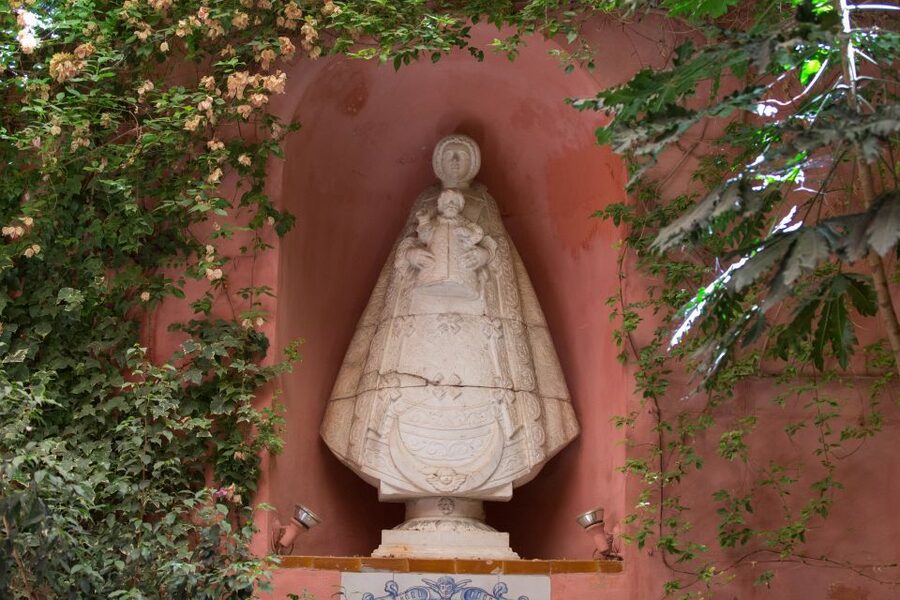
- A real family residence: The privately owned house is still home to the Salinas family, which gives the visit a more personal character.
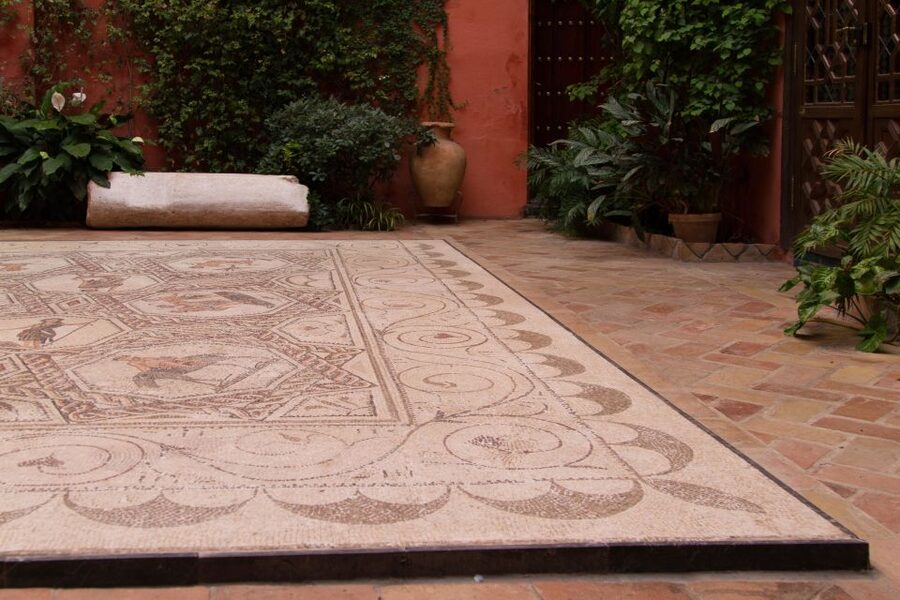
- A Roman mosaic indoors: The mosaic depicts Bacchanalian scenes and adds an older layer to the mansion’s later architecture.
- A 25-minute audio guide: Explanations are available in English, Spanish, French, and Italian.
- Easy Old Town location: Casa de Salinas is at Calle Mateos Gago, 39, just steps from the cathedral, Giralda, and Royal Alcázar.
Why Casa de Salinas is worth your time
Seville is full of grand buildings, but its smaller palaces often tell you more about how the city’s wealthy families lived. Casa de Salinas is one of those places. It is not a vast royal complex. It is a compact mansion with rooms, patios, decorative details, and a continuing private life behind its walls.
That distinction matters. At the Alcázar, you follow the story of kings, courtiers, and royal power. Here, you get a sense of an upper-class Seville home shaped by several centuries of local taste. The house shows how Gothic, Renaissance, and Mudéjar design could work together without looking forced.
The location makes it especially useful. Casa de Salinas sits on Calle Mateos Gago, very close to Seville Cathedral, La Giralda, and the Royal Alcázar. If you are already in the cathedral quarter, you can add it without arranging transport or crossing the city.
At $14 per person, the ticket is best judged as a short cultural stop rather than a full morning attraction. You are paying for access to a privately maintained historic home, an audio guide, and a focused look at details you might miss in larger monuments. I think it offers good value if you enjoy architecture and want something that takes roughly half an hour.
More audio guides in Seville:
- Seville: Hospital de los Venerables Ticket with Audio Guide
★ 4.6 · 190 reviews - Barcelona: Sagrada Familia Entry Ticket with Audio Guide
★ 4.6 · 105,312 reviews - Granada: Alhambra Entry Ticket with Audio Guide
★ 4.1 · 5,950 reviews
The setting on Calle Mateos Gago
The address is Calle Mateos Gago, 39, in Seville’s monumental Old Town. This puts you in one of the city’s most concentrated sightseeing areas, where the cathedral, Giralda, and Royal Alcázar are all close by.
That makes Casa de Salinas easy to fit into a day of sightseeing. You could visit before the cathedral, after the Alcázar, or during a pause between major monuments. Since the ticket is valid for one day, you have some flexibility around the rest of your plans.
The nearby setting also helps explain the house’s appeal. You are not visiting an isolated museum building. You are walking into the historic center and then entering a private residence that has survived alongside Seville’s most famous public monuments.
The practical point is simple: do not plan your whole day around Casa de Salinas. Treat it as a compact architectural visit that works well between larger sights. If you have already spent hours inside the Alcázar, the shorter format may be welcome.
Entering a sixteenth-century Seville home
The house was built in the 16th century, a period when Seville was one of Europe’s most important cities. Wealth from the New World reached the city’s port before spreading across Europe, and that money helped support impressive construction, art, and decoration.
Seville was sometimes called Nova Roma because of its splendor. Italian and Flemish artists worked in the city, while local builders continued traditions linked to Gothic and Mudéjar design. Casa de Salinas reflects that meeting of influences.
You can expect the building to feel layered rather than uniform. Some details point toward Renaissance taste, while others use the geometry and plaster decoration associated with Mudéjar work. The result is not a single grand style. It is a record of Seville’s changing fortunes and artistic connections.
The house became the property of the Salinas family at the beginning of the 20th century. The family carried out a careful restoration intended to recover the building’s earlier appearance after alterations made during its 400-year history, especially around 1900.
That restoration is important for understanding what you see. Casa de Salinas is not simply an untouched time capsule. It is a historic home that has been repaired and presented so its original 16th-century structures can be appreciated. The family still lives there, which gives the visit a different tone from a public palace or museum.
The patios and Mudéjar plasterwork
The patios are the architectural center of the visit. In Seville, a patio is not just an open courtyard. It is a place for light, air, movement, and display, often framed by arches, columns, tile, and plasterwork.
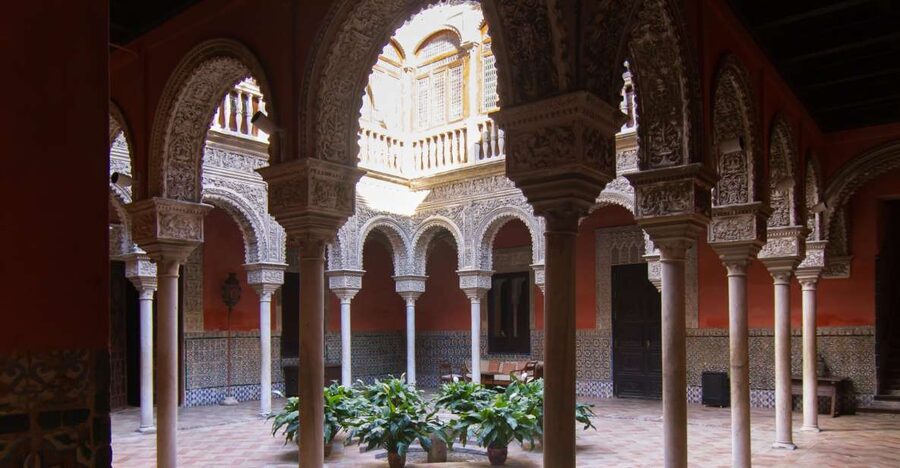
At Casa de Salinas, the 16th-century patios feature Mudéjar plasterwork arches. These arches are among the details to slow down for. The larger shape is easy to see, but the real pleasure lies in the surface work, repeated patterns, and the way the decoration frames the courtyard.
Mudéjar design grew from the work of Muslim craftsmen living under Christian rule. In Seville, those methods remained part of the city’s visual language even as Renaissance ideas arrived from Italy. Casa de Salinas lets you see that mixture in a small, readable space.
I find patios more rewarding when you give them a little time. Stand back first to take in the whole arrangement, then look at the plaster around the arches and the relationship between the interior rooms and courtyard. The audio guide should help explain the architectural details, but you will still want to look rather than simply listen.
The patios also offer a useful contrast with the Alcázar. The Alcázar gives you royal scale and a larger sequence of courtyards. Casa de Salinas gives you a more domestic version of the same broad Seville tradition.
A few more Seville half-days worth comparing
- Seville: Royal Alcázar Entry Ticket
★ 4.6 · 28,378 reviews - Seville: Cathedral and La Giralda Entry Ticket
★ 4.5 · 24,592 reviews - Seville: Live Flamenco Dancing Show Ticket at the Theater
★ 4.7 · 16,396 reviews - Seville: Casa de la Memoria Flamenco Show
★ 4.8 · 12,964 reviews
A Roman mosaic inside the mansion
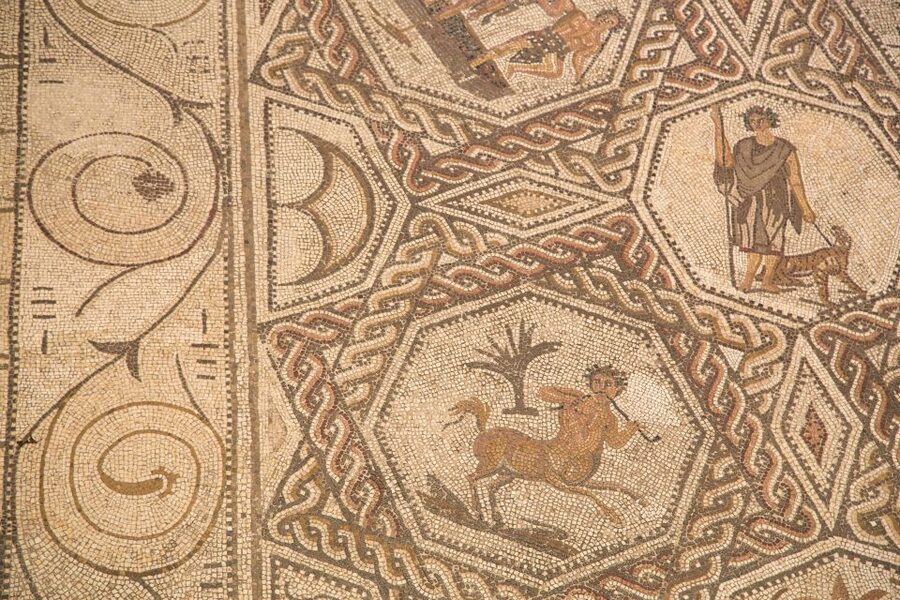
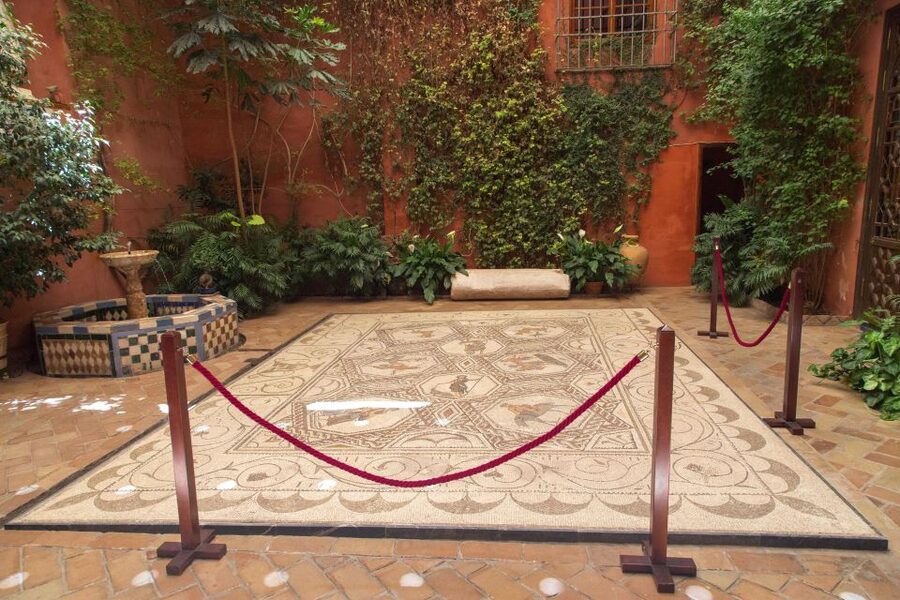
One of the most unusual details is a Roman mosaic showing Bacchanalian scenes. It brings a much older world into a house whose main form dates from the 16th century.
The subject matter depicts the indulgent, festive world associated with Bacchus. You do not need to be an ancient-history specialist to appreciate the contrast. A Roman floor mosaic inside a later Seville mansion shows how historic buildings often gather pieces from different periods.
The mosaic is also a reminder that Seville’s story did not begin with the Renaissance or the arrival of wealth from the Americas. The city has Roman roots, and those earlier layers still appear in its monuments and collections.
This is one place where the audio guide can add real value. A mosaic may catch your eye, but the explanation helps place it within the house and the wider history of Seville. If you have only a short time, make sure you do not pass it too quickly.
Original tiles and painted wooden ceilings
Casa de Salinas preserves original ceramic tiles, another feature closely tied to Andalusian architecture. Tile is practical in Seville’s warm climate, but it is also a major decorative element. Patterns, color, and placement can turn a wall or passage into part of the building’s visual design.
The house also includes winter and summer drawing rooms. These rooms show how a wealthy household could adapt its interior life to the seasons. You can expect the two spaces to feel distinct in purpose, even if the details are not explained at length during your visit.
Look up as well as around you. The drawing rooms have exquisitely painted wooden ceilings, and ceilings are easy to miss when you are concentrating on floor mosaics, wall tiles, and arches. The painted woodwork adds warmth and texture that a plain white ceiling would not provide.
The combination of tile, plaster, and painted wood is one of the strongest reasons to visit. Each material gives you something different: tile creates pattern, plaster creates depth, and wood adds color and craftsmanship overhead.
How the 25-minute audio guide works for you
The audio guide is included in the ticket and is offered in English, Spanish, French, and Italian. The tour lasts about 25 minutes, so it is designed as a concise introduction rather than a long lecture.
That length suits the building. Casa de Salinas is compact, and a short guide keeps the visit focused on the patios, mosaic, tiles, drawing rooms, and painted ceilings. You can listen while moving through the house instead of committing a large part of your day to a formal guided tour.
I like this format for visitors who want context but also want to set their own pace. You are not tied to a large group or a guide’s schedule once inside. At the same time, the audio gives you more than a quick walk through pretty rooms.
The main limitation is that 25 minutes does not leave room for a detailed treatment of every architectural feature. If you enjoy stopping for long periods or studying decorative work, you may spend longer than the stated audio duration. If you want a sweeping historical tour, you may find it too brief.
There are no guide names provided for this experience, so you should expect an audio-led visit rather than a tour conducted by a named historian or local guide.
How it compares with Seville’s larger palaces
Casa de Salinas is often compared with Casa de Pilatos, Palacio de Lebrija, and Palacio de Las Dueñas. All are privately owned Seville residences with elaborate interiors and connections to the city’s upper-class past.
The comparison helps set expectations. Casa de Salinas is the smallest and most compact option among these well-known house museums. Its strength is not scale. Its strength is the concentration of details and the fact that the property remains a family home.
Compared with the Royal Alcázar, Casa de Salinas is much shorter and less monumental. You will not get the same succession of huge courtyards, royal rooms, and extensive gardens. You will get a quieter look at domestic architecture and a simpler visit to fit around other plans.
If you have already visited the Alcázar, Casa de Salinas can feel like a useful second chapter. You can recognize some of Seville’s shared design traditions while seeing them used in a private setting. If you have not visited the Alcázar, I would not use Casa de Salinas as a replacement. It is better understood as a small companion to the city’s major palace.
Is $14 good value?
At $14, the ticket is reasonably priced for a central Seville attraction with access to a private historic property and an audio guide. The value depends on what you want from your sightseeing day.
I think it is a good buy if you enjoy historic interiors, decorative arts, and architecture that you can examine without spending several hours. The short visit also makes the ticket easy to justify when you are already near the cathedral.
The value is weaker if you measure attractions by size or the number of rooms. Casa de Salinas is not built for a long, all-day visit. You are paying for quality of detail and access to a less public side of Seville, not for a large collection or a long route.
For many people, the best approach is to place it between the cathedral and Alcázar. That way, the ticket adds a focused architectural experience without taking over your schedule.
Who should book Casa de Salinas?
I would recommend this visit to you if you:
- Enjoy historic homes more than large modern museums
- Like tile, plasterwork, wood ceilings, and architectural detail
- Want a short stop near the cathedral
- Have already visited the Alcázar and want a smaller related experience
- Prefer an audio guide in English, Spanish, French, or Italian
- Are curious about the difference between a royal palace and a privately owned mansion
Families who need a brief attraction may also appreciate the 25-minute format, though the appeal will depend on how much interest children have in interiors and decoration. Architecture students, photographers, and anyone interested in Andalusian design will find plenty to examine in a small area.
You may want to skip it if you only have time for Seville’s biggest sights, or if you prefer outdoor spaces and gardens. It is also not the right choice if you expect a large palace experience. The house is compact, and that is both its charm and its limit.
The property is wheelchair accessible. Free cancellation is available up to 24 hours in advance, and you can reserve now and pay later, which helps if your Seville schedule is still shifting.
Should you book Casa de Salinas?
Book it if you want a short, detail-filled visit close to Seville’s main monuments. The Mudéjar arches, Roman mosaic, original tiles, and painted ceilings give you plenty to notice, while the family residence adds a personal quality that a public palace cannot offer.
Skip it if you need a grand royal complex or have no interest in architectural decoration. Casa de Salinas will not compete with the Alcázar for scale. Its appeal is more intimate: a restored 16th-century mansion, still connected to a living family, with enough history and visual detail to make a 25-minute audio tour worthwhile.
FAQ
Where is Casa de Salinas located?
Casa de Salinas is at Calle Mateos Gago, 39, 41004 Sevilla, Spain. It is close to Seville Cathedral, La Giralda, and the Royal Alcázar.
How long does the audio tour last?
The audio-guided tour lasts about 25 minutes. The ticket itself is valid for one day.
Which languages are available for the audio guide?
The audio guide is available in Spanish, English, French, and Italian.
What does the admission ticket include?
The ticket includes entrance to Casa de Salinas and the audio guide.
Is Casa de Salinas wheelchair accessible?
Yes. The activity is listed as wheelchair accessible.
Can I cancel my booking?
Yes. You can cancel up to 24 hours in advance for a full refund. You can also reserve now and pay later.
Recently added around Seville
- Seville: Alcázar Fast-Track Access with Guided Tour★ 4.2 · 432 reviews
- Seville: Small Group Jewish Quarter Tour with Tapas & Drinks★ 5.0 · 119 reviews
- Seville: Sunset Roof Top Walking Tour★ 4.5 · 122 reviews
- Seville: Small-Group Jewish Quarter Discovery Walking Tour★ 4.9 · 499 reviews
- Seville: VIP Exclusive Early Access Tour of The Alcazar★ 4.8 · 276 reviews
- Seville: Authentic and Romantic Horse-Drawn Carriage Ride★ 4.5 · 341 reviews
- Seville: Sunset and Evening Paddle Boarding Tour★ 4.8 · 355 reviews
- Seville: Tapas, Taverns and History Guided Walking Tour★ 4.9 · 515 reviews
Audio Tours, compared.

Sagrada Familia Entry Ticket with Audio Guide
Read our review →
Casa Batllo Admission Ticket with Intelligent Audio Guide
Read our review →


Nerja: Caves of Nerja Entry Ticket with Audio Guide
Read our review →

Browse the lists this tour appears in