
Reviewed · WALKING TOURS
Granada: Historic Center and Lower Albaicin Walking Tour
Granada’s best introduction may be on foot, moving from grand Christian monuments into the narrow lanes of the lower Albaicin. This tour connects the city’s Islamic past, the 1492 Reconquista, and everyday street life in one compact walk, ending with a fine view of the Alhambra.
I like the wide mix of sights for $16, especially the way the route joins the Cathedral area with the old Moorish quarter. I also like the personal touch from guides such as Pablo, Irene, Jaime, and Anna, who explain architecture, suggest places to eat, and answer questions rather than simply reciting dates.
The main drawback is the walking itself. The lower Albaicin includes slopes, uneven streets, and steps, so this is not a good fit for people with mobility impairments or anyone who finds uphill walking difficult.
Key points at a glance
- A smart first-day orientation: The route gives you a useful map of central Granada before you tackle the Alhambra.
- A clear Moorish to Christian story: You see Islamic-era sites alongside buildings shaped by the Reconquista.
- A proper Alhambra viewpoint: The lower Albaicin stop gives you a memorable angle on Granada’s most famous landmark.
- Strong guide-led experience: Pablo, Irene, Jaime, Anna, Rocio, Emilio, and others have been praised for clear explanations, patience, and local suggestions.
- Good value at $16: Two and a half hours of guided sightseeing costs less than many short city tours.
- Bring sturdy shoes: The route includes old cobbles, narrow lanes, and an uphill section into the Albaicin.
Why this is a useful first look at Granada
Granada can feel confusing at first. The Cathedral, old market streets, Albaicin, and Alhambra all belong to the same city, but they occupy different levels and eras. This walk helps you connect them.
You begin in the center, near the monument to Isabel la Católica and Cristóbal Colón. From there, the guide leads you through the old core before reaching the lower Albaicin. That order makes sense. You start on easier central streets, learn the basic story of the city, then see how the old Muslim quarter rises toward the hill.
I especially like this for a first or second day in Granada. You get a quick sense of direction, learn which squares and buildings deserve a closer look, and can ask your guide for ideas for the rest of your visit. Several guides have also offered advice about food, flamenco, and places worth returning to on your own.
At 2.5 hours, the tour is long enough to provide real context but short enough to fit around other plans. It does not include entry into the Alhambra or the other monuments listed along the way, so think of it as a guided outdoor introduction rather than a ticketed sightseeing tour.
More Walking Tours in Granada
- Granada: Albaicín and Sacromonte Guided Sunset Walking Tour
★ 4.9 · 2,962 reviews - Guided Walking Tour of the Alhambra in Granada
★ 4.0 · 863 reviews - Granada: Albaicín and Sacromonte 2.5-Hour Walking Tour
★ 4.7 · 777 reviews
Starting beside Granada’s royal monument
The meeting point is in front of the monument to Isabel la Católica and Cristóbal Colón. This is a central location and a fitting place to begin, since the figures represent the political world surrounding Granada’s capture in 1492.
Your guide sets up the main story here: Granada was the last Muslim kingdom in Iberia, and the Reconquista ended in this city. That date matters, but a good guide can make it more than a memorized schoolbook fact. The route looks at what changed after 1492 and what traces of Islamic Granada remain in streets, buildings, names, and urban design.
Guides have included Pablo, Jaime, Irene, Anna, Rocio, Emilio, and Elene. The strongest feedback centers on their ability to make the past understandable without turning the walk into a lecture. Pablo is praised for mixing information with humor. Jaime is noted for answering detailed questions about everything from old paving stones to architecture. Irene is described as engaging and patient.
The exact guide can vary, and that means the tone may differ from one departure to another. Still, the repeated strength of this experience is the guide’s role in linking individual buildings to the larger story of Granada.
Corral del Carbón and the old commercial quarter
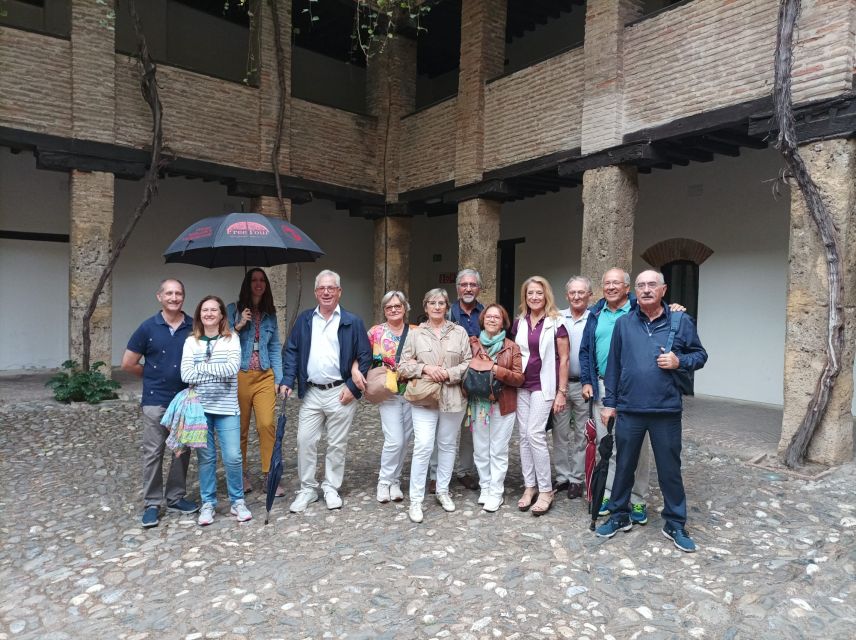
One of the early stops is the Corral del Carbón, a notable reminder of Granada’s commercial past. The name refers to an old merchant facility connected with trade and storage. Its presence helps you picture the city as a working center, not only as a royal or religious capital.
From here, the route moves toward the Alcaiceria. This narrow shopping area recalls Granada’s former silk market and its Islamic commercial roots. Today, it is a popular place for browsing souvenirs, but the tight lanes still give you a sense of how different the old city was from the broad modern streets outside it.
This is one reason a guide helps. On your own, you may see a pleasant alley full of shops. With explanation, you begin to understand why the street pattern is so compact and why the area matters in Granada’s story.
The Alcaiceria can be busy, and the lanes are not designed for lingering in a large group. Keep close to the guide and expect pauses to happen at practical points rather than in the middle of the narrowest passage. The reward is a quick but useful connection between old trade, Islamic culture, and modern Granada.
Bib Rambla, the Madraza, and the Cathedral
Plaza Bib Rambla is one of the central squares on the walk. The Giants Fountain provides an easy landmark, while the open space gives the group room to stop and discuss the city around it.
The square is valuable because it shows a different side of Granada from the Albaicin. Here, you see a more open civic space framed by shops, restaurants, and major buildings. Your guide can explain how public areas have changed over time and how the Christian city developed around older Islamic foundations.
The nearby Madraza adds another layer. It was an important Islamic school, and its survival gives Granada a direct link to the intellectual life of the Nasrid period. You may not enter every building on this walking tour, but learning what each place represents makes it easier to choose where to return.
The Cathedral then brings you face to face with the city’s post-1492 transformation. It is a major Christian monument, and its scale contrasts sharply with the narrow lanes and modest architectural details of the old Muslim quarter.
I like this section because the route does not isolate Islamic Granada from Christian Granada. You see both in the same walk. That makes the city’s past feel like a sequence of changes rather than two unrelated sightseeing themes.
Same base in Granada, a completely different kind of day:
- Granada: Alhambra & Nasrid Palaces Tour with Tickets
★ 4.7 · 19,801 reviews - Granada: Alhambra and Nasrid Palaces Entry Ticket
★ 4.6 · 15,130 reviews - Granada: Alhambra & Generalife Fast-Track Guided Tour
★ 4.7 · 8,313 reviews - Granada: Alhambra & Gardens Tour w/Nasrid Palaces Option
★ 4.5 · 6,437 reviews
Royal buildings and the story of power
The route also passes the Royal High Court, the Royal Chancillería, and the Royal Jail. These buildings help explain how Granada was governed after the Christian conquest.
The Royal Chancillería is especially useful as a stop because it represents law and administration, not just royal display. The Royal Jail adds another practical detail about how authority operated in the old city. Together, these buildings show how the center became a place of courts, government, religion, and commerce.
You will likely spend more time looking at exteriors and listening than going inside. That is important to understand before booking. If you want long interior visits, this is not the right product. If you want a guided explanation of the streets and facades you might otherwise walk past, it offers good value.
The guide’s storytelling makes a difference here. The strongest guides do not merely name the buildings. They explain why the buildings appeared in this part of the city and how Granada’s identity shifted after 1492.
Into the lower Albaicin
The character of the walk changes as you enter the lower Albaicin. Streets become narrower, the route becomes more uneven, and the Moorish past feels more present in the layout of the neighborhood.
The Albaicin is famous for its hillside lanes, whitewashed buildings, and views toward the Alhambra. This tour focuses on the lower section, not a full exploration of the entire neighborhood. That keeps the route manageable, but it also means you should not expect to reach every upper viewpoint or wander through the district at length.
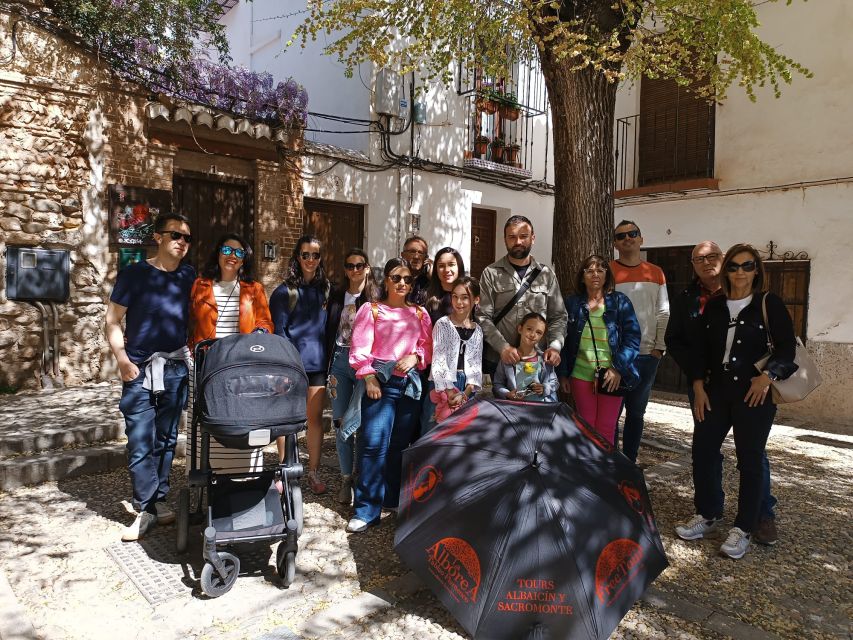
The climb can still be tiring. One family group found that some members with knee problems and angina needed pauses to catch their breath. Their guide, Jaime, adjusted the pace and allowed breaks. That is encouraging, but it does not change the basic fact that this is a walking route with an uphill section.
Wear comfortable shoes with good grip. Old cobblestones can be hard on thin soles, and the neighborhood’s slopes are less forgiving than the flat central streets. Bring water, especially in warm weather, though the tour details only specifically require comfortable shoes.
The Albaicin section is where the experience feels most distinctive. The route leaves behind the grand facades of the center and enters a residential quarter shaped by centuries of Muslim urban life. You get narrow streets, turns that open suddenly onto wider views, and a stronger sense of how Granada grew around the hill.
The Alhambra viewpoint
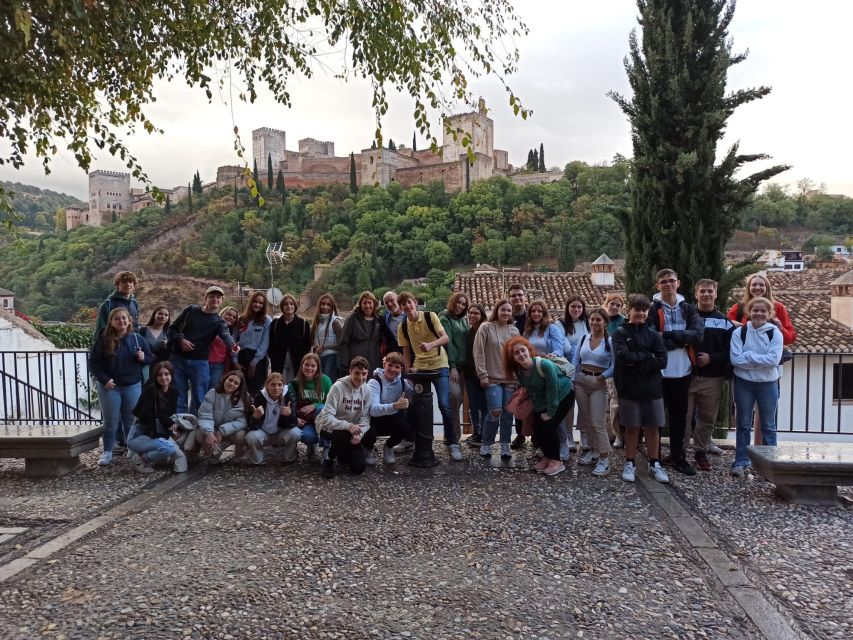
The tour finishes with a viewpoint toward the Alhambra. This is the visual payoff, and it gives you a chance to take photographs from below rather than from inside the palace complex.
The view matters because the Alhambra is not just another monument on Granada’s skyline. It is the landmark that gives the city its identity, and seeing it from the Albaicin helps you understand the relationship between the palace hill and the old town.
Do not confuse this stop with an Alhambra visit. You will not tour the palace, Generalife, or Nasrid Palaces on this walk. You get the exterior view and the guide’s context, which is useful if you already have an Alhambra ticket or plan to arrange one separately.
I would schedule this walking tour before your Alhambra visit if possible. The guide’s explanation can help you recognize the city below and understand why the palace occupies its particular position. It also gives you a better idea of how the Albaicin and Alhambra relate to one another.
The guides make the $16 worthwhile
At $16 per person, this is inexpensive for a 2.5-hour guided walk. The value comes less from the number of monuments than from the explanations tying them together.
A self-guided walk can take you past the Cathedral, Madraza, Bib Rambla, and Alcaiceria. What you may miss is the reason those sites belong in the same story. A good guide turns the route into a connected account of trade, religion, government, architecture, and cultural change.
The experience also appears to work well with small groups. One January family group of seven found themselves as the only participants, which made the tour feel almost private. Another group had five people. Group size can change, so do not book on the assumption that every departure will be tiny, but a quieter date may offer more time for questions and a gentler pace.
The guides have different strengths. Pablo is repeatedly associated with entertaining, well informed storytelling. Irene is praised for involving the group and responding patiently to questions. Jaime is especially strong with detailed historical explanations and adapting the pace. Anna is described as organized and friendly, while Emilio and Rocio also received strong praise for their explanations and personal manner.
There is one small caution about language. The tour is offered in English and Spanish, but two people found an English speaking guide’s accent difficult to understand at times. Most of the content remained clear, but if you need very slow or simple English, this is worth keeping in mind.
Who should book this walk?
I would recommend it to first-time visitors who want to understand Granada before exploring it independently. It also suits anyone who likes history, architecture, city photography, and local stories but does not want a full-day commitment.
Families can enjoy it, especially if the guide is willing to pause and answer questions. The route also works for people who want practical advice about what to do next, including food, flamenco, and additional sights.
I would be cautious if you have serious knee, heart, or mobility problems. The tour provider specifically says it is not suitable for people with mobility impairments, and the Albaicin climb can be demanding. A private arrangement with a slower pace might be different, but that is not promised here.
This is also not the right choice if your priority is entering monuments. The tour gives you exterior views and historical context. You will need separate admission if you want to visit the Cathedral, Madraza, or Alhambra interiors.
Cancellation is flexible up to 24 hours before the activity for a full refund, and you can reserve now and pay later. Those terms reduce the risk of booking early, especially when you are arranging an itinerary around the Alhambra.
Should you book it?
Yes, if you want a low-cost, well paced introduction to Granada’s center and lower Albaicin. The best reason to book is the combination of central monuments, Moorish streets, and an Alhambra viewpoint in one 2.5-hour route.
Book it near the start of your stay, wear proper walking shoes, and treat it as an orientation rather than a substitute for visiting the major interiors. If uphill walking is a serious concern, choose a flatter city tour instead. For most able walkers, this is a sensible way to get your bearings and give Granada’s layered past some meaning.
FAQ
How long does the Granada walking tour last?
The tour lasts 2.5 hours.
What language is the tour offered in?
The live tour guide is available in English or Spanish.
Where does the tour meet?
Meet the guide in front of the monument of Isabel la Católica and Cristóbal Colón in central Granada.
Does the tour enter the Alhambra?
No. The tour includes a viewpoint of the Alhambra, but it does not include entry to the Alhambra complex.
What should I bring?
Bring comfortable shoes. The route includes walking through old streets and an uphill section in the lower Albaicin.
Can I cancel for a refund?
Yes. You can cancel up to 24 hours in advance for a full refund. You can also reserve now and pay later.
Recently added around Granada
- Canyoning Adventure Rio Verde in Granada★ 5.0 · 136 reviews
- Granada: Alhambra and Nasrid Palaces Private Tour★ 4.9 · 242 reviews
- Granada: Sacromonte Caves Flamenco Show with Dinner★ 4.4 · 156 reviews
- From Granada: Alpujarra Villages Guided Day Tour★ 4.8 · 217 reviews
- Malaga: Granada Day Trip with Alhambra, Palaces and Gardens★ 4.5 · 197 reviews
- From Granada: Alpujarra Mountain Villages Tour★ 4.7 · 298 reviews
- Granada: Alhambra Palace Guided Tour★ 4.3 · 224 reviews
- Granada: Traditional Flamenco Show at Tablao Casa Ana★ 4.8 · 390 reviews
Walking Tours, compared.

Barcelona Tapas and Wine Experience Small-Group Walking Tour
Read our review →
Tapas Walking Tour with Food, Wine, and History
Read our review →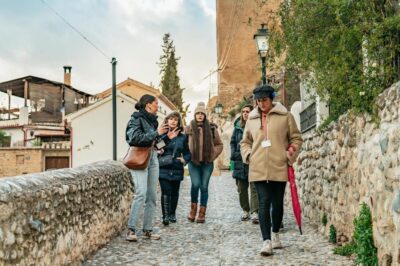
Albaicín and Sacromonte Guided Sunset Walking Tour
Read our review →
Toledo Tour & Vineyard Walk with Wine Tasting from Madrid
Read our review →

Barcelona Tapas Walking Tour: Food, Wine & History
Read our review →
Madrid Old Town & Royal Palace Walking Tour Skip the Line Ticket
Read our review →
Browse the lists this tour appears in